

From Oversight to Exposure: Fire Service Scrutiny Meets Dudley’s Political Realignment
West Mids fire authority under inspection. A former chief executive speaks out. A former MP returns. Consequences follow?

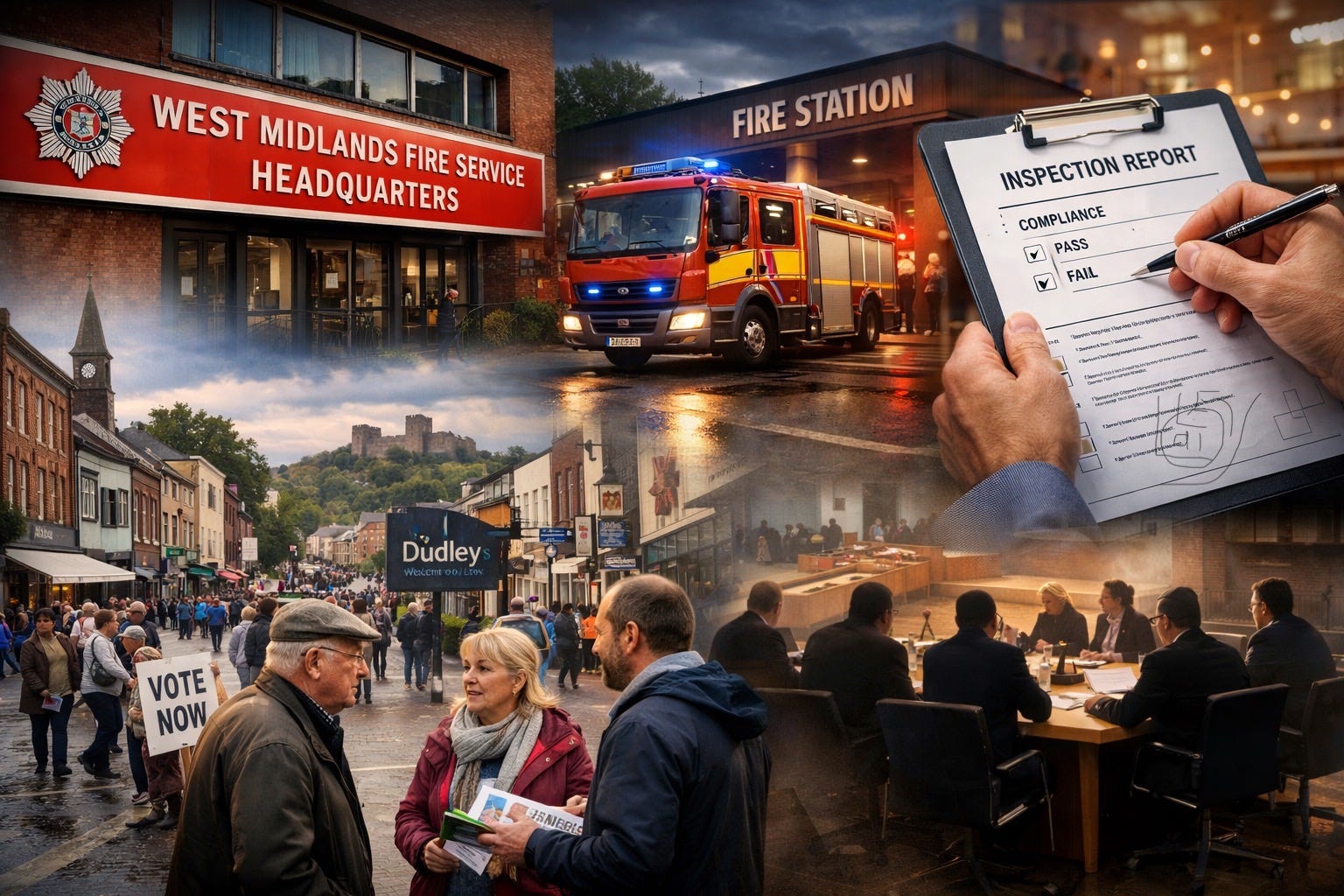
Firefighters run into burning buildings. Politicians run the service behind them. The Chair of the West Midlands Fire and Rescue Authority is responsible for governance, spending, and holding senior managers to account when things go wrong. When the Authority is placed under a Best Value inspection, that responsibility sharpens considerably.
That role is currently held by Councillor Cathryn Bayton, a Labour councillor for St James’s ward in Dudley, whose political authority rests heavily on claims of experience and competence built over a long career inside local government. Those claims now sit under scrutiny alongside the organisation she chairs.
A Best Value inspection is not routine housekeeping. It is the most serious form of external intervention available to central government short of removing leadership entirely. It is deployed when ministers believe there may be systemic problems with how an organisation is run, problems that cannot be solved internally. Inspectors examine governance, culture, financial control, leadership behaviour, and whether the authority understands its own risks. In plain terms, it is the state asking whether the people in charge know what they are doing.
In those circumstances, the Chair is not a ceremonial figurehead. They are the person politically responsible for oversight, challenge, and grip. They are expected to ask awkward questions, insist on clarity, and demonstrate publicly that they understand what has gone wrong and how it will be fixed.
That is why a recent public intervention from Oliver Lee OBE, a former chief executive of the West Midlands Fire and Rescue Authority, matters so much. Lee publicly challenged Councillor Cathryn Bayton’s response to questions about a £12 million underspend, pointing out that only weeks earlier the figure publicly cited was £0.5 million. He described her reply as cold and evasive, and said it failed to address the substance of the issue. He went further, stating plainly that public money was being mismanaged, and that he knew this because he had been inside the organisation at the time.
These were not casual remarks. They were detailed, measured criticisms from someone who previously ran the Authority. They go directly to the question of financial grip and leadership understanding. They also align uncomfortably closely with the very conditions that usually trigger a Best Value inspection in the first place.
Lee’s intervention also highlights something increasingly rare in modern public administration: candour.
In systems that often reward caution, ambiguity, and procedural language, Lee chose to speak plainly. That choice may come at a personal cost. People who are this direct about institutional failure are not always welcomed back into senior roles. Yet it is precisely this kind of blunt honesty that many large public organisations now lack. In local government, health, and emergency services alike, there is no shortage of process, but a chronic shortage of people willing to say clearly what is going wrong.
One is left with the uncomfortable thought that figures like Lee should not be quietly edged out of senior leadership conversations, but actively sought after. Organisations in difficulty do not need smoother messaging. They need leaders who say what they see and mean what they say. That contrast only sharpens the focus on the political leadership now responsible for the Authority.
Councillor Cathryn Bayton has not responded publicly to Lee’s challenge.
Silence is not neutral in politics, particularly not for a councillor whose public reputation rests on governance expertise. When criticism comes from a former chief executive, and when it sits alongside a live Best Value inspection, a lack of engagement does not read as calm authority. It reads as avoidance. For voters, especially those already sceptical of institutions, that creates doubt. And doubt, in local elections, is often enough.
This matters because Councillor Cathryn Bayton’s council seat is no longer secure. St James’s ward sits inside the Dudley parliamentary constituency, a seat that has shifted sharply in recent years and is now widely modelled as leaning towards Reform UK on current polling. Reform already polled strongly locally at the last general election, and the collapse of the Conservative vote has opened a clear path for them to become the principal challenger.
Local elections in the Black Country have a long memory. Dudley has been here before. In 2014, UKIP translated national anger into real council representation, breaking through in wards that had looked settled only a year earlier. The mechanism is well understood. Turnout falls, loyalty softens, and voters use local elections to send messages rather than manage services.
In a three-member ward like St James’s, Labour does not need to collapse for a seat to be lost. It only needs to slip. Reform does not need to top the poll. It needs to consolidate support, overtake Labour’s third candidate, and benefit from Labour voters staying at home rather than switching sides.
But it would be a mistake to describe that shift as simply “right of centre”. One of the most persistent misunderstandings in current commentary is the idea that Reform’s support is merely recycled Conservatism. In reality, Reform is attracting significant numbers of working-class Labour voters, people who feel culturally and economically abandoned by a party they no longer recognise.
To dismiss Reform as a right-wing protest vehicle is less analysis than reflex, a familiar label used to avoid confronting a harder truth. What Reform now represents for many voters is an untidy mix of old Labour instincts on work, fairness, and community, combined with newer, more aspirational attitudes that Labour itself once championed but then drifted away from.
It is not neat. It is not ideological. Politically, it resembles Woolworths pick and mix: voters selecting what speaks to them from a familiar counter, a bit of this, a bit of that, placed into one bag and judged on feel rather than doctrine. Labour once understood that instinctive appeal. Reform has rediscovered it. And it works.
Against that backdrop, Councillor Cathryn Bayton’s role as Chair of a fire authority under inspection becomes a political liability rather than an asset. What might once have been framed locally as experience and seniority now reads as exposure. It ties her directly to an institution under scrutiny, to unanswered questions about financial oversight, and to a governance culture now being examined by Whitehall.
That is where Marco Longhi enters the picture.
Longhi is not a generic Reform candidate. He is the former Conservative MP for the Dudley area, well known locally and, by many accounts, personally popular during his time in Parliament. At the last general election, standing as the Conservative, he performed far more strongly than many expected in a seat Labour should, on paper, have won comfortably. He was not demolished. He ran a disciplined, highly visible campaign and held a substantial personal vote even as his party faltered nationally.
Longhi understands Dudley’s electorate. He campaigns face to face, door to door, comfortable with difficult conversations and fluent in local grievance. He knows how to turn institutional failure into arguments that make sense on the doorstep. Personality still matters in Dudley, and Longhi’s calm, controlled manner cuts through where louder figures often fail.
For someone like Longhi, Councillor Cathryn Bayton’s position is an obvious line of attack. He does not need to allege corruption or scandal. He only needs to connect a few straightforward dots: a Labour councillor chairs a fire authority under government inspection, cannot clearly explain a multi-million-pound discrepancy when challenged by its former chief executive, and now asks voters to trust her judgement locally.
Which raises a reasonable question. Is Councillor Cathryn Bayton actually planning to fight the next council election.
There has been no clear public statement confirming that she intends to stand again for St James’s. No visible effort to shore up a marginal position. No sustained attempt to explain her leadership of the Fire Authority to local voters. What is visible instead is a councillor whose political energy appears concentrated regionally, whose local profile is fading, and whose most prominent role now carries reputational risk rather than credit.
That looks less like preparation for a difficult campaign and more like positioning for an exit.
There is nothing improper about stepping aside after long public service. Many councillors do exactly that, quietly and with dignity. But there is something questionable about leaving voters in the dark while continuing to hold senior office, particularly when that office is under formal scrutiny.
Councillor Cathryn Bayton was invited to comment on her intentions for the next Dudley Council elections and on the public criticism of her role as Chair of the West Midlands Fire and Rescue Authority. She was given several weeks to respond, including a clear deadline, and did not do so.
That invitation remains open. If Councillor Cathryn Bayton wishes to explain her position, clarify the issues raised, or set out her future intentions, she will be offered space for a balanced feature or a full interview.
At the moment, however, the impression is not of a councillor preparing to defend her record, but of one hoping the moment passes quietly.
In Dudley, and particularly in St James’s, it rarely does.