


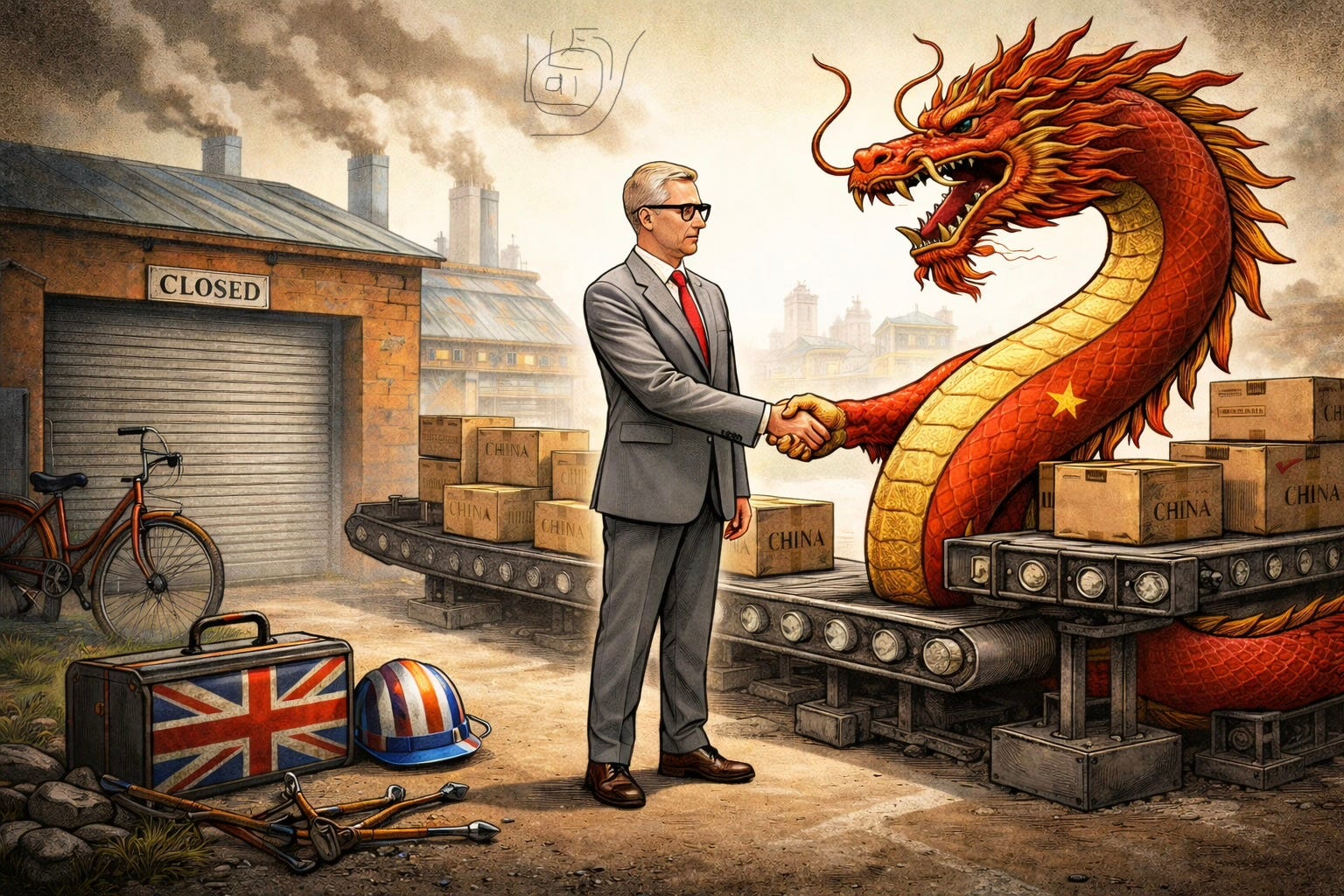
There are moments in public life when the most revealing thing is not what is said, but what quietly stops being asked.
For years, the West Midlands Combined Authority was keen to talk about manufacturing. British manufacturing. Local supply chains. Jobs rooted in place rather than footloose capital. When the original West Midlands Cycle Hire scheme launched, that story was told loudly and often. The bikes were made in Stratford-upon-Avon. The docks were manufactured in the region. It was not just a transport scheme, we were told, but a small example of how public policy could support domestic industry while nudging behaviour in a greener direction.
That language has not disappeared. If anything, it has intensified.
Under a Labour administration, the West Midlands now speaks fluently about clean growth, green jobs, sustainable transport and resilient supply chains. Those phrases appear in speeches, strategies, mayoral statements and press releases. They are part of the political wallpaper.
And yet, when it came to the region’s newest flagship micromobility scheme, those words were not translated into requirements.
The new contract has been awarded to Lime, a global operator whose business model relies on importing bikes and scooters manufactured overseas, servicing them locally, and scaling rapidly across cities. The arrangement is described as a concession rather than a purchase, a distinction that has already been leaned on to dampen scrutiny. But that distinction does not absolve the authority of choice. It simply relocates where those choices are made.
The result is a scheme that may well expand access to cycling and scooters, but does so without any visible commitment to British manufacturing, and without any clear accounting of the environmental or economic trade-offs involved.
That gap between rhetoric and reality deserves attention.
The holding statement that said less than it appeared to
Ahead of publication, the Combined Authority was asked a straightforward set of questions. Were British or regional supply chains part of the scored evaluation. Was embedded carbon assessed, including the emissions involved in manufacturing and shipping fleets from overseas. Was any economic comparison made between the previous locally manufactured model and the new globally sourced one.
The response, after some delay, was a holding statement.
It emphasised that Lime had won a competitive tender, offered “exceptional value for taxpayers”, and aligned with the Mayor’s transport priorities on active travel, congestion and air quality. It highlighted the creation of local jobs through warehousing and maintenance hubs. It noted that the previous scheme cost £1.4 million a year to operate, and that existing West Midlands-manufactured docking stations would be refurbished and reused.
What it did not do was answer the central questions.
There was no confirmation that British manufacturing was required, incentivised or even assessed. No reference to embedded carbon or transport emissions. No economic impact analysis comparing local manufacture with global sourcing. Responsibility for abandoning the existing locally manufactured bikes was attributed instead to “interested suppliers”, without explanation of what expectations or incentives the authority itself set.
The authority also indicated that a detailed response would follow within a week. That deadline passed without further clarification.
This matters not because of procedural niceties, but because the unanswered questions go to the heart of how Labour now understands industrial policy in practice.
Concession is not abdication
The word “concession” has done a great deal of work in recent days.
The argument runs like this: because the Combined Authority is not buying the bikes directly, it cannot reasonably be expected to influence where or how they are made. That logic is neat. It is also wrong.
Concession contracts across Europe routinely include conditions relating to environmental performance, supply chains, reporting, reuse, repairability and social value. Authorities may not own the assets, but they decide what kind of activity is permitted on public streets, under public licence, and on what terms.
In other words, the absence of a British manufacturing requirement is not a legal inevitability. It is a policy choice.
The previous West Midlands Cycle Hire scheme demonstrated that such choices were once made differently. British manufacture was not an afterthought. It was part of the story the authority wanted to tell about itself.
The question, then, is not whether Lime can operate a large-scale micromobility network. It clearly can. The question is why the authority no longer seems to regard domestic manufacturing as a core objective worth embedding into procurement.
Green transport and the carbon we do not count
Active travel schemes enjoy a kind of moral immunity in public debate. Bikes are good. Scooters reduce car journeys. Therefore the scheme is green. End of discussion.
But that logic collapses once we move beyond tailpipe emissions.
A bike does not arrive carbon-free. Neither does an e-scooter. Materials must be extracted, processed and assembled. Batteries must be manufactured. Finished vehicles must be shipped, often thousands of miles, before they ever touch a British road. At the end of their life, they must be disposed of, recycled or scrapped.
When vehicles are built locally, repaired locally and kept in service for longer, those impacts are easier to manage and, crucially, easier to see. When fleets are imported at scale from global supply chains, the carbon cost is externalised, diffused and rarely interrogated.
If a transport scheme is to be presented as part of a region’s decarbonisation strategy, it is not unreasonable to ask whether those embedded emissions were assessed, compared and weighed in the decision-making process.
So far, no such assessment has been placed on the public record.
Jobs, but which ones
The holding statement places significant emphasis on local jobs created through warehousing and maintenance hubs. Those jobs matter. They should not be dismissed.
But they are not the same as manufacturing jobs.
Manufacturing supports different skills, different wage structures and different long-term economic benefits. It anchors design, engineering and innovation in place. It creates spillovers into apprenticeships, tooling, materials science and fabrication.
Replacing manufacturing with logistics is not a neutral substitution. It represents a thinning of the industrial base.
The West Midlands understands this better than most regions. Its economic history is built on the difference between making things and merely moving them.
Which makes the quiet disappearance of manufacturing from the micromobility brief all the more striking.
A wider political drift
None of this needs to be framed as conspiracy. The timing alone tells a subtler story.
As national Labour figures speak increasingly about global trade, foreign investment and international partnerships, regional decisions appear to be aligning with that outward-facing posture. Buying green outcomes offshore is easier than rebuilding domestic capacity. It delivers visible results quickly, without the friction of nurturing local supply chains.
That may be a conscious strategic shift. If so, it deserves to be acknowledged honestly.
What sits uneasily is the attempt to maintain the language of local manufacturing and green jobs while procurement choices move in the opposite direction. At some point, the two cannot be reconciled.
Silence after a promised answer
Perhaps the most telling detail in this episode is not the Lime contract itself, but the failure to follow through on promised clarification.
When public bodies ask for time to provide technical answers and then do not provide them, it is rarely because the questions are obscure. More often, it reflects internal discomfort. Different priorities pulling in different directions. No settled narrative that satisfies policy, politics and presentation at once.
The unanswered questions here are not technical. They are political.
Does Labour still believe that public transport policy should actively favour British manufacturing. Does it regard local supply chains as something to be embedded through procurement, or merely celebrated in speeches. Is green policy about outcomes alone, or about how those outcomes are achieved.
Until those questions are addressed directly, the Lime deal stands as a small but telling case study in a larger shift.
The quiet answer we already have
No single contract defines a government. But patterns matter.
When authorities stop asking where things are made, they answer the question themselves. When manufacturing falls out of the brief, it falls out of the economy. When green language is detached from industrial reality, it becomes branding rather than strategy.
The West Midlands once told a different story about itself. One in which transport policy, manufacturing and regional identity were intertwined.
The Lime concession suggests that story is being rewritten, not with a bang, but with a shrug.
Whether that is progress or retreat depends on what Labour now believes “backing British industry” actually means.
So far, the wheels on West Midlands streets are telling us more than the words ever could.
Important story Mike - good digging