

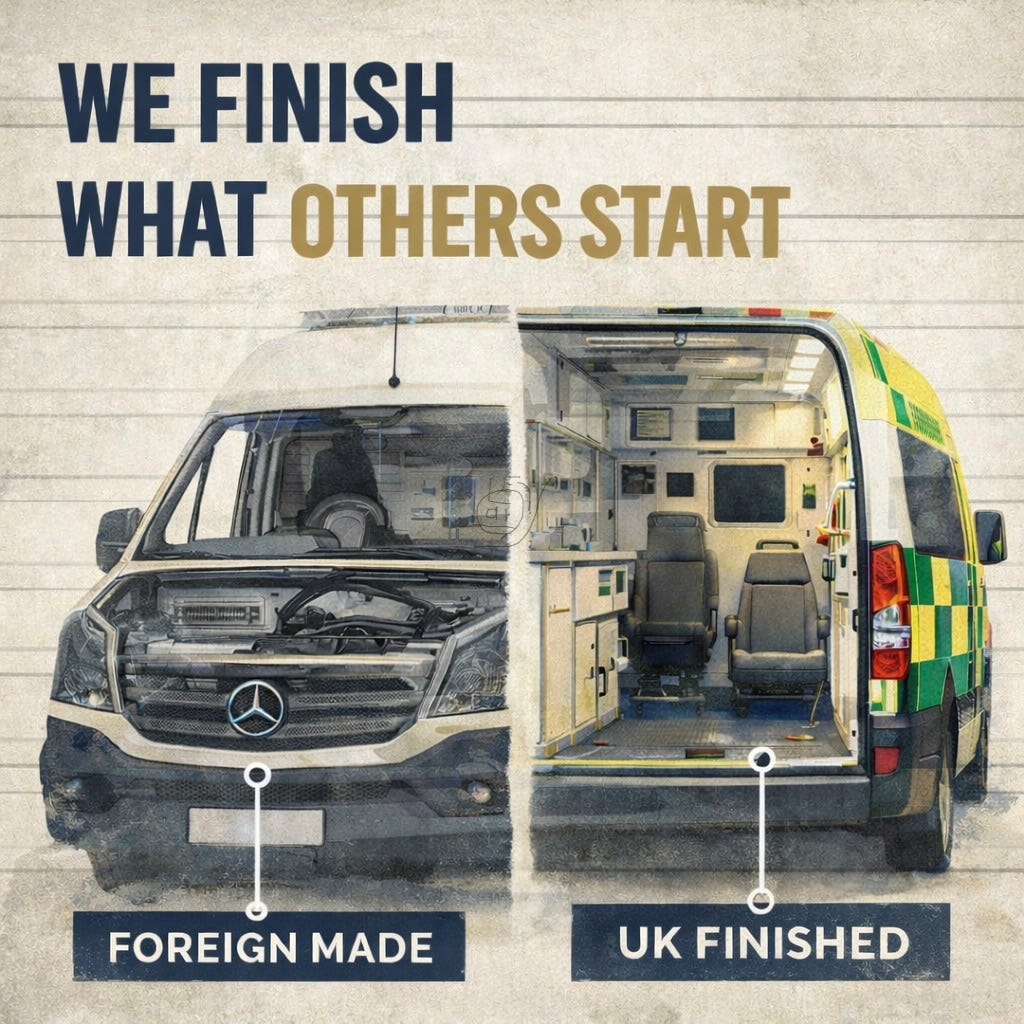
There is a quiet contradiction rolling through the streets of the West Midlands, and once you see it, it is difficult to unsee. The West Midlands Ambulance Service is expanding its fleet, putting more vehicles on the road, improving response times, doing exactly what the public would expect of a modern emergency service. Yet beneath the flashing lights and the professionalism of the crews sits a harder truth. We are saving lives in vehicles that Britain no longer knows how to fully build.
There is no evidence that WMAS has taken any ideological position against British manufacturing, nor any suggestion that it has consciously chosen foreign over domestic suppliers. Like any ambulance trust, its duty is straightforward. It must buy what works, what is reliable, what will perform under pressure. The reality it faces is not one of choice but of limitation. Even if it wanted to purchase a fully British-built ambulance tomorrow, it could not do so, because such a vehicle does not exist in the current market. That is not a procurement failure, nor a managerial oversight. It is the consequence of a gap that has opened up in the nation’s industrial capability.
That gap is felt most keenly in the West Midlands, a region that once defined British manufacturing at its most confident and expansive. This is the ground that produced Jaguar and Land Rover, names that carried British engineering to every corner of the globe. It is the legacy of MG and the Austin Motor Company, where entire communities were built around the rhythm of production lines and the pride of making something tangible, durable, and exportable. From Coventry to Birmingham to Solihull, this was not an economy of assembly but of creation. Vehicles were conceived, engineered, and manufactured here, not simply finished.
What remains today is not a collapse but a fragmentation. The ambulances used by WMAS still contain a significant British contribution, but it arrives later in the process than it once would have done. The base vehicles are built abroad, supplied by manufacturers such as Mercedes-Benz, Fiat and Volkswagen. These are robust, proven platforms, and they are chosen for precisely those reasons. Yet once they arrive in the United Kingdom, they are transformed. Specialist firms including Vehicle Conversion Specialists, O&H Vehicle Conversions and WAS UK take these vehicles and rebuild them into frontline emergency units. This is not cosmetic work. It is deep, highly skilled engineering that integrates complex electrical systems, medical infrastructure, reinforced interiors and communications technology into a vehicle that must perform flawlessly in the most demanding circumstances.
It is, in many respects, the best of British capability still at work. The skill has not disappeared. The engineering has not been forgotten. The standards remain high. What has been lost is the earlier stage, the industrial foundation on which all of this once depended. The United Kingdom has become exceptionally good at finishing what others begin, but it no longer controls the starting point.
This is not the result of a single decision or a sudden decline. It is the accumulation of years of drift, of production moving elsewhere, of investment decisions delayed or diverted, of an industrial strategy that has too often been discussed in theory rather than executed in practice. The country did not wake up one morning and decide to stop building vehicles of this kind. It simply allowed the capability to thin out, piece by piece, until the absence became normalised. Only when confronted with something as fundamental as an ambulance does the full extent of that absence become clear.
And yet, for all that, this is not a story of inevitability. The United Kingdom retains many of the ingredients required to rebuild. The engineering base is still present, particularly in the West Midlands. The skills have not vanished, even if they are less concentrated than they once were. The supply chains, though stretched, still exist. The shift towards electric vehicles, now gathering pace, offers a potential inflection point, a moment at which new platforms, new technologies and new production models could be established. With the right direction, that transition could favour domestic capability rather than further erode it.
What is missing is not the means but the alignment. There is no clear, sustained effort to bring these elements together into a coherent industrial strategy. The power of public procurement, particularly through the NHS, remains underutilised as a lever for domestic production. The demand exists in plain sight, yet it is not being systematically connected to the capacity that could be developed to meet it. Without that connection, industry lacks the certainty required to invest, and without investment, the capability cannot return.
This is where policy moves from the abstract into the practical. A government serious about rebuilding this capacity would not need to invent something entirely new. It would need to recognise what already exists and commit to joining it up. It would need to provide long-term signals to manufacturers that there is a stable market for a British-built platform. It would need to anchor that effort in regions such as the West Midlands, where the knowledge, infrastructure and heritage remain strong. Above all, it would need to approach manufacturing not as a nostalgic reference point, but as a central component of the country’s economic future.
The difficulty, as ever, lies in political will. There is no shortage of statements in support of British manufacturing. Across parties and across platforms, the language of support is well rehearsed. But translating that language into action requires a willingness to commit to long-term strategy, to accept risk, and to back industry before its success is guaranteed. That is a more demanding test of conviction, and it is one that is not always met.
At present, Britain occupies an uneasy position. It produces ambulances of exceptional quality, but only after the essential structure has been imported. It contributes the intelligence, the engineering, the life-saving capability, but not the foundation. The West Midlands, with its deep and enduring connection to manufacturing, stands as both a reminder of what was once achieved and an indication of what could be achieved again. The capability has not been entirely lost. It has been allowed to drift.
If you are a politician who genuinely believes in rebuilding British manufacturing, please step forward.
Thanks Ben i will of course most likely do a follow up using your knowledge base and make myslef look like an expert on the subject hjopefully even you will be impressed :)
Mike: One ambulance chassis supplier not mentioned is Ford, with the Transit. I'm sure you recall that Ford had a factory in Eastleigh, near Southampton that produced complete Ford Transit vans from 1972 until 2013 when production was transferred to the Ford Otosan plant in Turkey and the Eastleigh factory closed, ending all Ford vehicle assembly operations in the UK. Coincidentally (or not) the European Investment Bank, owned by the Member States of the European Union, including of course at this time, the UK, approved an £80 million loan in June 2012 to help Ford Otosan upgrade its factory to increase production of Ford Transit models.