

Has Warwickshire Police got a problem with the bleeding obvious?
Julie Purvin says another police force had to join the dots. Philip and Mandy Bond have their own concerns. Is Warwickshire Police listening?

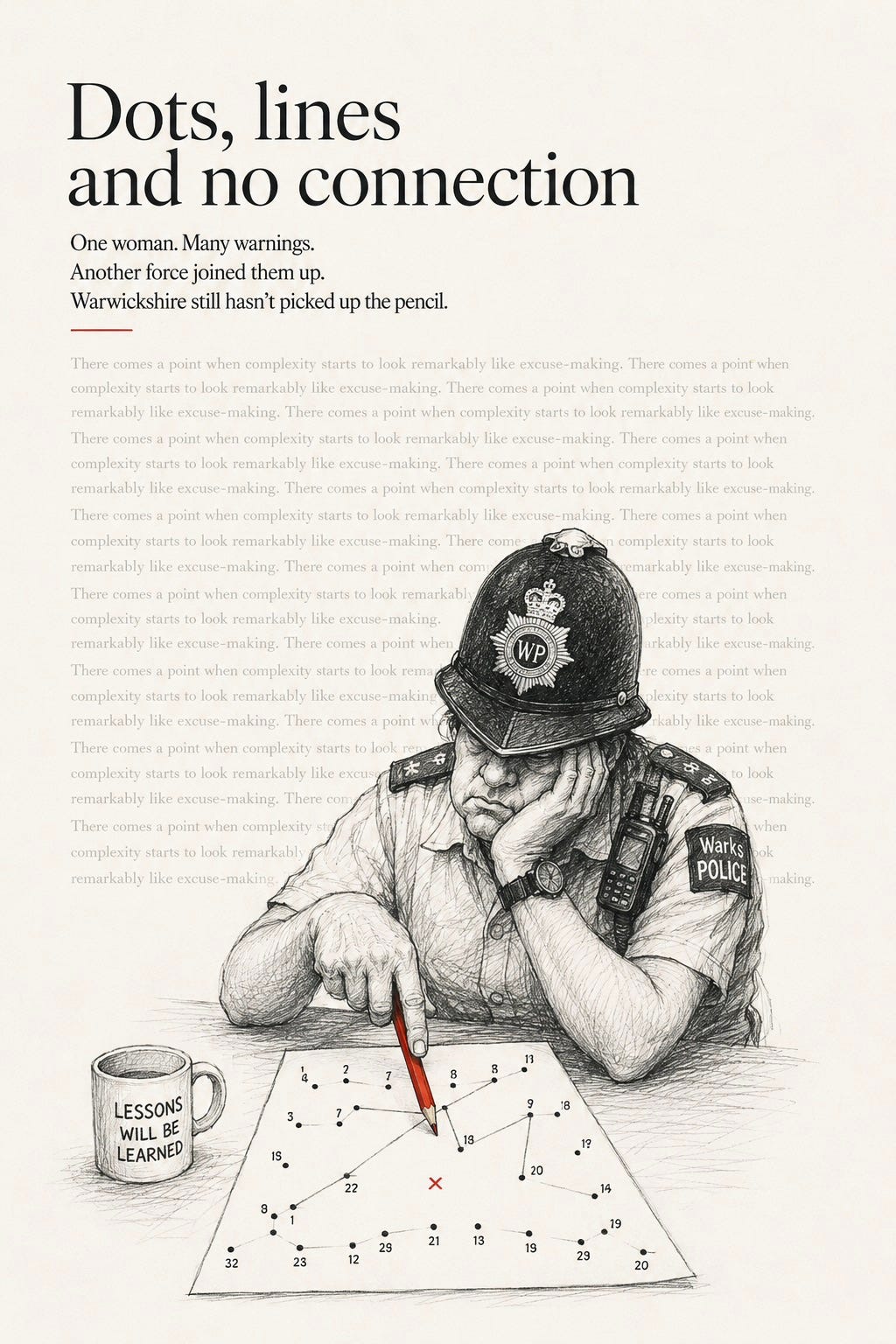
I am beginning to wonder whether Warwickshire Police has a problem with the bleeding obvious. There are dots. Then there are lots of dots. And eventually there are so many dots that you begin to wonder whether somebody has mislaid the pencil. I say that because over the last few weeks I have been looking at several complaints about policing in Warwickshire which have absolutely nothing to do with one another in terms of the people involved, and I want to make that clear from the start. What they do seem to share is an increasingly familiar complaint from ordinary people who say they have taken information to the police, waited for something to happen, supplied some more information, waited again and eventually started wondering whether anybody was looking at the whole picture rather than admiring each dot individually.
Meet Julie Purvin. Julie went into a Stratford upon Avon pub and met a man calling himself Jason Brown. Except Jason Brown wasn’t really Jason Brown, which, as opening lines to a relationship go, is not ideal. The man Julie met had used different identities and had a serious history of sexual offending and breaches of restrictions imposed upon him. None of this, unsurprisingly, was printed on his forehead. Julie says she began discovering things herself when bits of his story stopped fitting together. There was a hidden phone, a SIM card, names which changed and eventually the rather startling discovery that the man she knew as Jason Brown was appearing at Lincoln Crown Court under another identity. Most of us going for a drink in Stratford do not begin by asking the person sitting opposite for a DBS certificate, passport and two utility bills, and I doubt very much that we want to live in a world where we have to. That is rather the point of having police systems which know things the rest of us cannot possibly know.
Julie did what most of us would tell somebody in that position to do. She went to the police. She says she was frightened, she says she sought help through Clare’s Law, the Domestic Violence Disclosure Scheme which exists precisely so somebody can ask whether a partner has a history which might put them at risk, and she says Warwickshire Police effectively brushed her aside. Most astonishingly, Julie says one officer offered words to the effect that “love is blind” and not to worry. Now “love is blind” may have been perfectly serviceable advice from your auntie in 1973, usually shortly before she put another Babycham on the table, but it is somewhat less reassuring when the chap sharing your home has several names and a serious sexual offending history. Julie says it was only when an officer from Lincolnshire Police became involved that somebody began taking what she was saying seriously.
And here is where Warwickshire Police has a problem which cannot simply be wished away with the benefit of hindsight. The force itself subsequently took action against Brown connected with sex offender notification requirements and his relationship with Julie. In other words, the relationship Julie had been trying to get somebody interested in rather mattered after all. That does not automatically prove every decision Warwickshire Police made beforehand was wrong and there may be information which Julie did not know and which I do not yet know. That is why I am asking questions rather than announcing verdicts. But it does leave a fairly obvious one sitting on the table: what happened when Julie first tried to raise the alarm?
Warwickshire Police certainly knows what Clare’s Law is. Its own published information explains the Right to Ask process and its own figures show hundreds of such investigations being recorded. So I want to know whether Julie’s request was formally recorded, whether it was assessed and refused, whether she was never properly directed into the process in the first place, and whether the various names being used by Brown were successfully joined together on police systems. I also want to understand precisely what the Lincolnshire officer did which Julie believes changed everything. Perhaps there is a perfectly good explanation. If there is, I will happily print it. One of the advantages of asking questions is that occasionally somebody answers them.
Which brings me, by a different road entirely, to Philip and Mandy Bond. Their cases have nothing whatsoever to do with Julie or Brown and nobody should read anything into their appearance in the same article beyond the question I am asking about Warwickshire Police itself. Mr and Mrs Bond made reports of harassment to Warwickshire Police. I approached the force with their crime reference numbers and asked whether the matters remained under active investigation or review, whether an Officer in Charge was assigned, whether relevant evidential material was being retained and whether any indication could be given about process or timescale. Warwickshire Police confirmed to me that both reference numbers relate to reports of harassment which are “under investigation”. The force added that it was sorry to hear Mr Bond was dissatisfied and encouraged him to use its complaints procedure.
Fair enough, except Mr Bond’s complaint is rather more basic than wanting directions to the complaints page on a website. He says he and Mrs Bond have repeatedly supplied information and he is deeply dissatisfied with both the progress of the investigations and the communication they have received. Warwickshire Police may have perfectly proper explanations for that as well. Investigations take time, evidence has to be assessed and nobody has a right to demand that the police reach the conclusion they personally want. I have spent enough years around courts, policing and public bodies to understand that. But “under investigation” is a perfectly respectable answer for a while. Eventually it begins to sound rather like somewhere a file has gone for a nice lie down.
There is a further complication in the Bond story which I am treating with considerable care. Mr Bond alleges that political relationships involving former Warwickshire county councillor Justin Kerridge and Police and Crime Commissioner Philip Seccombe have affected the way matters have been handled. That is a serious allegation and it is not one I presently have evidence to state as fact. Indeed, a Police and Crime Commissioner is not supposed to interfere in individual operational investigations. If anybody is going to suggest that happened, the evidence needs to be considerably stronger than suspicion, political association or two people knowing one another. What can legitimately be examined is whether relationships existed, whether they were declared where appropriate, what decisions were actually made and whether there is any evidence whatsoever that those relationships crossed into operational policing. Until that evidence exists, allegation remains allegation.
There is nevertheless a reason why questions about public confidence in Warwickshire do not simply disappear. The force’s handling of hunting related matters attracted national attention after Channel 4 examined the policing of the Warwickshire Hunt. The subsequent independent review identified shortcomings around oversight and communication, although it also found no evidence that PCC Philip Seccombe’s membership of the Countryside Alliance influenced operational police decisions. I have no intention of deleting that latter finding because it happens to be inconvenient to those who suspect otherwise. Evidence works both ways or it isn’t evidence. But neither does that finding erase the wider damage done when the public begins wondering whether policing is sufficiently transparent, sufficiently curious and sufficiently willing to challenge assumptions.
Which is why I have asked Warwickshire’s Acting Chief Constable David Gardner to meet me. I am still waiting for an answer. I appreciate acting chief constables are busy people. So, for that matter, are women discovering that the man sharing their home isn’t quite the man he said he was, and people wondering what has happened to reports they made to the police. I do not expect Mr Gardner to sit down with me and discuss evidence from live investigations over a cup of coffee. He cannot and should not. I would, however, rather like to talk to him about something chief constables absolutely can discuss, which is confidence in their force and what happens when members of the public become convinced that nobody is listening.
Policing is difficult. I know that. Information can sit in different counties, on different systems and, in Julie’s extraordinary case, apparently underneath different names. Officers deal every day with people who are mistaken, confused, angry, frightened or sometimes all four before lunchtime. They also have to distinguish between an allegation and evidence, and I wish rather more of the internet understood the difference. But there comes a point when complexity begins to look remarkably like excuse making. Julie says she tried to tell Warwickshire Police something was badly wrong and says another police force eventually took it seriously. Warwickshire itself subsequently took action connected with the relationship she had been worried about. Mr and Mrs Bond say they have supplied information and are still waiting for investigations which Warwickshire Police confirms remain open to reach wherever they are going.
Three people, separate circumstances and no magic thread joining their cases together. Perhaps, when all the answers arrive, Warwickshire Police will have entirely reasonable explanations for everything. I genuinely hope so.
But while we are waiting, somebody might want to check the stationery cupboard. There are an awful lot of dots lying around Warwickshire. And sooner or later somebody has to pick up the pencil.