


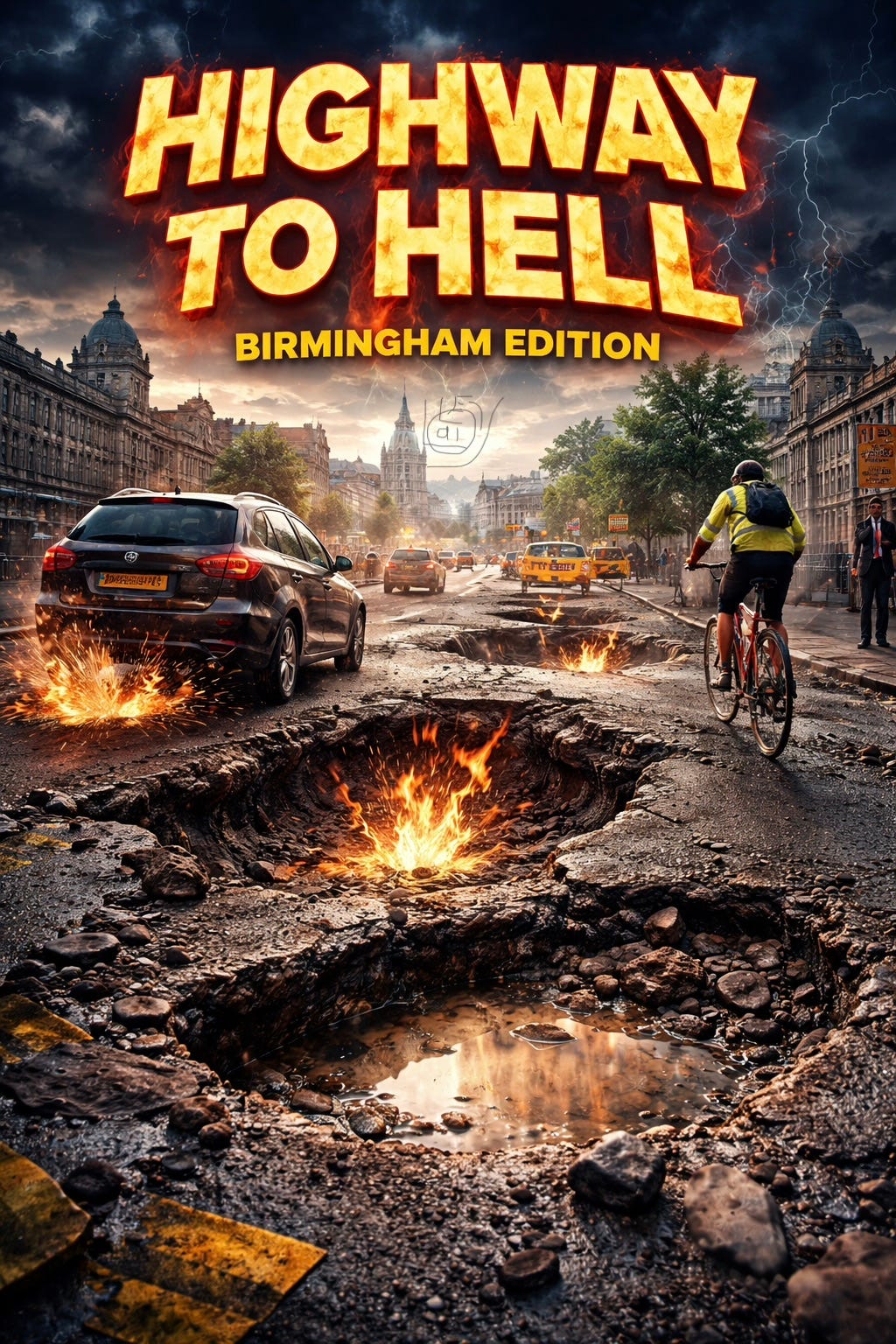
Birmingham’s roads tell a story that no press release can resurface. While politicians trade claims about investment and improvement, drivers are hitting potholes that have already destroyed tyres, cyclists are swerving into traffic to avoid craters, and residents are learning which streets to avoid by bitter experience. According to the council’s own figures, less than a mile of road was resurfaced last year. Against that reality, claims of progress ring hollow. Winter, armed with the inconvenient physics of freezing water, exposes what lies beneath the spin. This is not a mystery. It is the predictable outcome of under-resurfacing, weak repairs, and councils that have lost the will to enforce basic standards.
According to data released by Birmingham City Council, just 1,400 metres of road were resurfaced in the last full year. In a city with roughly 1,553 miles of road, that is less than a mile. At that pace, it would take close to 1,800 years to resurface the network. This is not an ideological argument. It is arithmetic.
Robert Alden, Councillor and Leader of the Conservative Group on Birmingham City Council, put that failure on the record in stark terms:
“Just 1,400 metres resurfaced last year by the Council. For context, that is less than one mile of road in a whole year. It is a failure. The Labour Council’s slashing of highways repairs over the last decade is now hitting cyclists and motorists alike. All across the city roads are pothole-ridden, gravel has sprayed out of holes, and with every cold snap freeze-thaw is breaking open more and more of the roads.”
Alden is not making a rhetorical flourish. As Leader of the Opposition group, his role is to force uncomfortable facts into the open and keep them there. Less than a mile resurfaced in a year is not spinable. It is an admission of systemic failure.
Why potholes explode in winter
There is a simple scientific truth at the heart of this mess.
Water is the only naturally occurring substance that expands when it freezes.
Almost everything else contracts as it cools. Water does the opposite. When it freezes, it expands, forcing apart whatever contains it. That is why ice floats. It is also why pipes burst, rocks split, and badly repaired roads tear themselves open every winter.
Water seeps into microscopic cracks in the road surface. Overnight it freezes and expands, widening those cracks. By day it melts, leaving larger voids. Repeat that freeze-thaw cycle, add traffic loading, and potholes are inevitable unless the surface was properly built and properly repaired.
This is not cutting-edge science. Engineers have understood it for decades. Which is why persistent potholes are not acts of nature. They are failures of standards.
This is not rocket science
Fixing a pothole properly requires cutting back to sound material, rebuilding the layers correctly, compacting them properly, sealing the edges, and using materials fit for purpose. Done properly, the repair lasts. Done badly, it fails again and again.
And this is where councils across the country, not just Birmingham, keep getting it wrong.
The real cause, statutory undertakers
Most repeat potholes do not start with age or traffic. They start with road excavations.
Gas, water, electricity and telecoms companies, legally known as statutory undertakers, dig up roads constantly. They are required to reinstate them to strict standards. Too often, they do not. Trenches are patched quickly, cheaply, and inadequately. The surface looks fine for a short while. Then it sinks. Cracks open at the edges. Water gets in. Winter finishes the job.
The deeper failure is this: councils do not inspect reinstatements aggressively enough. Poor work is signed off. Enforcement is weak. Penalties are rare. Undertakers learn that cutting corners carries little risk.
The result is a grotesque inversion of fear. Undertakers are barely inconvenienced, while motorists, cyclists and pedestrians absorb the danger and the cost.
That balance must be reversed.
Councils should make life genuinely uncomfortable for undertakers who fail to reinstate properly. Relentless inspections. Immediate rejection of substandard work. Financial penalties that actually hurt. Repeat offenders treated as repeat offenders. The aim is simple: undertakers should fear council enforcement regimes far more than road users fear the next pothole.
When councils get tough, potholes disappear. When councils go soft, potholes multiply.
Real roads, real damage
On Saturday, on the way to watch Warsaw get walloped by Barnet, a mate of mine hit a pothole hard enough to destroy his tyre outright. Not a slow puncture. Proper damage.
It turned out the hole had already damaged multiple cars that week. The council had already “patched” it. That patch consisted of loose tarmac tipped in, rolled over, and left. Within days it had fallen straight back out.
That is not weather. That is workmanship.
Huxtable, and the mechanics of failure
Tim Huxtable, Conservative Councillor and Shadow Cabinet Member for Highways, speaks about this problem from a position of responsibility, not commentary. His portfolio is roads, resurfacing, inspection and standards. When he criticises the council, he is describing how the system is supposed to work and how it currently does not.
As Huxtable put it:
“When I was previously running the roads in Birmingham, I cut through the red tape and got on with getting roads repaired and up to standard. Over the last 14 years there has been a collapse in proactive resurfacing, and that is why potholes and surface damage are now blighting the city.”
His argument is not abstract. It is about process. About inspection. About rejecting bad work rather than papering over it. He talks about roads the way engineers do, as systems that either hold together or fail depending on how seriously standards are enforced.
Alden and accountability
As Leader of the Conservative Group, Robert Alden provides the political spine to that critique. His job is not to micromanage highways but to hold the administration to account for outcomes. His criticism rests on evidence and scale. Less than a mile resurfaced in a year is not a marginal failure. It is a warning sign that the system itself is broken.
The problem with boasting
Against this backdrop sits Majid Mahmood, Labour Councillor and Cabinet Member for Transport and Environment, the politician with direct responsibility for highways performance.
Mahmood has publicly pointed to large investment figures as proof of success. But money spent is not the same as roads improved. Budgets do not fill potholes. Standards do.
If resurfacing rates are collapsing, if reinstatements are failing, and if residents are swapping pothole warnings like local folklore, then claims of excellence are disconnected from lived reality.
If the work is good, show it. Publish resurfacing lists. Publish inspection data. Publish enforcement action against undertakers. Publish outcomes, not optimism.
What needs to change
This is not complicated.
Inspect reinstatements properly.
Reject poor work immediately.
Penalise repeat offenders hard.
Make undertakers comply or pay.
Publish the results.
Water will always expand when it freezes.
That is physics.
Whether roads survive it is governance.
And until councils are prepared to govern with backbone rather than brochures, Birmingham, like too many cities, will remain stuck on the highway to hell.
My mate whose tyre was ruined could add to that vocabulary... he was furious ...
I was hopeless at science, but even I know that water expands when frozen, and our local taxi drivers have wonderful vocabularies for potholes.