
How Toothpaste Became a Health Problem
We made basic health look expensive, and the system is paying.

The £1 Truth
Toothpaste, Dental Decline, and What Thursday’s Vote Really Means
Walk into any supermarket or chemist across the West Midlands this week, Birmingham, Wolverhampton, Dudley, Solihull, take your pick, and stand in front of the toothpaste shelf. It tells you something. Not loudly, not dramatically, but clearly if you know what you are looking at. Rows of boxes at £3, £4, even £6 sit right where your eyes land, bright packaging, scientific language, promises stacked on promises, whitening, enamel repair, total protection. Each one nudging the same quiet message, better teeth cost more. And then, almost hidden, sits the £1 tube. Plain, unremarkable, easy to miss.
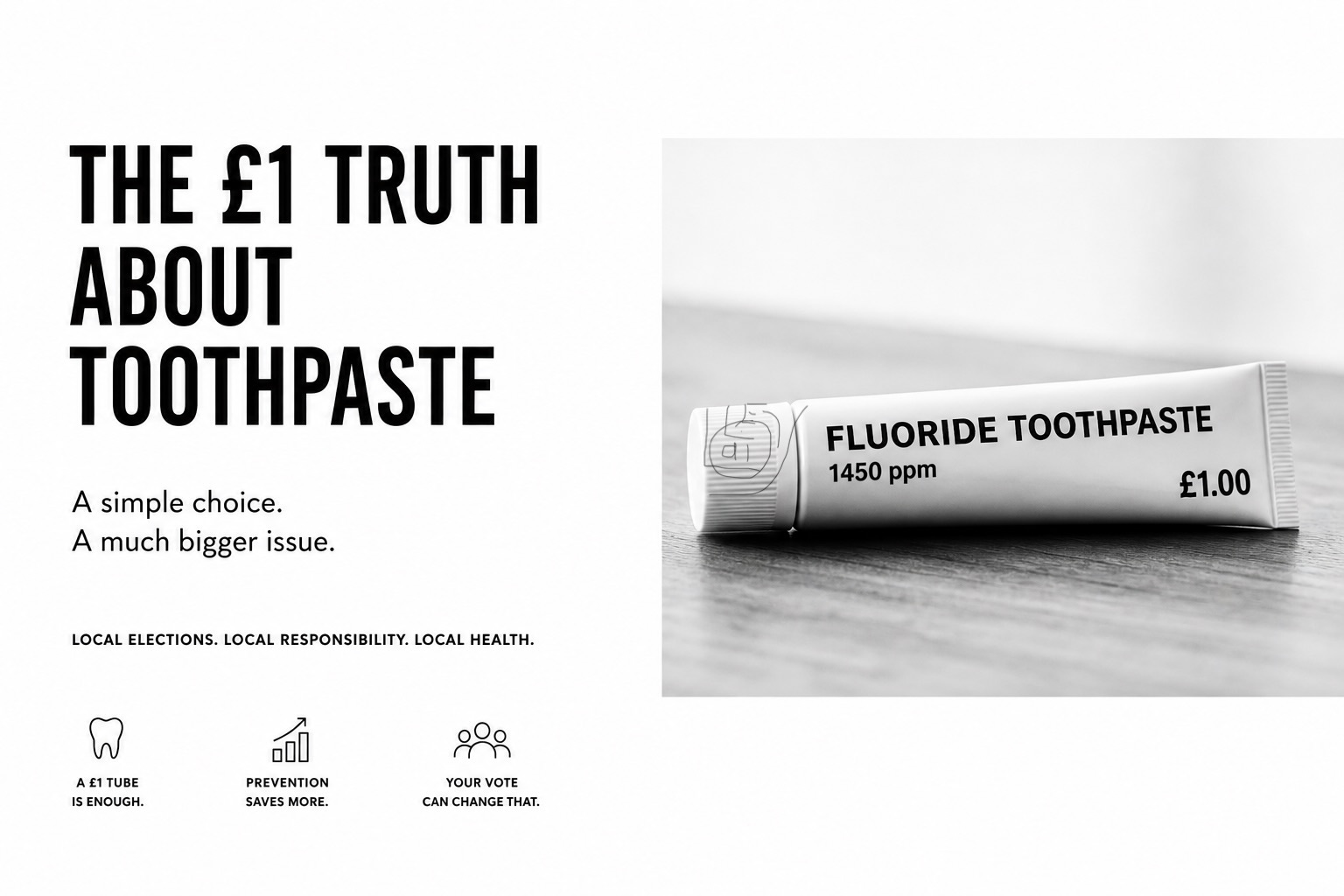
Here is the truth, and it is not complicated. For most people, that £1 tube does the job. Fluoride is what matters, around 1450 parts per million. That is the protection, that is the science, and it has been understood for decades. Everything else is margin, cosmetic, situational, often unnecessary. But the shelf tells a different story, and people believe the shelf.
People do not read policy papers, they read signals, and the supermarket shelf is one of the strongest signals there is. It is visual, immediate, and repeated every week. When £4 toothpaste sits front and centre and £1 toothpaste is pushed to the side, something shifts. Not dramatically, but steadily. People begin to assume that proper care must cost more, that cheaper options are a compromise. It is not true, but it sticks. And once that belief takes hold, behaviour follows. Some people spend more than they need to, quietly absorbing the cost. Others do the opposite, they delay, stretch what they have, cut corners. That is where this stops being about shopping and starts being about health.
Because when prevention slips, the consequences do not vanish. They move. They reappear later as pain, infection, missed school, missed work, and pressure on NHS England. What looks like pricing on a shelf becomes cost in a hospital, and the connection between the two is rarely made explicit.
It was not always like this. At the turn of the century, I sat as a non-executive director at Birmingham Dental Hospital, and the region’s dental health was something to be proud of. Not managed, not spun, simply strong. One senior professor said something that has never left me. They sometimes had to send students to Coventry to practise routine fillings because there was not enough decay locally to give them experience. Pause on that for a moment, because it reframes everything. We had a system so effective at prevention that the absence of disease became a practical issue. That is not nostalgia, it is a benchmark.
The change did not arrive in one moment. It crept in. Access tightened, fewer NHS appointments, longer waiting times, more practices drifting towards private or mixed models. What had once been routine became uncertain, and uncertainty is the enemy of prevention. At the same time, public health messaging lost its clarity. It did not disappear, but it softened, became less direct about what works and how little it actually costs to maintain basic oral health. Into that space stepped the market, and markets do not simplify, they differentiate. Oral care shifted from something basic and accessible into something branded and premium. Beneath all of this, inequality widened. Those who could navigate the system stayed within it. Those who could not drifted away, not suddenly, but steadily enough to change outcomes across the region.
This Thursday’s elections will not be fought on toothpaste, and no candidate will stand on a platform of fluoride levels or shelf pricing, but that does not mean the issue sits outside what is being decided. Councils do not run dentists and they do not sell toothpaste, but they sit at the centre of public health. They shape prevention, they shape understanding, and that matters more than most people realise. Because if people do not understand that a £1 tube protects their teeth just as effectively, then prevention weakens, not because people do not care, but because no one has explained it clearly enough.
Thirty years ago, the system absorbed risk early, quietly and effectively, preventing problems before they became visible. Today, it absorbs failure late, visibly and expensively, stepping in when issues have already developed into something more serious. Less access leads to weaker prevention, weaker prevention leads to more disease, and more disease leads to higher cost. And sitting at the very start of that chain is a misunderstanding so simple it is often overlooked, the belief that staying healthy costs more than it actually does.
We now live in a region where children are once again being admitted to hospital for preventable dental extractions. That should give pause, because this is the same region where, not so long ago, dental students struggled to find enough cavities to practise on. That is not just decline, it is reversal.
As voters go to the polls this week, they will hear plenty of noise. Gaza, immigration, boats crossing the Channel, the full weight of national and global issues pressing into a local contest. People are entitled to vote on those issues if they wish, and the parties will certainly be watching the signals. But these are local elections, and local responsibility sits elsewhere, in public health, in prevention, in the everyday conditions that shape whether people stay well or fall into difficulty.
If a candidate wants to talk about distant issues, let them, but do not let that be the end of the conversation. Bring them back to what they are actually there to do. Ask about public health, ask about access, ask why something as basic as oral care is still misunderstood when the consequences are now so visible. Because the real work sits in the detail, in homes, schools, and streets, in small decisions repeated over time that build into long-term outcomes.
A £1 tube of fluoride toothpaste is enough to protect your teeth. A £4 tube does not do it better, and a £10 tube does not change the fundamentals. But if people believe otherwise, and no one in a position of responsibility corrects it, the consequences follow. We have moved from a system that struggled to find disease to one that is managing its return, not because the science changed, but because access weakened, messaging blurred, and the cost of prevention was quietly misrepresented in people’s minds.
This week, you are not just casting a vote shaped by the loudest voices. You are handing responsibility to someone close enough to act. The real question is not just who you choose, but how hard you are prepared to hold them to it once they are in place.
Thanks Richard - You make a fair point that local elections often become national protest votes, and historically that has been true for decades. Governments of every colour end up being judged through local ballots. But I still think there is a danger in allowing local accountability to disappear completely beneath national and international arguments.
some local candidates do genuinely earn support on local performance alone. Bobby Alden, for example, as discussed in Monday’s article, is one of those figures who commands respect because people can physically see the work, the engagement, and the outcomes'm on the ground. That still matters, even in an era dominated by national grievance politics.
On the wider point about demographics and political culture, I do think Britain is struggling to have an honest conversation. Birmingham has changed profoundly within a relatively short historical period, and it would be absurd to pretend those changes have no political or cultural consequences. Issues such as Gaza or wider Middle Eastern politics resonate strongly within parts of the electorate because communities naturally bring their identities, loyalties, and concerns into democratic life. It's what we do
At the same time, I would be cautious about treating Muslim communities as monolithic. Like every large religious or cultural group, they contain conservatives, liberals, secularised families, modernisers, traditionalists, and people who simply want to get on with everyday life. But it is also true that moore conservative religious identities have become more visible and politically confident across parts of Britain, particularly where communities are large and concentrated, and Birmingham is clearly one of the cities where this can be felt most strongly.
The challenge for Britain is not diversity in itself. It is whether a shared civic identity remains strong enough to hold very different communities together under one legal and political F ramework. That debate is no longer fringe. It is now central to modern British politics whether people are comfortable admitting it or not.
My original piece was narrower in focus, .public health and prevention, but perhaps the deeper connection is that once trust and clarity weaken in any system, whether healthcare, politics, or social cohesion, fragmentation tends to follow.
When have local elections been local? The truth is that since WW2 local elections have been mid term referenda on the government in power. Today we are nearly at mid term through this Labour administration and it is more unpopular than any government since the 1930s. Today there is a difference… the growth of fringe parties due in part to mass immigration. Today we have 3.9 million Muslims in Uk … when I was born there were 32,000!!! It is not surprising therefore that issues like Gaza, Iran, anti-Semitism etc interfere with political debate. It is not surprising since Muslims are taught that their faith the Ummah Islami is more important than the laws of their nation. That is precisely what the Hadith states and as the words of Mohammed the Hadith exists to interpret the Koran. So we must expect from now on parallel societies, one grounded in British law and the other in Islam as is clearly the case in BIRMINGHAM. Politicians talk about Islamism but it is not a word that the Islamic World recognises. It is a western word to imply that there are extremist Muslims. The truth is there are two types of Muslims conservatives and westernised, who don’t take their faith seriously just as many Christians don’t. It is though the conservative Muslims be they Sunni or Shia that are in the ascendency in most Muslim countries and this is partly the fault of the West, for interfering in the Middle East. As to fluoride in toothpaste… it is now in the water throughout the country… you don’t need it in toothpaste if you clean your teeth regularly and drink water… the trouble is children these days do not drink water and don’t brush their teeth!!!