

If the Voters Want a Fool, Should We Stop Them?
Nigel Farage’s essay gives national force to a Birmingham debate on English, standards and democracy: should voters alone decide?
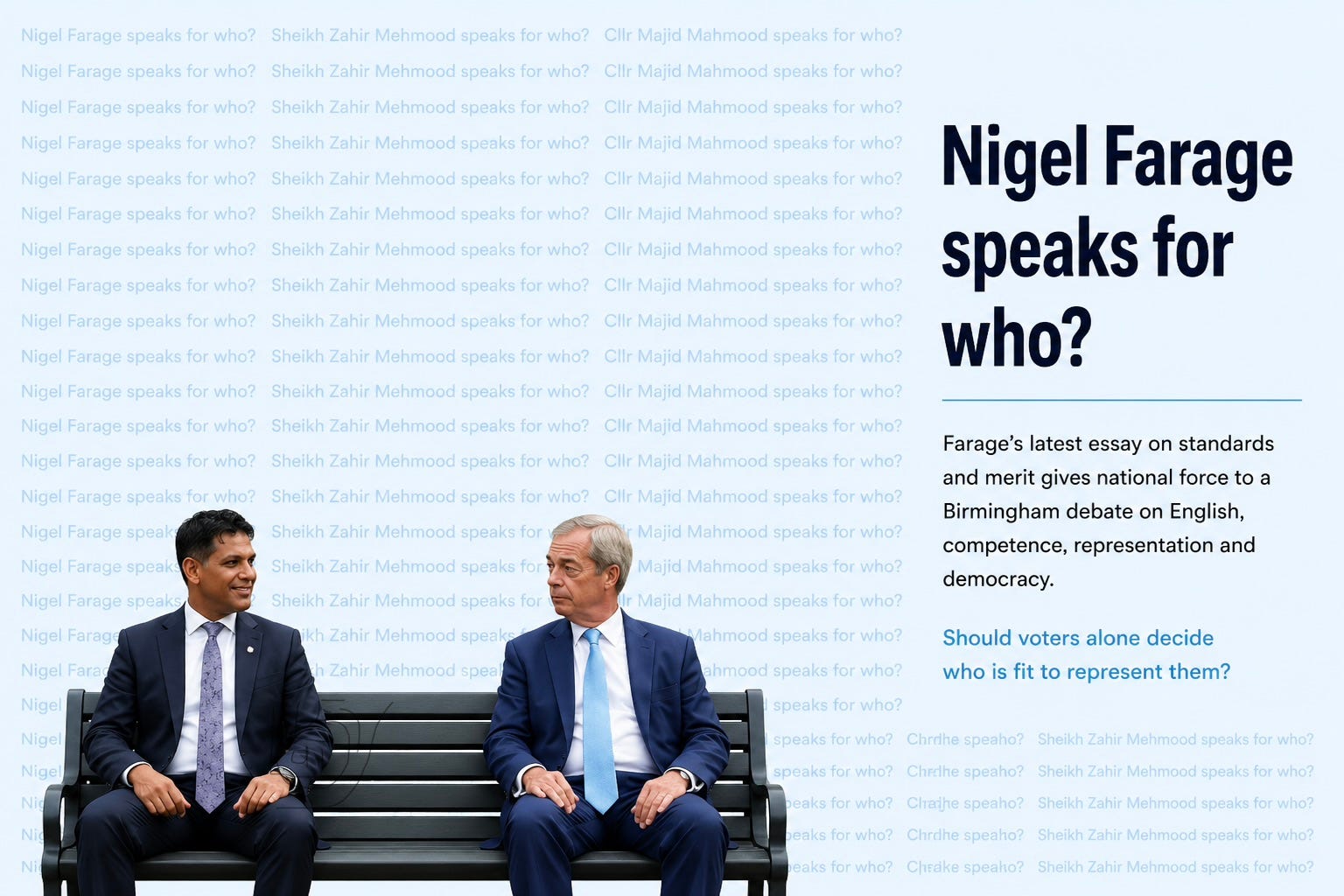
There are moments in politics when a subject stops whispering in the corners and walks straight into the room, muddy boots and all. Birmingham has just had one of those moments. Cllr Majid Mahmood, now enjoying one of those curious post-Labour bursts of popularity that often arrive when a politician leaves the machine and starts sounding more like himself, used X to praise Sheikh Zahir Mehmood for speaking openly about something many people have discussed privately for years. The Sheikh’s point was blunt. If someone cannot speak English properly, how can they properly represent residents on Birmingham City Council? That is not a small question. Nor is it a comfortable one. It touches language, class, migration, community politics, party selection, democracy, competence and that most delicate of civic nerves: who gets to speak for whom. Majid’s intervention matters because he is not some passing social media foghorn. Before Labour was badly mauled in Birmingham, he was a leading Labour councillor. When others were swept away, he survived. That tells you something. He knows his ward, his residents and his onions. You do not hang on in difficult political weather simply by having a red rosette and a hopeful expression. Before anyone thinks I have gone soft, I have not forgiven Majid for the potholes. Some are now so mature they should probably be twinned with other potholes in Europe. Nor have I forgotten his anti-car instincts when he held the roads brief. As a cyclist, even I found some of it hard to applaud. But politics is not a cartoon. A man may have a blind spot the size of a bus lane and still be worth listening to when he forces a serious democratic argument into the open.
The Sheikh’s remarks were sharper still. His argument, stripped of heat, was simple. A councillor must speak for residents, challenge officers, understand reports, send emails, engage with colleagues and represent the community in the working language of the council. If they cannot do that, how are they to perform the role? Some will say that is obvious. Others will say it is dangerous. Both reactions deserve attention. The trouble with Birmingham politics, and indeed British politics more widely, is that we have spent years confusing politeness with wisdom. Some subjects became unsayable not because they were false, but because they were inconvenient. Language competence in public office was one of them. Everyone knew it mattered. Everyone knew it occasionally caused difficulties. Everyone also knew that mentioning it risked being dragged into a row nobody wanted. So the subject was managed, softened, avoided and quietly passed around like a plate of sandwiches nobody quite fancied.
This Birmingham debate also sits inside a much larger national argument. Nigel Farage has recently written one of his long essays on what he sees as the effects of diversity, equity and inclusion, the Equality Act, public sector equality duties and what he calls a two-tier state. Politicians writing essays again is no bad thing. It provides material for every shade of political thought, and for cartoonists, which is one of democracy’s underrated blessings. Farage’s essay is not about Birmingham councillors speaking English, but it is relevant because it attacks the broader idea that public institutions should lower, bend or rearrange standards in the name of representation, identity or equity. He argues that “equality has nothing to do with it” and that positive action has become a route to unfairness. He says the Equality Act and public sector equality duty have helped embed a culture where institutions become more concerned with group outcomes than individual merit. Many readers will reject that argument. Some will embrace it. Others will agree with part of it and recoil from the rest. But it would be foolish to pretend it is not part of the same national weather. Farage is not shouting from a shed. He is leading a party that has become a major force in British politics. If he is writing long arguments about standards, fairness and who the state serves, Birmingham should at least read them before throwing the paper at the wall.
Yet here is where I refuse the easy answer. I am instinctively against formal preconditions for standing for elected office. I do not want a clipboard democracy, where some official decides who is clever enough, fluent enough, polished enough or respectable enough to appear on a ballot paper. I left school at fifteen with no qualifications. None. I was not exactly troubling the exam boards. Yet I was later elected, worked in public life, became involved in journalism, and eventually Birmingham University gave me a chance after a year at Fircroft College. I still do not have a law degree. Life, mercifully, is not always run by the people who design forms. That is why I dislike the idea that candidates should be filtered by qualifications. Today GCSE English and Maths. Tomorrow a degree. Next week a training certificate in community leadership with a module on inclusive stakeholder engagement and sandwiches. Before long, politics becomes a gated estate for the already approved.
I even dislike some existing restrictions on who may stand. Take Police and Crime Commissioners. I would rather voters were trusted. If a candidate has a criminal record, declare it. If they have no criminal record, declare that too. If they have no qualifications, let the public know. Then let the voters decide. The public must retain the right to vote for who the hell they want, including the awkward, the unpolished and, occasionally, the alarming. That is not a small principle. It is the foundation of democratic freedom. The people who frighten me most in politics are not usually the eccentrics, independents, awkward squad members or late developers. They are the tidy-minded gatekeepers who believe democracy would work much better if only voters were prevented from making choices of which sensible people disapprove.
But democratic freedom does not remove democratic responsibility. A councillor’s job is not ornamental. It is not a token position, a family badge, a community trophy or a party favour. Councillors read reports, question budgets, challenge officers, scrutinise decisions, answer residents, sit in meetings and, when necessary, stand up and speak. If they cannot communicate effectively in English, and English is the working language of the council, then voters are entitled to ask whether they can do the job. That is not racism. Accent is not the issue. Origin is not the issue. Faith is not the issue. Many people who came to Britain as adults speak English with clarity, grace and power. Many born here make the language sound as though it has been reversed over by a bin lorry. The issue is not purity. It is competence.
The most interesting part of this debate is that some of the strongest frustration appears to come from younger British Asians themselves. I have been told, more than once, that many feel embarrassed by older representatives who cannot communicate properly in public office. They do not see that as representation. They see it as patronising, limiting and unfair to their own communities. That matters. It means this is not simply an argument being imposed from outside. It is also a conversation emerging from within communities tired of being treated as voting blocs, cultural exhibits or electoral property. A voter is entitled to more than a familiar surname, a community connection or a party label. A voter is entitled to someone who can argue, explain, challenge, negotiate and make themselves understood when decisions are being made.
For decades, Birmingham’s political parties tiptoed around this. Labour, Conservatives and Liberal Democrats all knew the issue existed. They also knew it was easier not to mention it. Selection systems adjusted. Officers compensated. Meetings moved on. Communities were managed. Everyone smiled politely while democracy quietly lost a little muscle. Majid and Sheikh Zahir Mehmood have now punctured that silence. So, from a very different direction, has Farage, who frames the wider national issue as one of merit, standards and the dangers of institutional ideology. I do not agree with every word from any of them. I do not need to. The point is that a serious debate has started. That is healthy. It may be uncomfortable, but democracy is not supposed to be a spa treatment.
My position remains deliberately awkward. No state English test. No qualification barrier. No bureaucratic permission slip to stand for office. But parties should raise their standards. Voters should ask harder questions. Communities should stop accepting symbolic representation when effective representation is needed. Journalists should report plainly what they see. Candidates should be honest about whether they can actually do the job. Let the voters decide, yes. But let them decide with their eyes open. Democracy is not tidy. It is not always wise. It sometimes elects brilliance, dullness, courage, vanity, and occasionally someone who should not be left in charge of a stapler. That is the risk of freedom.
Still, if a community chooses someone who cannot communicate effectively in the council chamber, that is its democratic right. It is also its democratic burden. The conversation is now open. Majid helped open it on X. Sheikh Zahir Mehmood gave it moral force. Farage has placed a wider national frame around standards, merit and institutional fairness. Birmingham, for once, cannot pretend not to hear. And perhaps that is healthy. Because democracy belongs to the voters. But competence still matters.
Oh don't get me started on this topic - I think there is a great deal of truth what you say.
One of the fascinating things about jurisprudence is that courts can only interpret and apply the law Parliament gives then. When judges reach conclusions that leave large sections of the public scratching their heads, the instinct is often to blame the courts.. Yet many of those outcomes are ultimately rrooted in legislation drafted years earlier by MPs responding to the priorities and assumptions of the day.
The real constitutional question is whether Parliament is keeping pace with public expectations..? Laws derive their legitimacy not simply from passing through Westminster, but from maintaining the confidence of the people they govern. When there is a growing gap between public sentiment and legal outcomes, pressure inevitably builds for reform. What else..
That does not mean every popular view should become law. Democracy is more complicated than that. But it does mean legislators need to pay close attention when large numbers of citizens (subjects) feel that the law, and the results flowing from it, no longer reflect their understanding of fairness, accountability or common sense.
Perhaps the challenge for Parliament is not merely to pass more legislation, but to ensure that legislation remains connected to the public it is intended to serve.
Party "standards" are why I'm not in a Party. Agree with you on both voters deciding who, and the need for competence. Pity about total lack of competence currently in House of Commons, so far as legislation and outcome of court cases seem to be going.