

Invest in UK Manufacturing !!
Keir Starmer May Have Saved British Steel to Save His Own Skin. Fine. Let’s Frighten the Wits Out of Prime Ministers More Often.

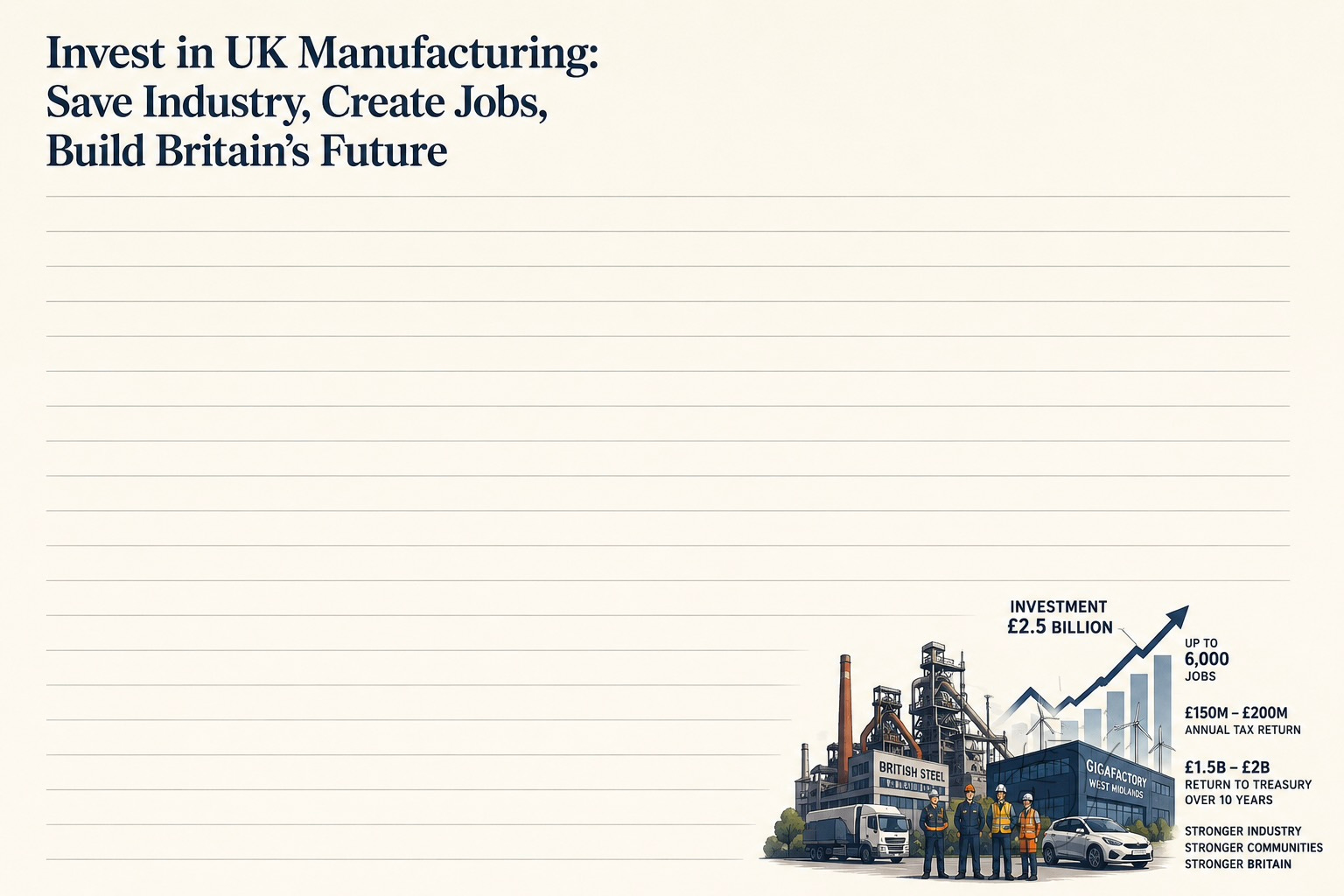
Keir Starmer may well have announced he was going to nationalise British Steel to save his own political skin. The honest answer is simple, who cares, if his current dilemma benefits British manufacturing? Prime Ministers rarely act because they are struck by some noble flash of wisdom. They act because events corner them. Voters grow restless, backbenchers circle, markets twitch, the press sharpens its tone, and history starts tapping its foot. If saving British Steel is partly an act of political survival, then good. Let us frighten the wits out of Prime Ministers more often.
Because the real question is not whether Starmer has stumbled into industrial policy under pressure. The real question is whether Britain can turn this rescue into something more than another temporary patch on a failing national jacket. British Steel matters. Scunthorpe matters. Steel matters. A country that cannot make its own steel has given up something deeper than a balance-sheet item. It has surrendered capacity. Steel runs through rail, defence, construction, energy, automotive supply chains, and the basic ability of a serious country to make serious things.
But saving British Steel cannot be the strategy. It is the emergency response. Dragging the fire engine to the factory gate after the roof has caught light is necessary, but it is not a plan. The better question is this. If government can find hundreds of millions to prevent collapse, why can it not find the discipline and imagination to build before collapse becomes inevitable? The figures already tell their own story. Support running into the hundreds of millions, potentially into the billions, simply to keep the lights on. Necessary, perhaps, but defensive. Money spent to stop something dying, not to build what comes next.
And this is where the Treasury consistently misreads the country. It sees the cost clearly and barely sees the return. A manufacturing job is not just a wage, it is a fiscal engine. Take a skilled worker on £40,000 a year. Strip it back to something realistic. Income tax and employee National Insurance will take roughly £7,000 to £8,000 straight back to the Treasury. The employer then adds their own National Insurance contribution, likely in the region of £4,000 to £5,000. Before that worker has even spent a pound, the Exchequer is already receiving something around £11,000 to £13,000 a year in direct taxation linked to that one job. Now look at what happens next. That worker spends. Rent or mortgage, food, fuel, car payments, repairs, a pint, a haircut, a bacon sandwich from the local café. That spending carries VAT and other duties, and it sustains the income of other workers who in turn pay their own taxes. It is entirely reasonable to estimate that another £4,000 to £6,000 a year flows back to the Treasury through indirect taxation and the wider activity that spending supports. Put it together and a single £40,000 manufacturing job can realistically return something in the region of £15,000 to £18,000 a year to the public purse.
Now multiply that properly. A factory employing 6,000 skilled workers is not a burden on the state, it is a revenue engine. On those assumptions, payroll-linked taxation alone moves towards £90 million a year. Add indirect taxation from spending and you are comfortably into nine figures annually flowing back to the Treasury from one site and its immediate economic footprint. Stretch that over a decade and you are looking at around £1 billion returned from the workforce alone, before you even touch corporation tax, business rates, exports, or supply chain activity. And that supply chain is not abstract. It is the toolmaker, the logistics firm, the maintenance contractor, the training provider, the software supplier, the café selling bacon sandwiches at seven in the morning, the pub on a Friday night, the small engineering firm down the road picking up overflow work. Every one of those transactions carries tax. Every one feeds back into the system.
Now strip all of this back even further, the way a business would look at it. Take the proposed West Midlands gigafactory. Around £2.5 billion in investment. Up to 6,000 direct jobs. On cautious assumptions, those workers alone are returning roughly £96 million a year to the Treasury. Over ten years, that is just under £1 billion back from payroll-related taxation alone. Add the wider ecosystem, supply chain firms, local services, secondary employment, and it is entirely reasonable to see that figure rise towards £150 million to £200 million a year in total tax flows. Over a decade, you are now looking at £1.5 billion to £2 billion coming back to the Treasury from a £2.5 billion investment. Extend that to fifteen years, and the state is no longer subsidising anything. It is recovering its capital and moving into net gain.
Now compare that with British Steel. Support is already running into hundreds of millions, with projections that it could move towards or beyond £1.5 billion simply to keep the operation viable. That matters, because once steelmaking is gone it is extraordinarily difficult to bring back. There is real value in preserving that capacity. But financially it behaves differently. If British Steel supports a few thousand jobs, those workers may still return £50 million to £70 million a year in combined taxation, with more through the supply chain. That is valuable, and losing it would be costly. But the spending itself is defensive. It prevents loss. It does not create a new stream of growth. The comparison is unavoidable. Spending £1.5 billion to preserve steel protects an existing economic base and prevents a collapse. Spending £2.5 billion on a gigafactory builds a new economic base that can return £150 million to £200 million a year and anchor an entire future industry. Put crudely, and this is the part the Treasury never says out loud, spend £1 billion trying to hold decline in place and you slow the bleeding. Spend £1 billion building modern industry and over time you can get £1.5 billion or £2 billion back while rebuilding skills, supply chains and national capability. That is not ideology. That is arithmetic.
And once you see it clearly, the argument changes. The West Midlands is not starting from scratch. Nearly 280,000 manufacturing jobs still sit in the region. This is not a museum piece waiting to be rediscovered. It is a foundation that has been allowed to shrink below its natural weight. Which brings us, uncomfortably, back to the Midlands past. Derek Robinson, known as Red Robbo, became a symbol of an era when British industry was tearing itself apart. I knew that world. I was the money steward for the AUEW Small Heath 2 branch, where he was a member, part of what is now Unite the Union. And in one sense, he was right. When factories close, they do not politely reopen. Skills scatter. Apprenticeship chains break. Supply networks dissolve. Communities lose not just wages, but identity and confidence. Industrial capacity does not return on demand. But British Leyland showed the other side, weak management, poor quality, bad design, political panic, a national argument playing out on a production line, and then the Austin Allegro, a symbol of getting the future wrong.
That is the warning, and it is a serious one. The lesson is not that the state should never invest, it is that public money must build the next Mini, not preserve the next Allegro. If public money is being used, the question must be brutally simple and answered honestly. Are we building the future, or are we subsidising the past? This is why the answer cannot come from one tribe alone. Not just politicians, not just civil servants, not just unions, not just economists. It has to be forced collaboration, workers, engineers, economists, colleges, civil servants, politicians, local leaders, all in the same room, none dominant, each bringing the piece the others lack. Because Britain has tried the alternatives, leaving it to the market, handing it to Whitehall, allowing industrial relations to dominate, outsourcing thinking to consultants, and the result is what we see now, a country unbalanced, over-reliant on London, and repeatedly surprised when industrial capacity disappears.
Even the old political dividing lines do not hold up when you look at them closely. Margaret Thatcher acknowledged that Britain could not live by services alone, however much the caricature says otherwise. Keith Joseph argued for competitiveness and productivity, not the abandonment of industry. Michael Heseltine understood that regions cannot simply be left to manage their own decline and that government has a role in rebuilding economic capacity. And Red Robbo, for all the headlines and mockery, understood something just as important, that once you let industry go, you lose more than jobs, you lose capability, confidence and control.
The failure of modern Britain is not that one side won. It is that we took the harshest parts of each argument and forgot the useful ones. The Midlands now needs the useful part, and it needs it quickly and at scale. Steel, yes, but not just steel. Battery plants, rail manufacturing, grid equipment, heat pumps, defence supply chains, precision engineering, advanced materials, these are not optional extras or political talking points, they are the skeleton of a functioning economy, the difference between a country that makes things and one that simply consumes what others produce.
So yes, good on Keir Starmer if British Steel is saved, even if the motive is survival, even if the timing is panic, even if the conversion to intervention comes only when the alternative becomes politically unbearable. Good. Now do it properly. Do not just nationalise the losses and call it strategy. Industrialise the recovery. Build the capacity that pays back. Listen to the people who still know how to make things, cut, weld, wire, cast, assemble, test, repair, because they are not an echo of the past, they are the foundation of the future.
The Midlands does not need a museum of its industrial history, however proud that history may be. It needs a manufacturing future that is just as real, just as productive and just as confident. And after decades of managed decline, of drift, of hesitation, of half-measures dressed up as strategy, it might be time to admit something quietly obvious but politically uncomfortable.
You cannot build a serious country if you no longer know how to build.
Great read. Manufacturing, local food production, cottage industries. Our youth lack their own value, work used to give both value & purpose - a way to earn, to fund a life, a family, a way of being, a feeling of offering a service to the country, to your folk. I used to believe in 'Universal Basic Income' - not anymore. There is nothing better than earning your own bread & beer - it always tastes better, lasts longer. There are our countryfolk who may need the dole / benefits, of course. But we have written off too many of our young men & women, consigned to 'earning' on TikTok for a while - feeling little value, little purpose, no service, no future. Hands, minds & spirits are for more than scrolling, and when combined & expressed, folk like Robert Owen, Emily Hobhouse, James Watt & William Blake rise
Excellent piece