

Khalid Mahmood Has Asked the Question. Where Are Our MPs?
A record 230 people on one inflatable has turned the Channel argument on its head. Khalid Mahmood asks whether France’s duty to protect life should now be tested.

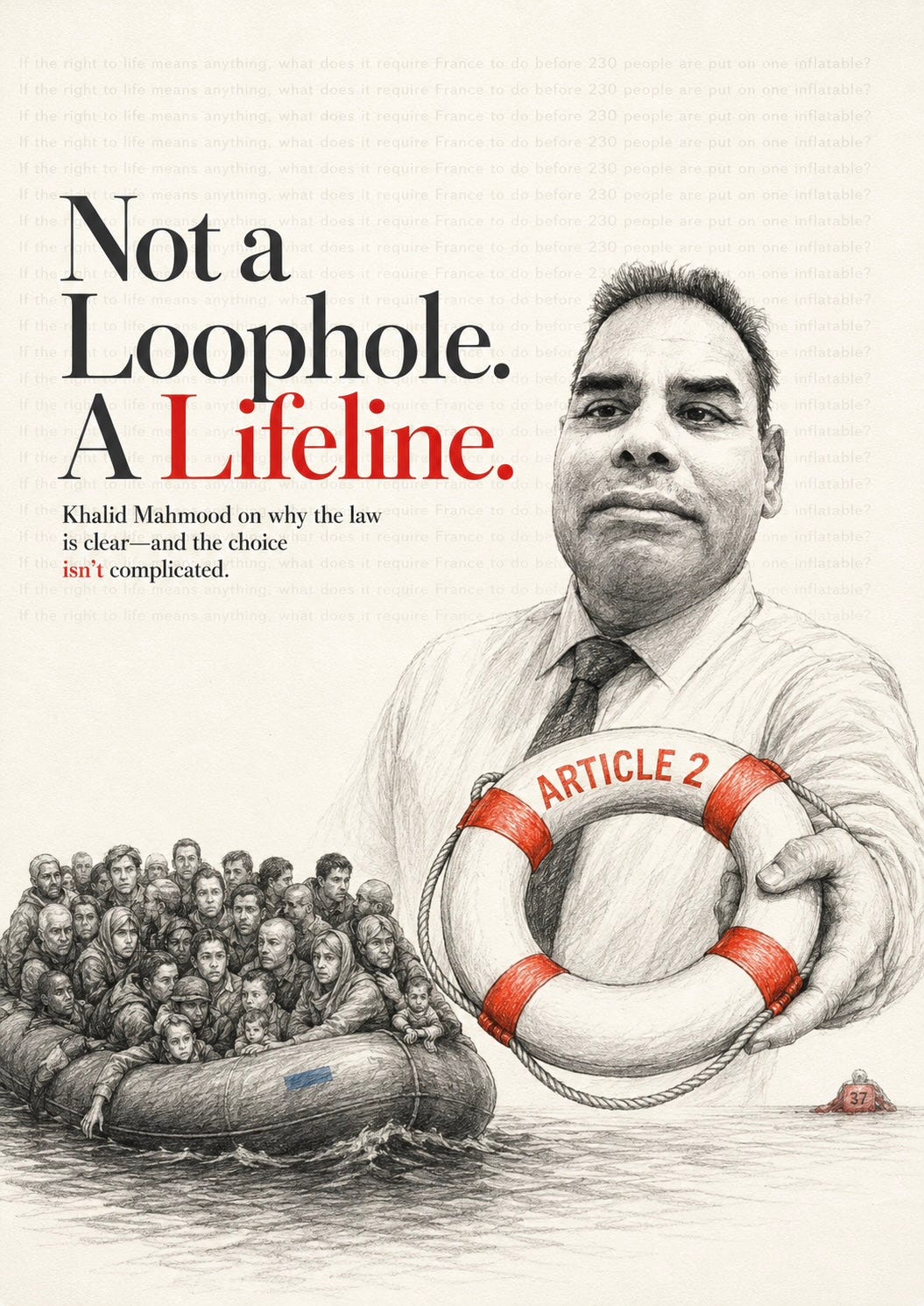
Two hundred and thirty people. One inflatable boat. The English Channel. You do not need a master mariner’s certificate, or much more than a functioning pair of eyes, to suspect this is not an entirely satisfactory passenger to rubber ratio. On 10 August, 230 people arrived in Britain in a single small boat, a record. The total so far this year remains well below the annual record set in 2022, so I am not predicting that record will be broken. But the smugglers have changed the mathematics. If fewer boats get through but vastly more people are crammed into every one that does, success measured simply by counting boats can become a dangerous illusion. At 230 people a boat, only 132 more boats carrying that number would be enough to push this year beyond the previous annual record. One such boat a day between now and New Year would do it comfortably. I am not suggesting that will happen. I am suggesting that when your response to enforcement is to put hundreds of human beings onto what remains, fundamentally, an inflatable, the safety problem has become rather more serious than a convenient statistic about fewer boats.
Which brings me to Khalid Mahmood. Khalid represented Birmingham Perry Barr as a Labour Member of Parliament for more than twenty years and, after hearing him raise this on television, I spoke to him myself. His point is wonderfully simple. We have spent years being told what the European Convention on Human Rights (ECHR) supposedly prevents Britain from doing about people who have crossed the Channel. Khalid asks what that very same Convention requires France to do before they cross it. If French authorities know that dozens, and now apparently hundreds, of people are being packed into unsuitable inflatables and sent into one of the busiest shipping lanes in the world, what responsibility does France have to protect their lives? It is a candid question, an awkward question and, best of all, an original one. Khalid is not even a Member of Parliament now, which rather raises the question of what some of those who still are have been doing with all that thinking time.
I should declare my own formidable credentials in European human rights law. I once worked in the law, mainly in personal injury and, if we are being candid, towards the more ambulance chasing end of the trade. I never studied European law at university. I do remember the European law lecturer, but chiefly because she was rather dishy, which probably tells you everything necessary about the academic rigour I brought to Strasbourg jurisprudence. So rather than declaring France guilty from my armchair, I did what any rusty former legal practitioner ought to do. I looked it up. Article 2 of the European Convention on Human Rights protects the right to life and the European Court of Human Rights has long recognised that governments can have positive obligations to take reasonable steps where authorities know, or ought to know, of a real and immediate risk to life. That does not make governments guarantors of everybody’s safety and there are difficult questions about jurisdiction once a boat is at sea. But while people are standing on French soil, gathering on French beaches and climbing into boats from France, asking what France reasonably ought to do to protect them is hardly an eccentric proposition.
Indeed, Khalid has not suddenly invented a peculiar Birmingham interpretation of European law. In 2021, Rob Jones of the National Crime Agency (NCA) told Parliament that its biggest concern was a mass casualty event in the Channel and said that everything it did was driven by an “Article 2 responsibility”. Five years later we have reached the extraordinary spectacle of 230 people aboard one inflatable. So the connection between the right to life and Channel safety is hardly novel. What Khalid has done is turn it around. If Britain recognises an Article 2 responsibility when dealing with the danger, what responsibility rests upon France while these people are still within French jurisdiction and before the boat becomes Britain’s problem?
There is even a legal mechanism by which governments can test questions of this kind. Article 33 of the Convention permits one signatory state to bring a case against another before the European Court of Human Rights. That does not mean ministers should be dispatching a fleet of barristers to Strasbourg tomorrow morning. It means there is a perfectly respectable question for the British Government to answer: has it obtained legal advice on France’s positive obligations under Article 2 in relation to dangerous Channel departures, and has the possible use of Article 33 ever been seriously considered? After years of politicians arguing that the answer to Strasbourg is to leave it, there would be a certain charm in discovering that one answer to the Channel problem might actually be to use it.
And now to the bit closer to home. Parliament currently has 37 Labour Members of Parliament across the West Midlands region. Each is paid a basic parliamentary salary and, quite properly, has public money available to employ staff and run a constituency office. The Independent Parliamentary Standards Authority (IPSA) sets those arrangements. Put the current salary, maximum outside London staffing provision and maximum office costs together and the core publicly funded parliamentary operation comes to more than £400,000 per Member. Across those 37 West Midlands Labour Members, that is more than £15 million a year before other legitimate costs such as travel and accommodation are considered. Before anybody reaches for the smelling salts, that is emphatically not £15 million being stuffed into Members’ pockets. Most of it employs people, pays for offices and makes parliamentary representation possible. Quite right too. Democracy costs money. But if taxpayers are putting more than £15 million of parliamentary machinery around one political party’s Members in this region, I do not think it unreasonable occasionally to ask whether thinking is included in the package.
Our Labour Members of Parliament are not silent on immigration. They vote on it, speak about it, issue statements about it and disappear through division lobbies concerning it. My question is rather different. What ideas are they originating? Which of them has looked at the Channel problem and asked something that did not already appear on the party briefing sheet? Which of them is prepared to make their own Government uncomfortable by asking whether Khalid Mahmood has identified something worth pursuing? A Member of Parliament is supposed to be a representative, not merely lobby fodder with a constituency office attached. We elect individual human beings because every now and again we might reasonably hope to benefit from the contents of their heads.
Perhaps Khalid is wrong. Fine. Let the clever human rights lawyers tell us why and then at least we will know. France may be able to demonstrate that it is already taking every reasonable measure the Convention requires, or the jurisdiction arguments may defeat the proposition entirely. That is what legal advice and courts are for. What I find harder to accept is that 230 human beings can be packed onto one inflatable and sent across the English Channel while the political response remains another recital of the same phrases we have heard for years. This is not an argument for being hard on migrants. Quite the opposite. It is an argument about protecting their lives.
Khalid Mahmood thought to ask the question. He no longer draws a Member of Parliament’s salary and no longer occupies a green bench in the House of Commons, yet he has managed to turn the whole human rights argument through 180 degrees and pose something worth answering. There are 37 Labour Members of Parliament across the West Midlands and more than £15 million of core parliamentary machinery around them. Surely one or two can get behind him.
Or are we about to hear the rustle of 37 parliamentary duvets being pulled a little higher?