

Knocking Doors and Breaking Through: Hugo Rasenberg’s Harborne Push
At 21, Hugo Rasenberg has already done the rounds, campaigns, defeat, and digital reach most candidates never grasp. In Harborne, he is not just standing. He is building.

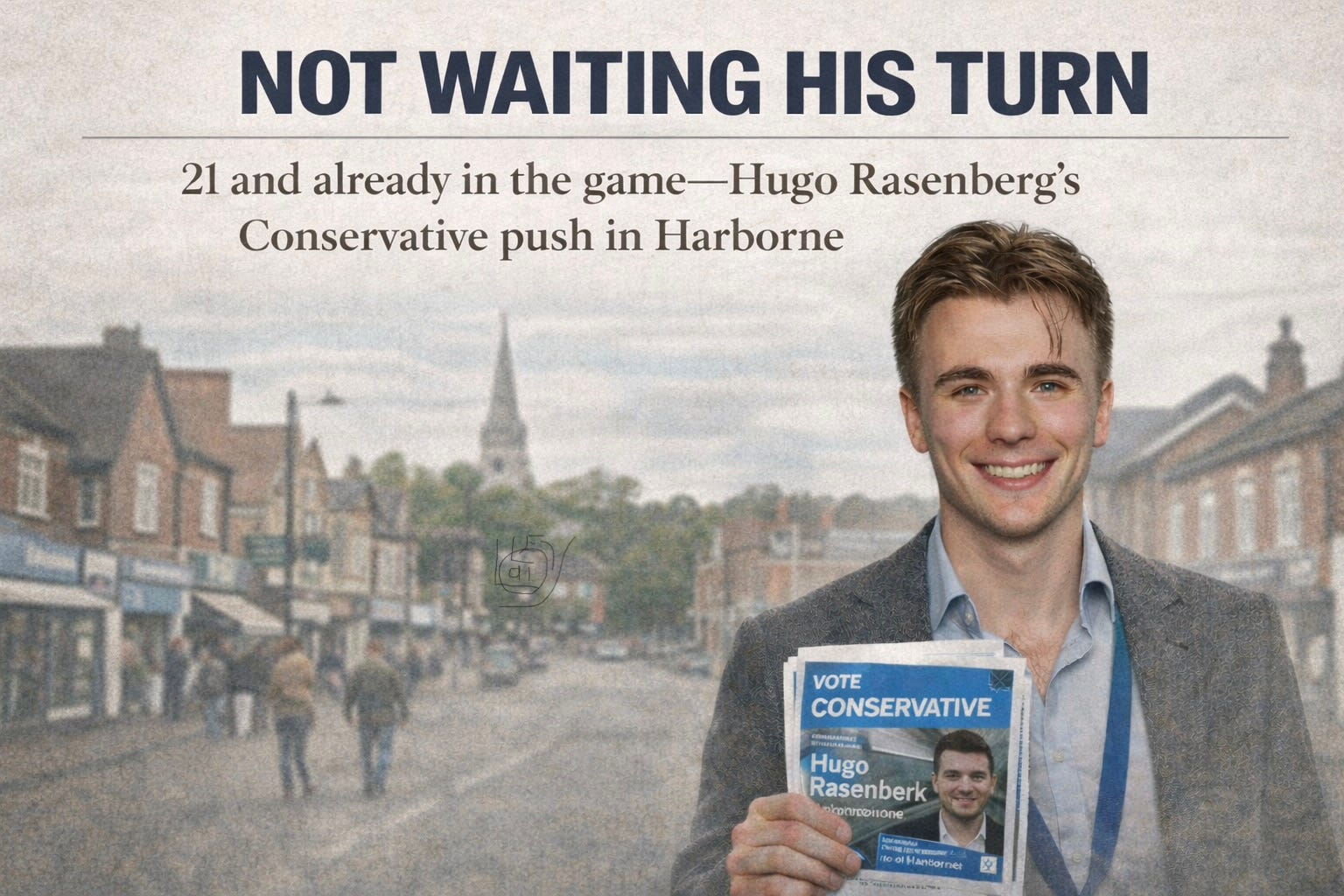
There is something faintly improbable about meeting a 21-year-old who speaks about ward-level campaigning with the weariness of a veteran and the metrics of a digital strategist. Yet that is precisely where Hugo Rasenberg sits, somewhere between political enthusiast and fully formed operator, already shaped by defeat, persistence, and the quiet grind of local politics. He is standing in Harborne for the Conservative Party in the May 2026 elections, but his story does not begin in Birmingham. It begins, more tellingly, on a school bus in High Wycombe.
At eleven years old, Hugo had a question read out publicly at a school event chaired by John Bercow, at the time both a sitting Member of Parliament and, more importantly, the Speaker of the House of Commons. The question itself cut through the room with a clarity that belied his age: why could teenagers not vote in the referendum when it was their future at stake? It drew amusement, as such moments often do, a child asking an adult question in a room not quite ready to answer it. But that moment matters. It sits there as an early signal. Because while others moved on, Hugo did not. He was already tuning into the Today programme on the bus, not out of boredom, but because his education came easily and left him with time. Time that might have been wasted elsewhere was instead spent absorbing political debate, listening closely to James O’Brien on LBC, not passively, but with intent. This was not a passing interest. It was the early formation of something more deliberate.
His early schooling, by his own admission, was not marked by discipline. An all-boys environment, plenty of energy, little direction. The usual distractions filled the gaps, not because he lacked ability, but because he had not yet found where to place it. That changed in sixth form. Something sharpened. He describes it as stepping into adulthood early, a moment where the drift stopped and focus took hold. The studies followed, the results improved, and good A-levels were achieved not by chance, but by application. It was the first real indication that the earlier restlessness had simply been misdirected energy rather than lack of capability.
By the time most students arrive at university still adjusting to independence, Hugo had already begun building something resembling a working life. At sixteen, he joined the Conservatives, but more significantly secured a short-term internship with Joy Morrissey. It was not a grand title or a long posting, but it was a foothold, and an unusually early one. From there came the now familiar introduction to local party life, fish and chips events, rooms dominated by older members, and the quiet decision to engage rather than withdraw. He set up a Young Conservatives branch, undertook further work experience, and secured a paid role with a sustainable development company whose message was rooted less in ideology and more in practical economics, turn the lights off, save money. By the time he arrived at the University of Birmingham, studying politics, social policy and economics, he was not approaching the subject as theory. He had already seen its application.
University, for Hugo, was not a retreat into academia but an extension of activity. He found the academic side manageable, which freed time for what he clearly preferred, campaigning. It was through this that he came into contact with Andy Street, and from there, an unexpected turning point. A direct call. An invitation to join the mayoral campaign team. The work was demanding, forty to fifty hours a week, modestly paid, and largely unglamorous, but it provided something far more valuable, immersion. Six months inside a major regional campaign is not something many 20-year-olds experience. He did, and by his own account, he absorbed everything. When the campaign ended in defeat, it hit him hard. Not disappointment, but devastation. The distinction is telling. It reflects investment, not detachment.
What followed was less structured, but perhaps more revealing. With the campaign over, he needed to sustain himself. So he turned to what he had, contacts, skills, and persistence. He began producing video content for Conservative councillors, reaching out directly, building work incrementally. It was not glamorous, but it worked. All of this ran alongside his university studies, a balancing act that would stretch most students, but which he seemed to absorb into his routine. Eventually, this led to a more stable role with Founders Makers, a firm specialising in social media and HR content, a natural progression for someone already fluent in the language of digital reach.
His selection as the Conservative candidate for Harborne in December 2024 marked a clear transition. By March 2025, he had formally launched his campaign outside the Royalty Cinema, drawing media attention and assembling a sizeable group of activists. Since then, the work has been sustained and methodical. Thousands of doors knocked, repeated engagement, visibility built not in bursts but through consistency. He speaks of being recognised in the street, drivers stopping, conversations beginning before introductions are made. Whether anecdotal or indicative, it points to presence, and in local politics, presence matters.
Alongside this, his campaign has developed a significant digital dimension. In the last 90 days, he reports 820,000 unique Facebook views, with a single post relating to graffiti removal reaching 600,000 after council inaction. He was notably keen to demonstrate the figures, producing them repeatedly, not as boast, but as proof. And on inspection, they hold. This is not wild exaggeration. On Twitter, now X, he cites one million views within a week. For a ward-level candidate, those figures are not incidental. They reflect an understanding that modern campaigning operates as much through screens as it does on pavements.
Looking forward, his ambitions extend beyond simply winning a seat. He speaks of structural change, beginning locally but with broader implications. Central to this is the idea of a community development company for Harborne, structured as a credible CIC, with local backing and endorsement from Andy Street. It is, by any measure, ambitious, perhaps overly so for a first-term councillor, but it signals intent. Not merely to participate, but to shape.
There is a temptation to dismiss Hugo Rasenberg as another young political hopeful. That would be a mistake. He is not drifting into politics. He has been moving towards it, deliberately, for years. He has already experienced the early cycle, curiosity, discipline, exposure, defeat, recovery, and now candidacy, all by the age of 21. If he does not secure election in Harborne this time, it will not be through lack of effort or commitment. He has approached the ward with an intensity that many more experienced candidates struggle to sustain. There is also, increasingly, a sense of genuine connection to the area, built not through rhetoric, but through repetition and presence.
Win or lose, he is not the finished article. But he is clearly an emerging one. And in a political environment where endurance is often in short supply, that alone may prove to be his most valuable asset.
That is very interesting. It's a long time since I came across a dedicated Conservative. He might well disturb the other right wingers.