

Knocking Doors While Everything Unravels
Labour candidates are knocking doors, but the bin strike, rising agency spending and growing internal tensions are telling a very different story.

The Script Isn’t Working Anymore
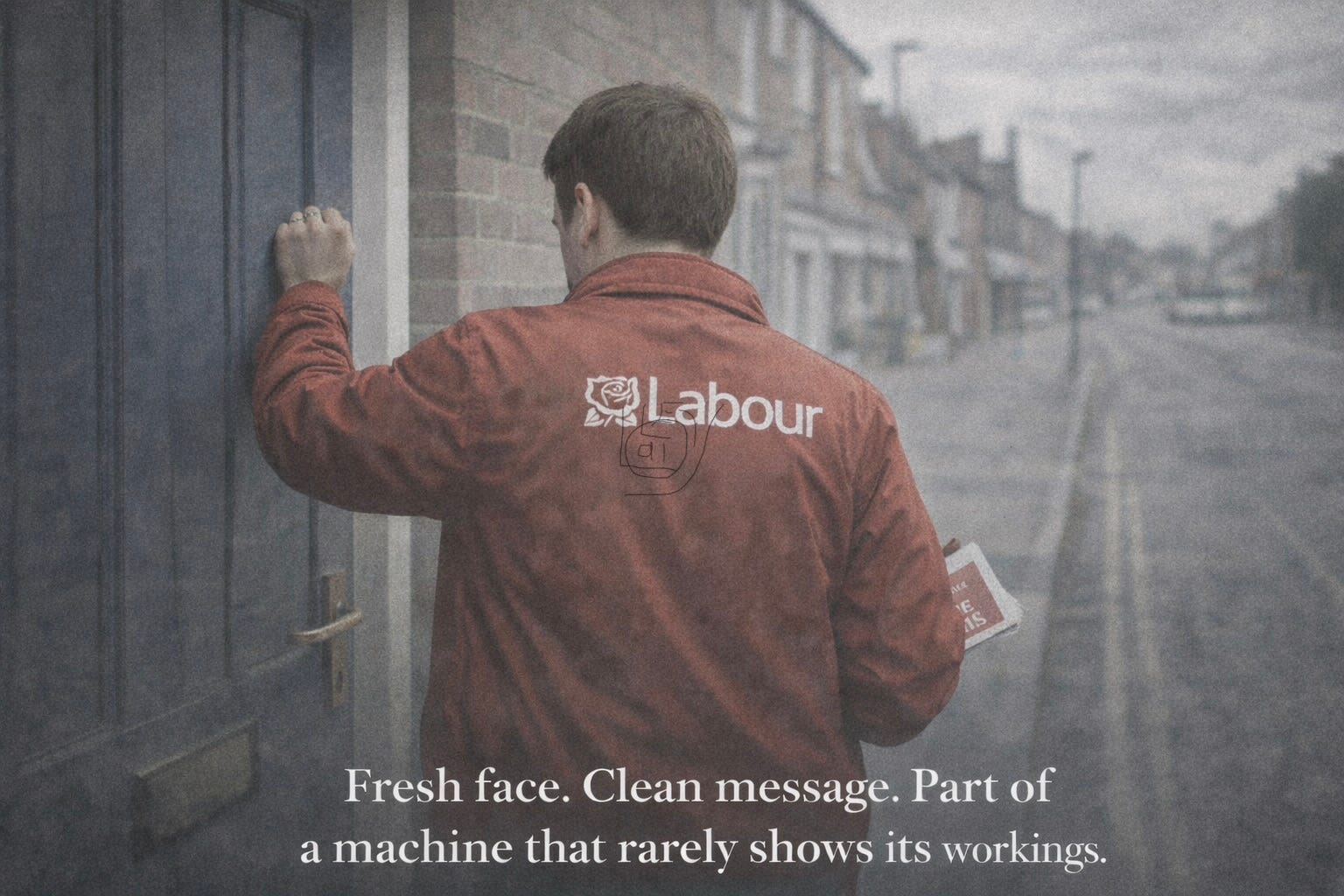
There is a moment, just after the door opens, when everything pauses. It only lasts a second, maybe two, but it is long enough to feel whether what you are about to say will land or whether it will drift past unheard. I have stood in that moment more times than I care to remember, knocking doors, delivering the line, doing what Labour people have always done, and perhaps that is why, looking at this election now, I find myself quietly relieved that I no longer have to.
This is not just another round of local elections in Birmingham, it is a campaign being fought under pressure, where Labour candidates are being asked to defend decisions they did not always shape, explain problems that have not been resolved, and persuade voters to trust a story that is becoming harder to hold together with each passing week.
Because once you have done it yourself, once you have stood on those steps with the leaflet in your hand and the argument in your head, you know exactly how it works. You begin with stability, with responsibility, with the careful language of difficult decisions taken in difficult times. The lines are not accidental, they are prepared, refined somewhere deep within the machinery of Birmingham City Council, and increasingly echoed and reinforced by the wider apparatus of the Labour Party itself, shaped by professional political operators and career administrators whose role is to maintain message discipline rather than reflect local nuance. These are not always the visible figures at the top, not the well-known strategists whose names occasionally surface, but the quieter, largely unseen layers of the organisation, the permanent machinery that drafts, adjusts and circulates the language that candidates are expected to carry. Most of the time, you do not know who they are, and that is part of the point. The system functions as a machine, and the machine endures. Those who prepare these lines will still be there long after the votes are counted, another councillor in, another councillor out, another script adjusted and delivered, while the candidate is left to carry the weight of it as though it were entirely their own.
At first, it works. It always does. There is a rhythm to campaigning, a familiarity in the exchange, a sense that if you hold your ground and deliver the message clearly enough it will land somewhere. But then the questions begin to change, not dramatically, but enough to unsettle the flow. Why is the bin strike still dragging on? Why does it feel as though nothing is being resolved? Why, if everything is under control, does it not look that way from the street outside?
And it is precisely when that carefully constructed language meets the harder edge of reality that the strain begins to show. The spending on agency staff has risen sharply as the dispute has hardened, not drifting or fluctuating, but rising in step with the conflict itself in a way that is difficult to separate from the strike it is said not to be replacing. The explanation is always there, carefully worded, technically sound, but the pattern is visible, and once seen it becomes difficult to dismiss. And that is before you confront what it actually represents, because Labour was never meant to be the party that replaces its own workforce with insecure labour in order to sustain a dispute. It was meant to stand with workers, not manage them, not sidestep them, and certainly not spend heavily over a protracted period to wear them down. Agency work, by its nature, offers no security, no long-term future, no real protection when things go wrong, and yet here it is being expanded in the middle of an industrial conflict as though it were simply another operational tool. You do not need to dress that up in legal arguments or financial categories to understand how it looks. To many, it appears as though Labour is doing the work that employers have always done, holding the line against its own workforce, using public money to outlast them, and hoping that, eventually, they will give way. That is not a comfortable position for a party built on the idea of solidarity, and it is one that sits uneasily, however carefully it is explained.
That discomfort only grows when you look beyond your own campaign and see the bin workers themselves out there, visible, organised, speaking directly to the same residents. This is not passive support, it is active, targeted campaigning, and it is directed, quite deliberately, at Labour councillors and Labour candidates. They have resources, they have structure, and they have something far more powerful than either, a base of striking workers, their families, their friends, and a wider network of political supporters who are motivated, engaged, and willing to act. I have been part of campaigns where getting a dozen people out felt like strength, where that level of turnout carried energy and presence. Now you look across and see that doubled, sometimes more, and you understand instinctively that this is not the kind of campaign you would choose to have against you, particularly not when the wider polling position of Labour is already under pressure. This is organised, visible resistance, meeting you on the same ground, speaking to the same voters, and doing so with a clarity and conviction that cuts through the carefully balanced language you are trying to maintain.
So you move the conversation on, as you must, into the bigger picture. Regeneration. Growth. The future of the city. You point, quite reasonably, to developments such as Paradise Circus, Perry Barr regeneration scheme and Smithfield Birmingham as evidence of ambition and progress. These are the flagship schemes, the ones meant to define Birmingham’s future, and yet they now carry with them a different set of associations, rising costs, widening gaps, figures that no longer feel settled. None of this rests solely with the current leadership, these are long-running projects with deep roots, but that distinction offers little comfort when you are the one standing there being asked to explain where the money has gone and what it is all delivering.
And just as you begin to steady that argument, the conversation drops back down to ground level again, to the things people encounter every day. Potholes. Roads left unrepaired. The small but constant irritations that tell their own story about how a city is functioning. Again, there are explanations, there are always explanations, funding constraints, weather, maintenance cycles, all entirely logical, all perfectly defensible, until you are standing in front of someone who simply wants to know why nothing has been done.
It is at this point that the accumulation becomes impossible to ignore. The strike. The spending. The developments. The condition of local services. Each one manageable on its own, each one capable of explanation, but together forming something heavier, something that feels less like a series of isolated issues and more like a pattern.
And then there is the part of the story that rarely gets said out loud, but which sits quietly underneath everything else, the way candidates themselves now come to be standing on those doorsteps in the first place. There was a time, not so long ago, when local Labour parties selected their own candidates, when those who knew the ward, who had worked in it, who had built relationships over years, had a real say in who would represent them. That process was not perfect, nothing ever is, but it carried with it a sense of ownership, of local democracy, of decisions being made by those who understood the ground.
Selection as a Labour Party candidate is now, in many cases, increasingly shaped by full-time party officials rather than rooted local membership, individuals tasked with ensuring candidates are in place across vast numbers of seats, often operating to tight timelines and central expectations rather than the character or needs of any one ward. These officials may only occupy such roles for a short period, a year or two, before moving on, yet during that time they exercise significant influence over who is deemed suitable to stand. The process is frequently mediated through a small circle of trusted local figures, but that does not remove the reality that decisions are being shaped away from the wider membership, and it is not unknown for personal preferences, alliances, or less generous motivations to determine outcomes. Good councillors, well regarded in their communities, can and do find themselves removed without meaningful local challenge, not because they have failed, but because, for whatever reason, they no longer fit.
That contradiction does not disappear just because it is not spoken.
And layered on top of all of this is a broader unease about where the party itself now stands. Labour was never just an administrative machine, it was an expression of alignment, a clear statement of who it represented and why. That clarity feels less certain now. Whether it is a kind of self-absorption at the top, or a belief that the old loyalties no longer need to be tended in the same way, there is a growing sense that the connection to its working roots has been loosened, not necessarily by design, but by drift, by distance, by a failure to notice what is changing on the ground.
You do not need to spell it out to understand where this leads, because what is happening here does not end with the council elections. It moves beyond them. Labour MPs, particularly across Birmingham and the wider West Midlands, should be looking at this very closely, because the same tensions, the same perceptions, the same questions are already beginning to take shape at a national level. Seats that once felt secure may not feel that way for much longer. It is no longer unrealistic to suggest that more than half of the current Labour MPs in the city could be at risk if this trajectory continues, and across the West Midlands the figure could be higher still. The question is not whether they can see it, but when they will choose to act on it. Will they continue to stay quiet, to hold the line, to support a position that many voters increasingly question, or will they recognise what is unfolding and respond accordingly? Because once the May council elections pass, the immediate campaign may end, but the consequences will not. What follows may feel less like a recovery and more like the beginning of something darker.
And so the candidates continue, because they must, moving from house to house, holding the line, delivering the message, doing the work that campaigning has always required. But beneath that steady rhythm there must be moments, however brief, where the distance between what is being said and what is being felt becomes harder to ignore, where the script begins to feel less like a guide and more like something that no longer quite fits.
Because in the end, this is not simply a difficult election. It is something else, something heavier, something that does not resolve neatly once the votes are counted. It is the sense that the ground has shifted, that the connection has weakened, that the argument no longer carries in the way it once did.
And when the results come in, and the immediate noise fades, what may be left is not clarity, but a quiet, uneasy realisation.
Not a new dawn.
A darker one.
An interesting, clear perspective on the predicament the Labour Party finds itself in - largely in my opinion a position they created. They simply cannot take responsibility, evasion and "spin" instead. "Head in the sand" comes to mind.
The electorate - not just in B'ham - I expect simply want to give all the political parties a good, non-physical "kicking".