

Labour Chaos as Birmingham Boss Ousted… Then Party Claims ‘Nothing’s Changed’
Labour loses control of Birmingham City Council in a dramatic late Tuesday vote, yet hours later insists nothing has changed, exposing a deeper crisis about who really holds power.

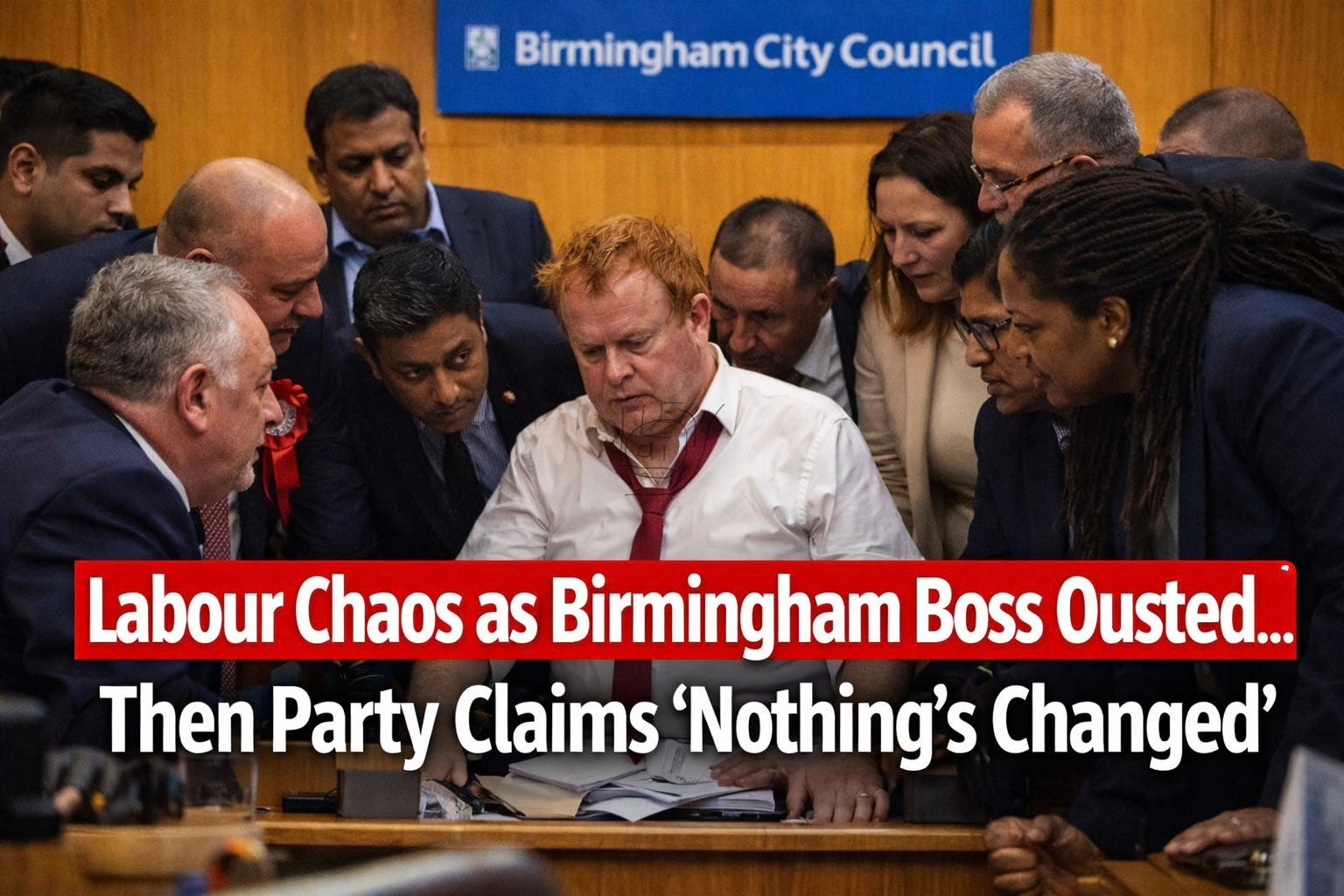
Late Tuesday afternoon, in full public view, Birmingham City Council witnessed something rare.
Not just a defeat.
Not just a leadership challenge.
But the visible collapse of authority inside the Labour Group.
And once it began, it moved with speed and precision.
The collapse was already underway
Speaking directly with Councillor Ewan Mackey, Deputy Leader of the Conservative Group, one point comes through clearly.
This did not begin on Tuesday.
Councillor Mackey describes a slow deterioration stretching back to January. Quiet conversations. Observations. Watching how difficult it had become for Labour to manage its own councillors.
Votes that should have been routine became strained.
Whips struggled.
Loyalty became conditional.
And gradually, unmistakably, the Labour Group began to fragment.
This was not a sudden ambush.
It was the final act of a slow collapse.
The chamber told its own story
As pressure built around Councillor John Cotton, the physical movement inside the chamber spoke volumes.
Labour councillors left their seats and gathered around him in a tight huddle.
Not confidence.
Containment.
Councillor Mackey is careful in his account. He does not count numbers, nor does he claim certainty. But the impression is clear, something was slipping.
And more telling still, there is a suggestion that some Labour councillors may not even have been present for the decisive vote.
That is not rebellion.
That is disengagement.
The test vote that sealed it
Before the decisive motion, there was a test vote.
Labour lost it.
That was the moment the outcome became inevitable.
Once authority is gone in a chamber like that, it does not return within the hour.
The opposition recognised it immediately.
A motion, not improvised but executed
The decisive motion was not improvised.
It was tightly controlled, prepared within the Conservative Group. Councillor Mackey makes the point plainly, no one outside the elected Conservative councillors was trusted to draft it.
It was held back.
Timed.
And then introduced at exactly the right moment.
But this must be said clearly.
This was not a Conservative victory alone.
Other opposition groups joined.
Councillors from across the chamber, including former Labour members, aligned in that moment.
This was a collective act by those no longer willing to sustain the status quo.
The charge sheet, laid out in full
The case against Labour was not rhetorical.
It was structured and sustained.
More than a decade of recurring failures.
Warnings raised repeatedly and ignored.
Budgets balanced “only on paper”, relying on reserves and one-off savings.
A growing dependence on reserves as a substitute for real financial discipline.
Equal pay liabilities consistently underestimated, with mitigation plans left incomplete, ultimately contributing to the 2023 crisis.
A failure to deliver large-scale transformation.
And industrial relations breakdowns, particularly in waste services, exposing deeper organisational weaknesses.
Most importantly, this was not framed as political opinion.
It was grounded in the findings of auditors.
A pattern.
Not an accident.
Councillor Cotton, and the question of legitimacy
Let’s deal with this plainly.
Councillor John Cotton is widely regarded as a decent man.
I share that view.
But here is the uncomfortable question.
Is decency, in itself, a qualification to run a council the size and complexity of Birmingham?
Because Birmingham is not a parish council.
It is one of the largest local authorities in Europe.
And it requires more than personal decency.
It requires authority.
And that is where the problem begins.
Not elected, but elevated
Inside the chamber, and among those who have watched this unfold, there is a consistent understanding.
Councillor Cotton was not so much voted into leadership by the Labour Group as elevated into that position.
And the force behind that elevation was not internal consensus.
It was the Labour Party’s regional office.
At the centre of that sits Sam Donoghue, Regional Director of the Labour Party.
This is the critical point.
Leadership that comes from within a group carries authority.
Leadership that is shaped externally depends on compliance.
And compliance, as Tuesday proved, does not survive pressure.
Installed, then left exposed
This is the contradiction that defined the day.
Councillor Cotton was elevated into leadership through regional influence.
But when the moment came, that same structure did not hold the group together.
He was left exposed.
No firm mandate from his own councillors.
No unified backing.
No ability to command the room when it mattered most.
This was not simply a leadership failure.
It was a failure of how that leadership was constructed in the first place.
The small issue that triggered a larger revolt
At the centre of this sits something almost absurd in scale.
A relatively small financial issue, in the context of a council of this size.
And yet it triggered disproportionate consequences.
Councillors pushed to breaking point.
Some removed.
Others alienated.
What should have been manageable became destabilising.
That is not about the money.
That is about judgement, and control.
Why the opposition succeeded
The Conservatives led the move.
They prepared the ground.
They timed the intervention.
But they did not carry it alone.
Other opposition groups stepped in.
Former Labour councillors stepped in.
This was not a single-party manoeuvre.
It was a convergence.
And that is why it worked.
Labour’s response, denial in real time
And then came the response.
Posted publicly after the vote, Birmingham Labour described events in very different terms.
They called it “a cheap trick”, claiming it had “no implications for the leadership of the council”, and pointed to Conservatives, supported by Liberal Democrats and Greens.
At almost the same time, they insisted they were “carrying on with the job”, investing £130 million into frontline services “under the strong leadership of Councillor John Cotton”.
Pause on that.
Because this is where the story becomes almost surreal.
Late Tuesday afternoon, the Council had just passed a vote of no confidence in its leader.
And yet, hours later, the official line is that nothing has changed.
No implications.
Strong leadership continues.
That is not spin.
That is denial.
The problem with denial
Because politics can absorb defeat.
It can recover from mistakes.
But it cannot function if it refuses to acknowledge reality.
Councillor Cotton has lost the confidence of the chamber.
That is a matter of record.
To suggest otherwise is not messaging.
It is a refusal to engage with what just happened.
And that refusal points directly back to the deeper issue running through this entire episode.
Control without accountability.
Narrative without alignment to events.
The constitution says otherwise
There is another problem for Labour.
And this one was not raised quietly.
Councillor Robert Alden, Leader of the Conservative Group, was clear in drawing attention to it.
The Council’s own constitution is explicit.
A Leader remains in office until they are removed by a vote of no confidence passed by a simple majority.
That is exactly what happened on Tuesday.
Which leaves Labour in an increasingly difficult position.
Because if the constitution is to be taken seriously, this was not a political gesture.
It was removal.
And if it was removal, then the claim that nothing has changed does not hold.
The officers’ dilemma
But this does not stop at politics.
It now moves into the machinery of the Council itself.
Because someone has to decide what happens next.
That places Joanne Roney, Birmingham City Council’s Managing Director, in an unenviable position.
If Councillor John Cotton continues to act as though nothing has changed, is she to take instruction from him as Leader?
Or is she to follow the constitution, which appears to say that position has already gone?
This is not theoretical.
Elections are only weeks away, and current polling suggests two uncomfortable possibilities for Labour.
First, that Councillor Cotton may not retain his own seat, with Reform UK strongly positioned in several areas.
Second, that Labour itself may no longer be in control of the Council.
That sharpens the question considerably.
Because any decision taken now by senior officers is not just about today’s politics.
It is about what stands up in the weeks that follow.
And there is another layer.
If the constitutional position is clear, and it is not followed, there is a very real possibility that external parties, including ironically, trade unions, could seek to challenge decisions taken under a disputed authority, I can readily think of one such trade union.
That would move this from political theatre into legal territory.
For senior officers, that is not a comfortable place to be.
So the question becomes unavoidable.
Do you follow the individual who claims authority?
Or the framework that defines it?
The test of reality
There is, however, a very simple test of whether anything has changed.
Did Councillor Cotton leave the Council House in the Leader’s chauffeur-driven car?
Because if the vote of no confidence has the meaning the constitution gives it, then the office has gone.
And if the office has gone, so too have its privileges.
If, on the other hand, nothing has changed, as Labour insists, then the constitution itself is being treated as optional.
Either way, one question remains.
Which version of reality is Birmingham supposed to believe?
Final word
This was not just a vote of no confidence.
It was a moment of exposure.
A system that relied on control without cohesion was tested.
And it failed.
Late on a Tuesday afternoon, in plain sight.
And somewhere inside the Council, decisions are already being made.
Quietly.
Carefully.
And with careers very much in mind.
I think I'm on top of this as anyone could be and I'm clueless - looks like Labour are just ignoring matters and hope it all goes away. But it's not great optics ... for Labour
Great piece Mike