

Labour Promised a Heavyweight. Birmingham Got a Light-Middleweight
Labour sold Rachel Reeves as an economic heavyweight. Professor David Bailey offers a balanced verdict, but this old Birmingham businessman remains decidedly disappointed.

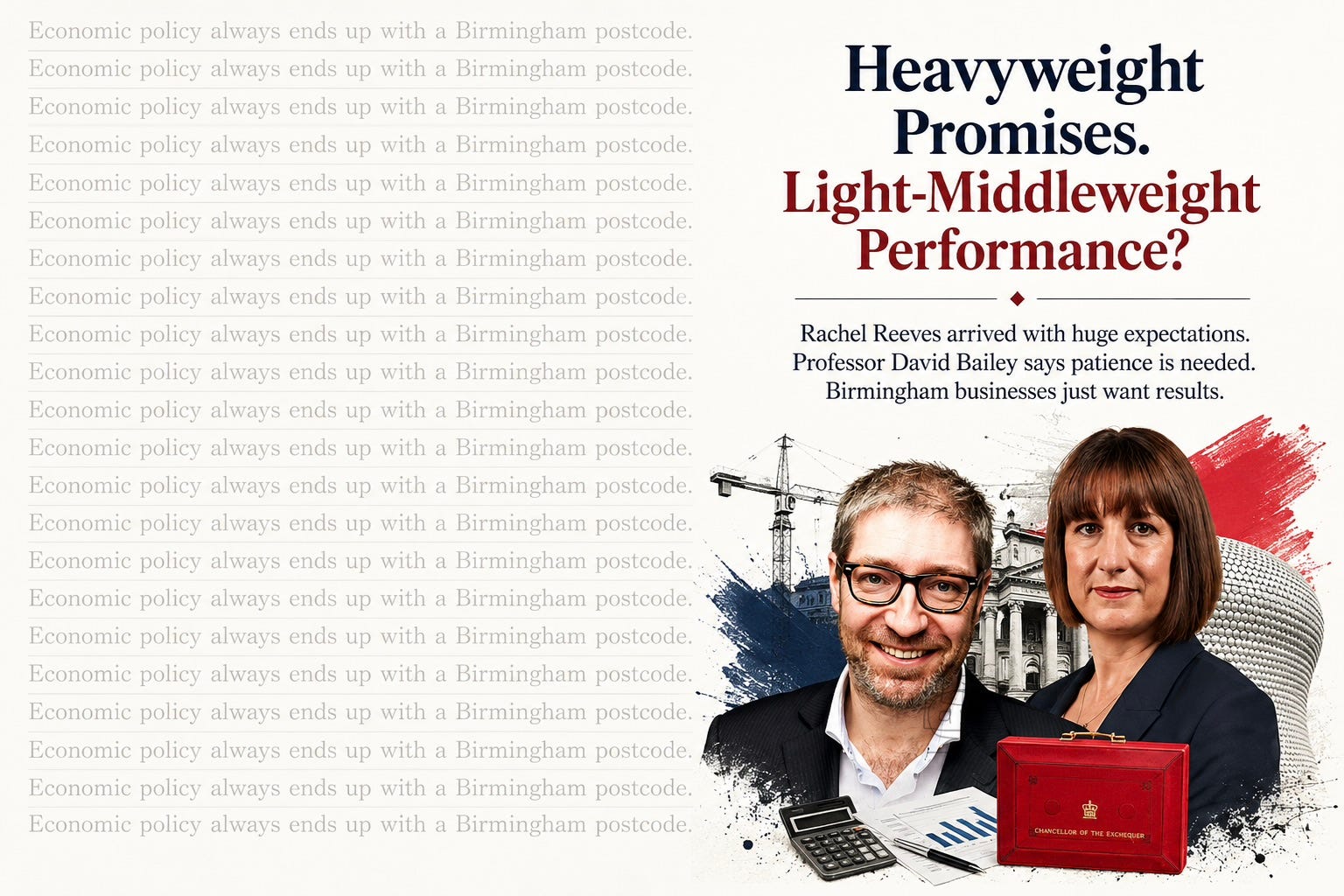
As a younger member of the Labour Party, I remember Rachel Reeves being talked about with reverence. Labour grandees assured us that here was the future: an intellectual heavyweight with the credentials and judgement to become a great Chancellor. The Bank of England (where she had worked) was always mentioned. It became shorthand for excellence, as though merely passing through its doors conferred economic genius. Perhaps it should only have been shorthand for having worked there. Prestigious institutions, like every workplace, employ people of differing abilities. Looking back, I cannot escape one blunt conclusion. Labour promised a heavyweight and, in my view, delivered a light-middleweight: technically trained and carefully coached, but never possessing the authority or punch we had been led to expect.
Naturally with the moving of PM Starmer to make way for Andy Burnham, Reeves will also be moving on. So how is she to be judged?
Perhaps I judge Chancellors differently because I once owned and operated an engineering works in the West Midlands in the 1980s. We had to make the payroll on a Thursday, not discuss it as an abstract entry on a Treasury spreadsheet. Once you have worried about finding the wages, watched an order book thin out and agonised over whether the business can afford another apprentice or machine, you never hear economic policy in quite the same way again. Decisions taken in Whitehall reverberate through Birmingham workshops, factories, cafés, hotels and small businesses. In Westminster they are fiscal adjustments. Here they decide whether somebody is recruited, whether investment proceeds and whether an owner sleeps on Wednesday night. Economic policy always ends up with a Birmingham postcode.
That is why Professor David Bailey’s assessment of Reeves interests me. Dave is Professor of Business Economics at Birmingham Business School, a leading voice on manufacturing and regional policy, and one of those rare academics who can explain difficult things without making everybody else feel stupid. His students have just given him a Students’ Choice Award, confirming what Birmingham already knows: he is one of our brightest and best-loved little academic gems. Dave approaches Reeves calmly. I approach her as an old engineering businessman muttering from ringside that the favourite still has not cut the mustard.
My disappointment was deepened by the damage to the constructed image of competence. Her book, The Women Who Made Modern Economics, was found to contain more than 20 examples of material drawn without proper acknowledgement from sources including Wikipedia and published sources. Reeves denied deliberate plagiarism, while her publisher accepted shortcomings and promised corrections. Then came the dog-eared CV. The length of her Bank of England service had been overstated online, and the description of her later HBOS work shifted from economist to retail banking. None of that alone proves somebody cannot run the Treasury. Taken together, however, it chipped away at the mythology Labour had built around her. “Rachel from Accounts” stuck because it resonated: less transformational economic titan, more machine politician with a spreadsheet and briefing note.
Professor Bailey is fairer. He believes Reeves’s strongest decision was to place planning reform near the centre of economic policy. Britain’s problem is not simply how much government taxes or spends; it is also that we have made it painfully difficult to build homes, factories, electricity networks and major infrastructure. For Birmingham, this matters enormously. We possess the location, universities, engineering knowledge, manufacturing heritage and workforce, but too often projects become trapped between ambition and delivery. If planning reform speeds approvals and removes genuine barriers, Birmingham could attract investment, restart stalled regeneration and put cranes on a skyline too familiar with artist’s impressions and delayed digging.
The difficulty for Reeves is that the benefits arrive slowly while the pain arrived immediately. Bailey identifies the rise in employer National Insurance as especially damaging to Birmingham and the wider West Midlands. This is now a city with a large service sector and thousands of small and medium-sized employers. Raising the cost of taking somebody on did not remain inside a red Treasury box. It became a restaurant leaving a vacancy unfilled, a hotel stretching existing staff, an engineering firm delaying an apprentice and a small company postponing expansion. One decision rarely makes news. Thousands of cautious decisions can kill a labour market.
Bailey nevertheless gives Reeves credit for restoring fiscal credibility after the Truss turmoil, creating the National Wealth Fund and pursuing pension and investment reforms that may direct more capital towards infrastructure and productive industry. His central criticism is strategic. By ruling out rises in income tax, employee National Insurance and VAT before the election, Reeves boxed herself into a corner. When reality arrived, she was pushed towards employer National Insurance, welfare changes and Winter Fuel Payment restrictions. The long-term reforms were overshadowed by immediate rows, and the Chancellor who had promised stability looked politically trapped by promises she had helped design.
Professor Bailey’s score is five out of ten: neither catastrophic nor transformative, a Chancellor who understood Britain’s structural weaknesses but failed to convert that understanding into convincing growth or public confidence. His patience is greater than mine. Labour promised me a heavyweight. I think it delivered a light-middleweight. Dave says the judges should wait until the final bell because planning, pension and infrastructure reforms take years to work. That is why he is the balanced, much-loved professor, while I am the dramatic old businessman waving his scorecard before the fight has officially ended.
Birmingham will provide the fairest test. We do not ultimately judge Chancellors by speeches, fiscal headroom or the neatness of spreadsheets. We look out of the window. Are factories expanding? Are businesses recruiting? Are apprentices being trained? Are homes being built? Are cranes appearing? Are families more secure? If Reeves’s reforms eventually produce more investment, jobs, housing and infrastructure across Birmingham and the West Midlands, history may be kinder than I am today, and I will happily concede that Professor Bailey read the fight better. Until then, my verdict remains unchanged. I expected a heavyweight and got Rachel from Accounts: a light-middleweight machine politician who never quite lived up to Labour’s extravagant billing.