

Labour Pushed Him Out, Harborne May Put Him Back
A well-known councillor, a weakened party, and a ward that knows its own mind. Harborne is shaping up to be anything but a routine Labour hold.

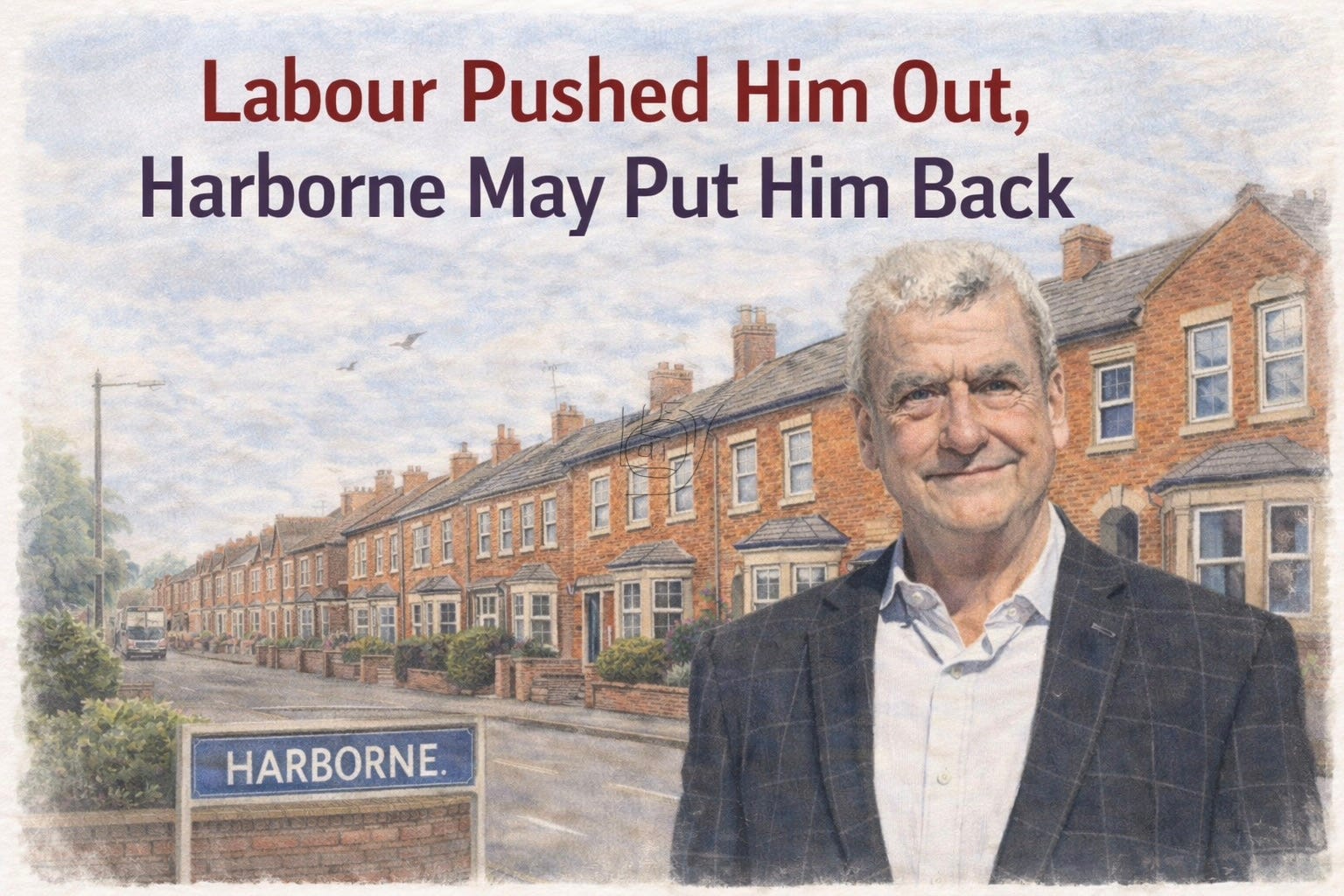
GRIT: The councillor Labour forced out, and Harborne may return
In Harborne, this is not a contest built on slogans, gimmicks or a candidate trying to make themselves known in the final stretch. It is something much more settled than that, shaped by familiarity, reputation, and the quiet accumulation of trust over time. Martin Brooks is not asking voters to take a chance on him. He is asking them to continue with someone they already know, someone they have seen at work, and someone whose record exists in plain sight rather than in the usual bundle of campaign promises.
That matters more than party strategists often care to admit. In local politics, especially in places with a strong sense of themselves, recognition is not a shallow advantage. It is often the difference between a candidate who feels rooted and one who feels imported. Harborne knows Brooks. It knows his manner, his positions, his willingness to speak up, and that puts him on very different ground from someone still trying to establish a relationship with the electorate.
The wider political backdrop only sharpens that advantage. Across Birmingham, there is now a mood that is difficult to ignore and even harder to disguise with the usual managerial language. Years of financial crisis, visible service reductions and the gradual thinning-out of local provision have left their mark. People may not follow every internal argument at the Council House, but they know when a city begins to feel poorer in its public life. They notice when a library opens less, when a centre loses its purpose, when something familiar is steadily hollowed out and then described, insultingly, as transformation.
They also notice who speaks when that happens, and who chooses not to. Brooks spoke. He did not need to shout, and he did not need to posture. He simply said what many residents could already see for themselves, that decline was being repackaged as reform and that local provision was being chipped away under cover of tidy language and bureaucratic reassurance. That is not rebellion for the sake of it. It is judgement, and in politics judgement can be far more unsettling to a leadership than noise.
By the time his break with Labour came, it felt less like a bolt from the blue and more like the inevitable end of a relationship that had been under strain for some time. A councillor who would not fall fully into line had become an awkward presence inside a structure that increasingly prized message discipline over independent thought. Yet in forcing the issue, Labour may have made the oldest mistake in politics: assuming that removing a man from a group also removes his standing with the public. It does not. It simply sends him back to the electorate on new terms.
And those new terms may suit him rather well. In Harborne, Brooks does not have to construct an identity from scratch or persuade people he understands the ward. That work has already been done through presence, consistency and local engagement. What he now offers is not novelty, but continuity. In a political culture addicted to churn, that can be a surprisingly powerful thing.
There is, though, a deeper story to Brooks, and it is one that gives shape to everything else. He is not simply a councillor who found his voice late in his political life. He was here before, decades ago, a young councillor who rose quickly, chaired committees and operated at a level that gave him a city-wide reach rather than the narrower viewpoint of ward-only politics. Even then, he was not some anonymous backbencher drifting through the system. He was a figure of substance, involved in the machinery of the city and familiar with how decisions were made, where power sat, and how easily institutions could drift away from the people they were supposed to serve.
Then he left Birmingham, not into obscurity, but into a very different arena altogether. His work took him into post-conflict environments where governance was not an item on an agenda but the difference between stability and fracture. In southern Serbia, working with the OSCE, he was part of the difficult, patient effort to help hold together a region emerging from violence, rebuilding institutions, restoring trust and giving communities some chance of functioning again. It was not glamorous work. It was grounded, complex and immensely serious, and it earned him an OBE for improving regional security and stability.
And that was not the limit of it. His path took him through the Balkans and beyond, into other conflict-affected settings, including Afghanistan, places where systems had collapsed outright and had to be pieced back together with care, resolve and a proper understanding of what failure looks like when it is no longer theoretical. Work of that kind leaves its mark. It teaches lessons that cannot be acquired in committee rooms or absorbed from briefing papers. It gives a person a much sharper sense of what public institutions are for, and of how much damage is done when they begin to retreat from ordinary life.
That is why his politics in Harborne make more sense than some of his critics would like to admit. When Brooks talks about libraries, local centres and the steady erosion of public provision, he is not speaking as a man fussing over marginal amenities. He is speaking as someone who understands that communities depend on structures that often go unnoticed until they begin to disappear. Strip enough of them away and the damage is not always immediate, but it is always real. A place becomes thinner, meaner, less connected to itself. People may not dress it up in policy language, but they know when it is happening.
Seen that way, his stance is not some burst of theatrical dissent. It is continuity, shaped by experience. He was a serious figure in Birmingham when he was young, he went away and worked in environments where governance mattered in its rawest form, and he came back with a broader frame, a harder-earned perspective, and a lower tolerance for managed decline dressed up as necessity. Labour, to its cost, seems to have mistaken that for mere troublemaking.
The political context now makes that misjudgement look even more dangerous. Labour is not approaching these elections from a position of confidence, either in Birmingham or nationally. Locally, its record has been defined by financial collapse, service retrenchment and a growing sense that the leadership has lost its feel for the places it governs. Nationally, the wider party has hardly offered a more reassuring picture, lurching from one problem to the next and often looking less like a government-in-waiting than a machine permanently caught between caution and confusion. The result is that the Labour badge no longer carries the automatic reassurance it once did. In some wards it still has force, but in others it has begun to feel less like an asset and more like dead weight.
Harborne may be one of the clearest examples of that shift. It is a ward with a strong local identity and a population not especially inclined to vote as instructed. It tends to look hard at what is in front of it. And what is in front of it here is not simply a Labour candidate versus an opponent. It is a last-minute Labour replacement set against a well-known independent who has already built trust, already made his case and already shown that he is prepared to take a stand when the easier route would have been silence.
That is why the balance of expectation now appears to be moving. No serious reading of this race presents it as a straightforward Labour hold. Quite the opposite. The drift of opinion, the weakness of the brand, the strength of Brooks’ local recognition, and the clarity of his message all point in the same direction. Nothing is guaranteed in politics, and only a fool writes the result before the voters do, but it would be equally foolish to pretend this contest is evenly poised. It does not look that way. It does not sound that way. And increasingly, it does not feel that way.
Brooks, by all accounts, is campaigning hard and doing so with mounting confidence. That matters. Candidates do not always admit when a campaign is going badly, but confidence that grows through sustained canvassing usually rests on something tangible. It suggests doors opening rather than closing, conversations going the right way, and a sense that support is not merely polite but active. In a race like this, that can become self-reinforcing. Momentum is not everything, but it is not nothing either.
Arguably, the deeper irony is that Labour may have done him a favour. At a time when the party brand is under serious strain, being pushed out allows him to stand before voters free of that baggage, carrying only his own record, his own politics and his own name. There is a case, and not a wholly absurd one, that in some wards the most practical thing Labour could do for certain candidates would be to expel them and let them run as independents. That may sound flippant, but it captures a real problem: the badge is not helping the way it once did, and in Harborne it may be doing the opposite.
If Brooks wins, and at this stage that looks a very live possibility, the significance will extend beyond one ward. It will suggest that local recognition can beat party machinery, that experience can still count for something, and that voters are willing, when given the chance, to choose the person they trust over the structure they are told to obey. More than that, it will expose something Labour would rather keep hidden, that in trying to discipline a man who would not keep quiet while his ward lost provision, it may have removed not a liability, but one of the strongest candidates it had.
And if that is the verdict Harborne returns, the message will travel far beyond its boundaries.