

Labour’s Birmingham bin war just turned into a money crisis
A year-long bin strike, a £580,000 funding cut, and a union questioning its link to Labour. Birmingham’s refuse dispute is turning into something much bigger.

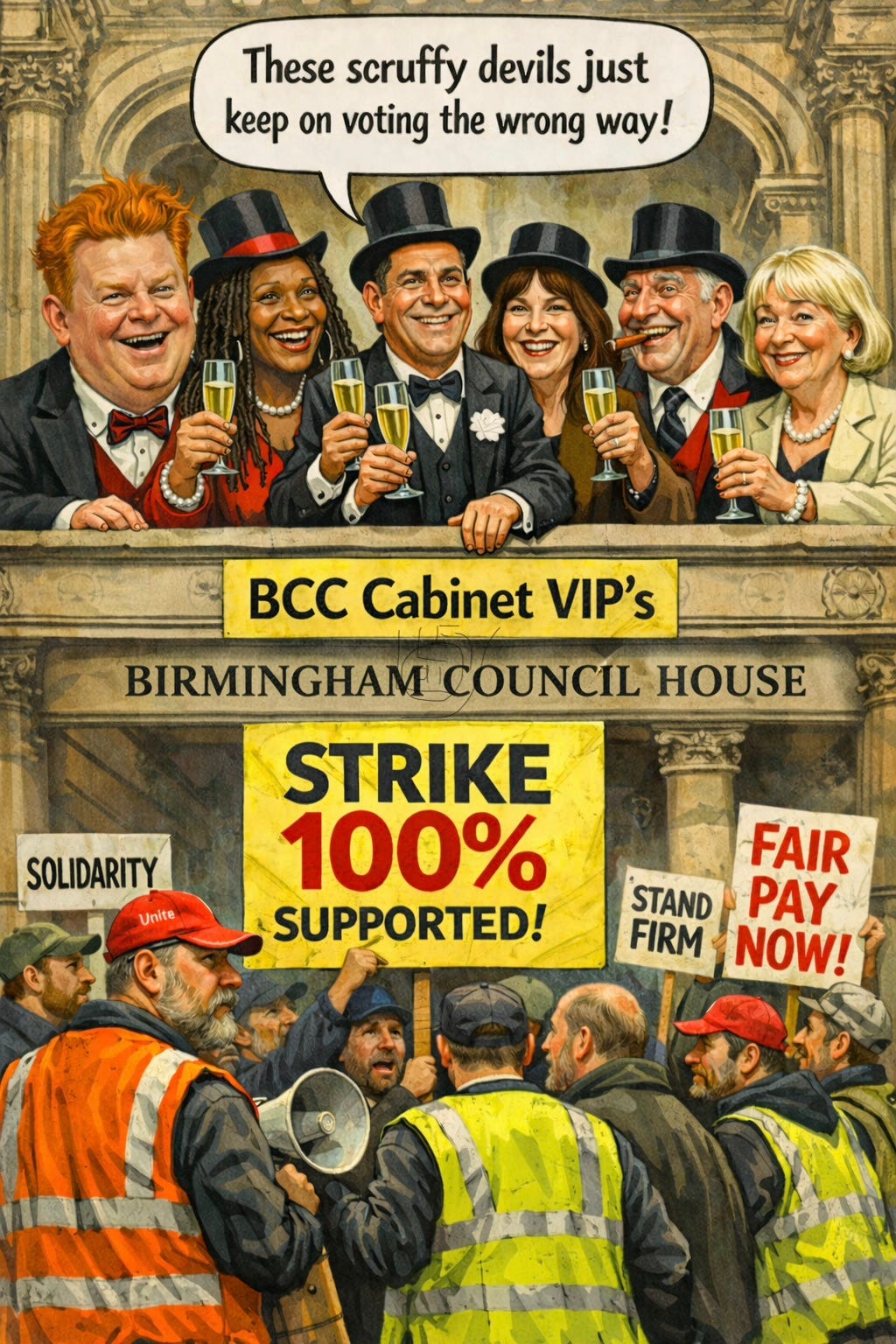
Two senior Labour figures in the West Midlands were asked a series of straightforward questions this week.
Neither answered.
Earlier this week Midlands GRIT wrote to Birmingham City Council leader John Cotton and to Labour’s West Midlands regional director Sam Donoghue seeking their response to two developments now shaking Labour’s relationship with organised labour.
First, Unite the Union has announced it will cut its affiliation fee to the Labour Party by 40 per cent, a reduction worth about £580,000.
Second, Birmingham refuse workers have voted unanimously to extend their strike mandate until September 2026.
Midlands GRIT asked both men three straightforward questions.
What was their response to Unite cutting its funding to Labour?
Did the handling of the Birmingham dispute contribute to that decision?
And what steps, if any, were now being taken to repair relations between Labour and organised labour?
Both were invited to respond by 5pm on Thursday.
At the time of publication, neither had replied.
Their silence matters.
Because what began as an industrial dispute about refuse collection is now becoming something much larger: a political rupture between Labour and one of the unions that helped create it.
The irony of Terry Duffy House
There is an irony here so heavy it could fill a refuse lorry.
Sam Donoghue’s regional Labour office operates from Terry Duffy House.
Terry Duffy served as President of the Amalgamated Union of Engineering Workers between 1978 and 1985 and sat on the General Council of the Trades Union Congress.
The AUEW was one of the great engineering unions of Britain’s industrial era. Its tradition eventually flowed into the modern structure of Unite.
In other words, Terry Duffy represented the labour movement that helped build Labour’s political machine.
And now, from a building named after a trade union leader, Labour officials are watching Britain’s largest union slash its financial support to the party.
If that sounds like symbolism, it is because it is.
A party created by trade unions
To understand the scale of this moment, a little history matters.
The Labour Party did not begin as a conventional political party.
It was created by trade unions.
In 1900, the Labour Representation Committee was formed by trade unions and socialist societies determined to send working-class representatives to Parliament.
Unions funded it.
Union members organised it.
Union activists built it.
Without organised labour there would have been no Labour Party.
That relationship has been the structural backbone of British politics for more than a century.
Now one of the largest unions in the country is openly questioning whether that relationship still works.
The timing could hardly be worse
The financial context makes Unite’s decision even more uncomfortable for Labour.
Only days ago Labour supporters received fundraising emails warning that Reform UK had dramatically out-raised the party.
According to Labour’s own figures circulated to supporters, Reform raised £19.8 million in 2025, while Labour raised about £10.3 million.
That is not a minor gap.
Modern political campaigns are expensive operations involving data teams, digital advertising, organisers and targeted communications.
Money does not guarantee victory.
But lacking it certainly makes defeat easier.
Which is why Labour is currently asking supporters for donations.
And at almost the same moment that appeal was sent out, Unite announced it was cutting more than half a million pounds from its contribution.
The strike that refuses to disappear
Meanwhile the dispute at the centre of this story continues to grind on.
Birmingham refuse workers say changes to job roles could reduce pay by as much as £8,000 in some cases.
Unite says a framework for a settlement had previously been discussed through the Advisory, Conciliation and Arbitration Service, but that agreement never materialised.
The union also says government-appointed commissioners overseeing Birmingham City Council blocked a deal that had begun to take shape.
Those commissioners reportedly receive daily rates exceeding £1,000.
For many workers the contrast is stark.
Highly paid oversight at the top.
Pay cuts further down the system.
It is not a formula for quick industrial peace.
The dispute moves into politics
Unite organisers are now signalling that the dispute will move directly into the political arena.
In communications circulated to members this week, the union warned it would campaign across Birmingham in the run-up to the 7 May elections and would challenge politicians “whatever the colour of your rosette”.
That marks a significant escalation.
What began as an industrial dispute is now becoming an openly political confrontation.
Labour caught between two instincts
For Labour the politics are increasingly awkward.
The party wants to demonstrate fiscal discipline and managerial credibility while governing large public authorities.
At the same time it still presents itself as the political home of organised labour.
In Birmingham those two identities have collided.
To critics on the right, the strike proves Labour cannot run Britain’s second city.
To critics on the left, it looks like Labour turning its back on the workers who built it.
Either way, the dispute is damaging.
The uncomfortable paragraph
Here is the part many Labour figures in Birmingham may find hardest to read.
The Labour Party was created by trade unions to represent working people in Parliament.
Today one of the largest unions in Britain is cutting its funding to Labour, consulting its members on whether they should remain affiliated at all, and preparing to campaign in Birmingham’s elections against politicians it believes have attacked its members.
That is not an internal disagreement.
That is a historic political relationship beginning to fracture in public.
A moment that cannot be ignored
None of this means the relationship between Labour and the union movement is about to collapse overnight.
History runs deep.
But Birmingham has clearly become something more than a local dispute about refuse collection.
It is now a test case.
A test of whether Labour in government can maintain the trust of the labour movement that created it.
As someone who is, incidentally, also a member of the Labour Party, that question feels particularly uncomfortable to write.
But it is the obvious question nonetheless.
If one of Britain’s largest unions now feels compelled to cut funding and reconsider its affiliation to Labour, voters are entitled to ask a simple question.
What exactly has gone wrong in Birmingham?
And more importantly, who is prepared to fix it?
How many regional or Birmingham MPs are 'sponsored' by Unite the Union? How will the union's decision affect them locally, not just ££, rather any non-££ support e.g. in an election. Likewise how many Birmingham City Council Labour councillors and their likely candidates in May 2026 receive support from Unite the Union? I understand - as an observer - that one candidate lost their support sometime ago.