

Labour’s Birmingham Warning Shot
Former Labour MP Khalid Mahmood has said what many voters already feel: Labour is losing touch, and May 7th could be the reckoning.

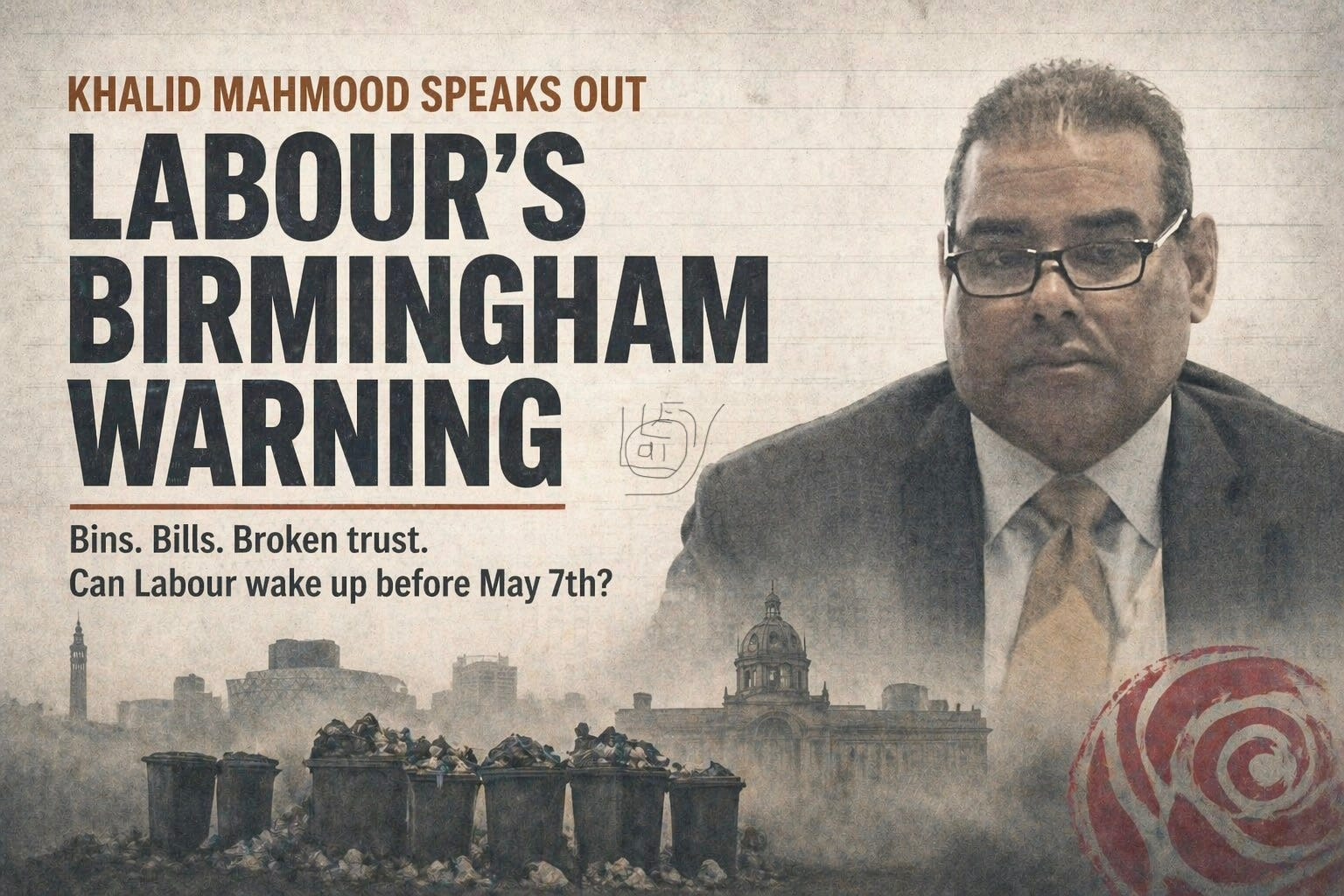
Khalid Speaks Out, But Will Labour Listen?
Sometimes in politics, somebody simply says aloud what a lot of people have been muttering quietly for months, and when that happens it tends to cut through far more effectively than another carefully managed party statement. This week, that voice came from Khalid Mahmood, and whether Labour likes it or not, Birmingham should probably pay attention. Khalid is not some passing commentator looking for relevance, nor is he a man throwing stones from the sidelines for the sake of it. He spent more than two decades representing Birmingham Perry Barr in Parliament, he understands how Labour works, and he has seen enough political cycles to recognise when trouble is building.
I have known Khalid since the 1980s. He has always been direct, sometimes blunt, and never especially interested in dressing things up to make them more comfortable. That does not mean he is always right, because nobody in politics ever is, but it does mean that when he speaks this plainly, people tend to stop and listen. This time, he has delivered a very public warning, and it is one Labour would be foolish to dismiss too lightly.
His argument is simple enough: Birmingham Labour is losing touch with the people it was supposed to represent. That should concern them far more than the usual internal manoeuvring over positions and personalities. When Khalid says, “Labour in Birmingham is facing real and visible difficulties, and people can see it in their daily lives,” that is not opposition attack material being thrown from across the chamber. It is a former Labour MP looking at his own party and deciding the problems can no longer be politely ignored. Frankly, many residents would agree.
The bins are perhaps the clearest example because they reduce politics to something everyone understands. You can have all the strategy papers, all the speeches, and all the internal leadership battles you like, but when rubbish sits uncollected for months and streets begin to look neglected, voters make their judgement very quickly. Government begins with bins, not with faction fights, not with positioning for the next leadership contest, and certainly not with councillors obsessing over their own advancement. For more than a year Birmingham has struggled badly with that most basic civic responsibility, and people notice it every single day when they walk out of their front doors.
At exactly the same time, council tax rises. People are being asked to pay more while receiving less, and that is not some complex ideological debate requiring a panel discussion on regional governance. It is a simple household calculation understood perfectly well by every family opening the bill. Khalid called it a failure of governance, and many people across the city would struggle to disagree with that description. It feels less like management and more like managed decline.
He is also tapping into something very real on transport policy, because across Birmingham there is now a growing sense that the people designing these schemes are often insulated from the practical consequences of them. The Clean Air Zone, reduced speed limits, endless congestion measures, and the wider feeling of anti-car policy have created genuine resentment. If you are comfortable financially, replacing your car may be irritating but manageable. If you are a tradesman, a delivery driver, a shift worker, or a family relying on an older vehicle because that is what life allows, it becomes another bill, another delay, and another daily frustration.
Politics is never judged by the elegance of a policy document. It is judged by whether ordinary life feels easier or harder. For many people in Birmingham, it currently feels harder. Getting to work takes longer, getting across the city feels like punishment, and every new policy seems to arrive with another cost attached to it. The wealthy adapt, professionals work from home, but the people Labour was built to represent often end up carrying the real burden. That matters politically because frustration eventually becomes voting behaviour.
Then there is the council’s financial collapse, perhaps the greatest humiliation of all. Birmingham should be Britain’s second city, not a case study in municipal embarrassment, yet bankruptcy, confusion over the true scale of the deficit, and the arrival of commissioners have created exactly that impression. Was the gap £700 million? Was it £300 million? Even now, clarity feels strangely absent, and when the numbers move around like that public trust disappears quickly. People do not expect perfection, but they do expect someone to know where the money has gone.
The commissioners, brought in under the Conservatives and still there under Labour, have created the strange political theatre of local democracy without much obvious democratic control. Councillors remain in place, meetings continue, statements are issued, but power often appears to sit somewhere else entirely. Responsibility becomes blurred, accountability evaporates, and residents see only the end result: higher taxes, worse services, and nobody who seems fully in charge. That is dangerous political territory for any governing party.
But Khalid’s most important warning is not really about bins, traffic, or bankruptcy. It is about identity, and that is where Labour should be most worried. Labour is losing its emotional connection with working people. That is the bigger issue because once that connection starts to break, rebuilding it becomes far harder than fixing a missed bin collection or balancing a budget spreadsheet. Traditional Labour voters increasingly feel the party no longer speaks for them, only at them. Their concerns are treated as awkward, their frustrations as unsophisticated, and their priorities as something to be managed rather than understood.
Some drift towards Reform UK, others look to the Green Party of England and Wales, and many simply disengage from politics altogether because they no longer believe anyone is listening. That is how parties decline, not usually with one dramatic betrayal, but through the slow erosion of trust and the quiet emotional withdrawal of the people who once formed their foundation. It is rarely loud at first, but it is always dangerous.
So what happens now? Will Labour listen? That is the real question. Political parties are rarely comfortable with internal criticism. They prefer discipline to honesty and often treat people raising problems as though they are the problem themselves. There will be those who quietly agree with Khalid over coffee and then publicly keep their distance by lunchtime. There will be muttering about timing, about unity, and about not helping the opposition. In politics, inconvenient honesty is rarely rewarded, particularly when it comes from your own side.
So what happens to Khalid? Probably what often happens to people who say uncomfortable things inside Labour, polite acknowledgement followed by determined silence. Some may try to dismiss him as part of yesterday’s politics, an older voice looking backwards rather than forwards. That would be too convenient. Because whether one agrees with every point or not, he is describing something many voters already feel, and pretending otherwise will not make it disappear.
And what is his next move? If I know Khalid, he will keep saying it. Long before Westminster, he was a prop forward for Camp Hill Rugby Club, my old rugby club, and he approached rugby much the same way he approaches politics, direct, determined, and not especially interested in standing back politely while others talked around the problem. Props do not deal in subtlety. They deal in hard yards, collisions, and going straight at what is in front of them. Fair to say, Khalid never messed around.
That same instinct remains. He tends to go straight at the issue rather than circle around it, which makes him useful in politics and occasionally unpopular. He is not likely to retreat quietly because that is simply not how he is built. If Labour hoped this would be a brief moment of discomfort before everyone moved on, they may be disappointed.
Now comes the real test, May 7th. If Labour suddenly woke up, listened, and acted, could it still save itself in these local elections? Possibly, but only just. Not with slogans, not with another round of carefully managed statements, and certainly not with another internal blame game. It would require visible change, quickly: competence on basic services, honesty on finances, and a genuine willingness to listen to people outside the usual political circle.
Voters can forgive mistakes. What they rarely forgive is being ignored. If Labour shows humility and urgency, it may still steady the ship. If it carries on assuming loyalty is automatic, if it mistakes control for consent, and if it keeps treating working people as a demographic rather than a duty, then May 7th may become more than a difficult local election. It may become a warning shot for Labour nationally.
Because voters are patient, but they are not infinitely patient. Khalid Mahmood has said what many were already thinking. The only question now is whether Labour hears it before the ballot box says it much louder.