


It is Monday morning and within hours the Labour Government has or will release the details of its tougher immigration plan. The theme was announced on Saturday, when most of the country was getting ready to watch the football, taking the kids swimming or doing the weekly shop. Today we will finally see what Labour claims this policy really means. At the time of writing (the weekend), we cannot know how firm or how flimsy the measures will be.
But we do know this. The timing was deliberate. The announcement on Saturday was not a leak or an accident. It was a calculated manoeuvre, designed to settle the ground before the political working week began. Labour played an old, reliable trick. Tell the country something significant when the noise is low. Then reveal the detail when the stage is yours.
The Saturday announcement gave Labour two advantages. First, it softened the shock for a party whose activist base despises any tightening on immigration. Second, it allowed ministers to spend the weekend doing quiet firefighting. No live radio grilling. No urgent Parliamentary reaction. No real scrutiny. Just a steady drip of prepared lines while the country was distracted by football scores and supermarket queues.
And that lays bare the truth. Labour is not walking into this immigration shift with confidence. It is tiptoeing into it. The party knows it must respond to public sentiment, but it also knows its own activists loathe that sentiment.
This brings us to the deeper political reality. Labour knows perfectly well that tougher immigration control has been the public’s preference for decades. Poll after poll across every region, income band and demographic has shown a consistent view, and let us be absolutely clear, that includes long-established ethnic minority communities. They are every bit as vocal about fairness, pressure on services and social cohesion as anyone else, often more so. The voters have been saying the same thing for years. And not quietly.
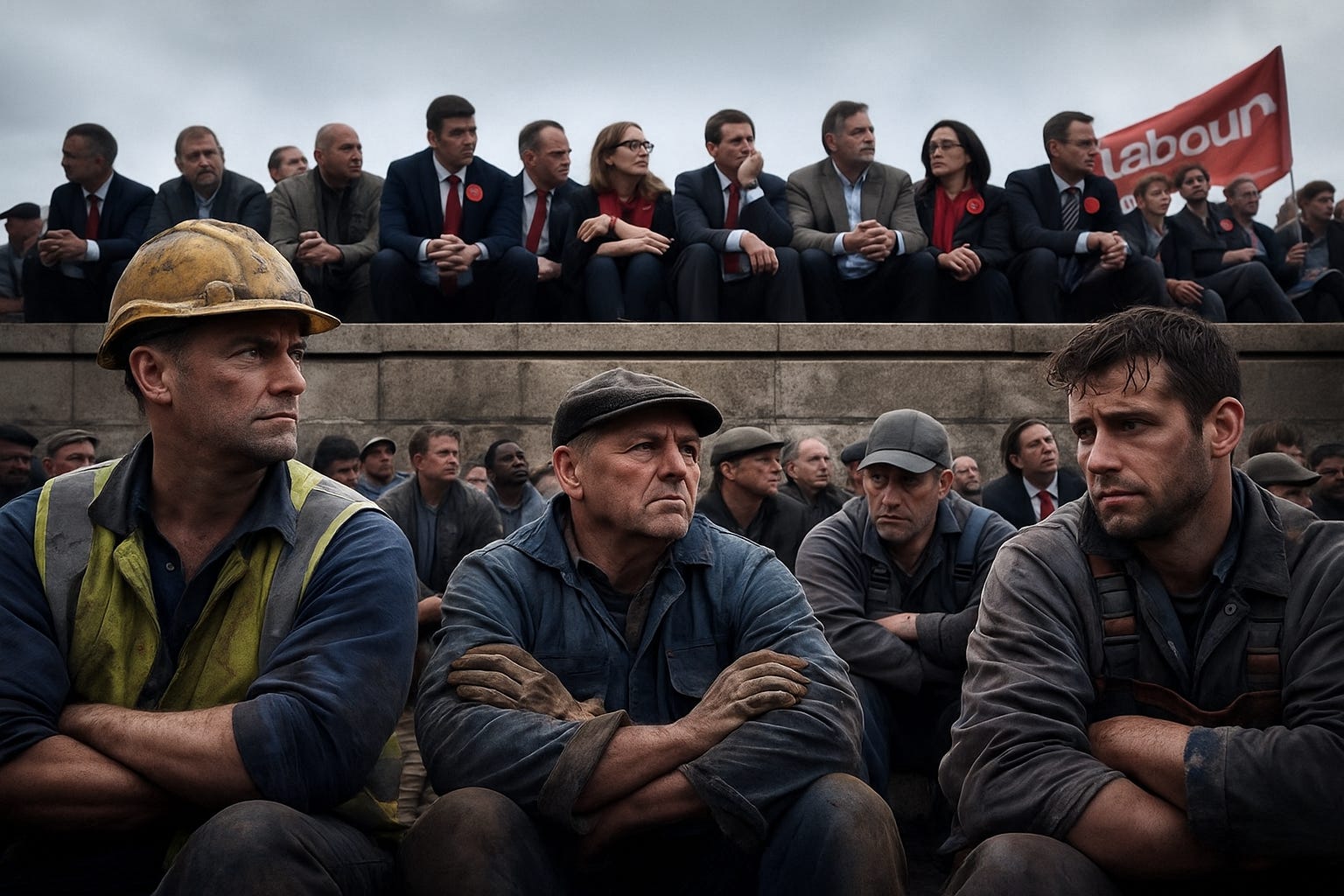
The problem for Labour is that its activist class, the people who run Constituency Labour Parties, dominate selection committees and set the tone of internal debate, reject those views completely. As do the apparatchiks who administer the party. Labour’s activists themselves are far to the left of Labour’s voters. They see immigration not as an economic or social issue but as a matter of moral identity. To them, firm immigration control is vulgar, reactionary and embarrassing. They see voters who hold these views as misguided or worse.
This internal tension defines Labour’s every move. The elected MPs and councillors sit uncomfortably in the middle. Many are far closer to the activists than the voters, both socially and culturally. They win votes from the public, but their careers depend on activists and internal gatekeepers. It is no surprise that the average Labour representative feels more at home in a university seminar than on a factory floor. This is where the disconnect comes from. It is not accidental. It is structural.
This is why Labour approaches immigration like a man walking a tightrope. On one side, public opinion, firm and longstanding. On the other, a party activist base who treat that same opinion as unforgivable heresy. In between stands the Labour leadership, trying to pretend it is acting from principle while actually performing a very slow sidestep towards the middle ground. Not out of conviction, but survival.
The choreography is made even more complex by the lobby groups Labour listens to most. The large university sector, heavily reliant on foreign student income. Public sector managers who argue that migration fills workforce gaps. Trade union officials whose views often reflect a world of conference halls and policy papers, rather than the instincts of ordinary workers they claim to represent. These groups do not merely shape Labour’s instincts, they shape its caution.
A party shaped by these influences struggles to look the voters in the eye. The activists do not trust the public. The representatives do not want to offend the activists. The leadership does not want to face a revolt. Yet the public continues to demand exactly what Labour has avoided for years.
This is not unique to Labour. The Conservatives have spent years preaching control while surrendering it in practice. The Conservative clergy is as disconnected as Labour’s, equally cautious, equally nervous, equally trapped between lobby groups, cultural instincts and the polling they dare not follow honestly. This is why both parties are polling so badly. They share the same disease. They speak to themselves more often than they speak to the country.
Which brings us back to today. As this Monday unfolds, Labour will aim to look firm, confident and decisive. It will try to sound as though this has always been its direction, and that today’s announcement is a natural expression of its values.
Perhaps it will convince some. But the bigger question remains. Has Labour done enough? Will the public see this as a serious attempt to address an issue they have cared about for decades? Or will they see it as political choreography designed to stem Reform UK’s rise and contain a rebellious activist base?
And there is an even harder question. If Labour is only acting now, at this late stage, because public opinion has cornered it, what does that say about the purpose of modern politics? What use are politicians who wait for the wind before raising the sail?
And this leads directly to the other half of the story.
Reform UK: The Party Labour Created and the Fight They Cannot Lose
Labour’s move on immigration is not simply a policy shift. It is a direct threat to Reform UK, whose surge has been fuelled by one core belief, held tightly by millions of voters. The belief that the main parties will never act.
Reform’s identity rests on this. The claim that Labour and the Conservatives are two wings of the same unresponsive class. The belief that the political establishment is incapable of change unless forced by an outside shock.
Without Labour constantly glancing over its shoulder at its activist class, it has arguably abandoned the very working-class voters it was built to represent, pushing them straight into the values now shaped by Reform UK. Reform becomes not an outsider force, but a manifestation of the modern, trendy Labour Party itself. The irony is disturbing.
If Labour now steps onto Reform’s territory, even partially, the pressure shifts. Reform will be forced to explain what makes them different. What makes them necessary. What makes them still worth the protest vote when the protest has apparently begun to be absorbed.
Can Reform hold its identity?
Can it retain its grip on public trust?
Can it outmanoeuvre Labour without drifting into extremes?
Has Labour done enough to blunt Reform’s rise, or has it only sharpened the contest ahead?
These are not small questions. Reform’s entire project now faces its first genuine stress test.
We will see, in the days ahead, whether Labour has taken a meaningful step or merely staged a performance. And we will see whether Reform UK can meet this moment, or whether the ground beneath them is already beginning to shift.
More tomorrow on midlandsGRIT.