

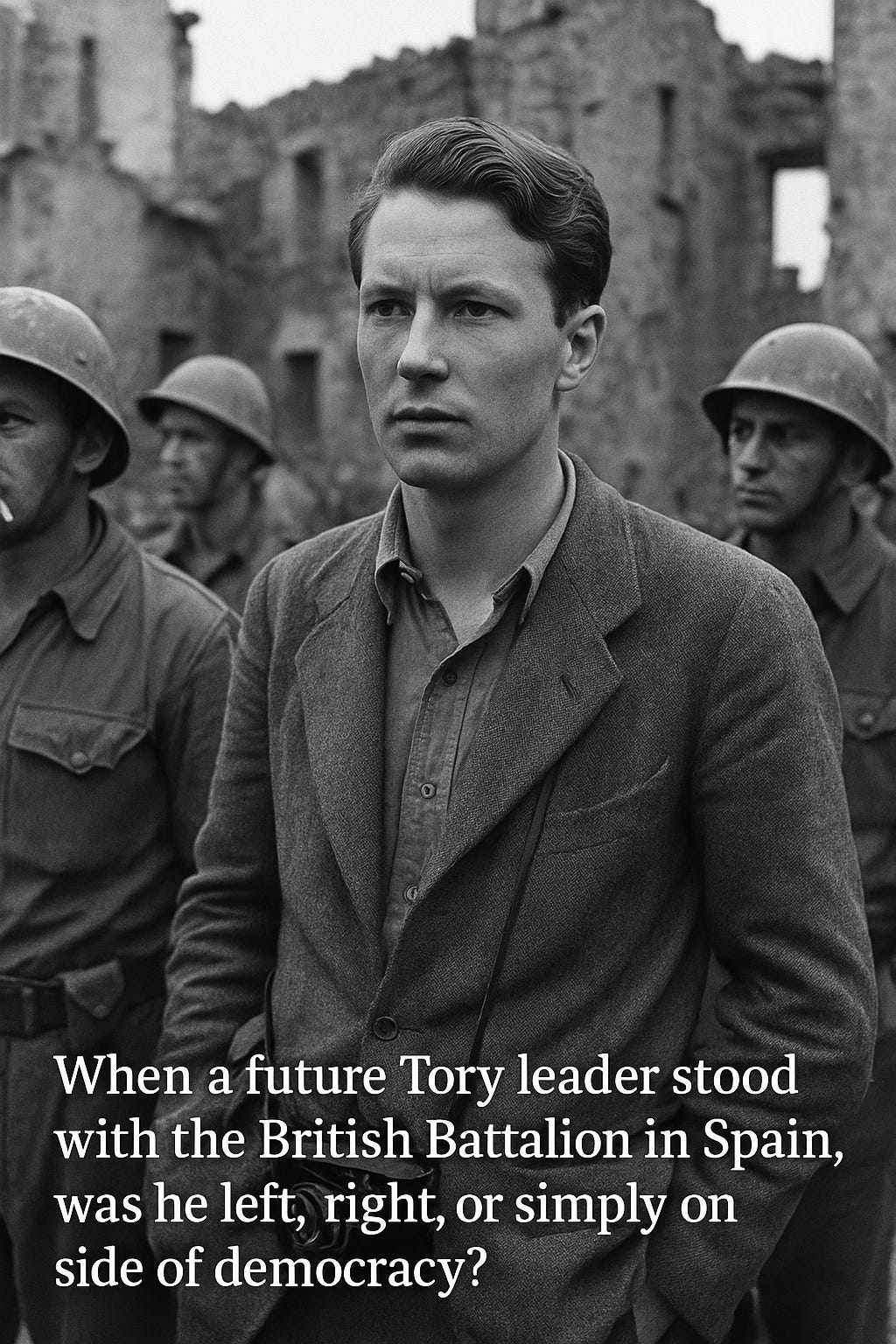
In early 1938, in the months before the Battle of the Ebro, Heath travelled through Republican Spain officially as a political observer, but close enough to the front to mix with British Battalion volunteers, see the war at work, and, like many British visitors, offer practical help where he could before returning home profoundly changed by the experience.
If you consult the political dictionaries, they will tell you that the terms “left” and “right” arrived in 1789, when France was cracking open at the seams and the National Assembly was trying to work out who was on the side of the people and who was on the side of the palace. Reformers sat on the left, the defenders of the old order on the right, and with that, Europe gained a new political compass. A neat little story. A tidy origin. And absolutely foreign to Britain.
Because this island, for all its fondness for rows, has never been quite as tidy as those French seating plans. Our own political arrangements grew not from barricades and guillotines but from arguments over kings, bishops, trade, land and the authority of Parliament. Out of that came the Whigs and the Tories, two great lumbering beasts of the seventeenth century that spent the next two hundred years circling one another in a dance that was political but not ideological. The Whigs wanted to keep the monarchy in check and guarantee Parliament’s supremacy, while the Tories defended the old ways, the old crown and the old church. But left and right? Not a chance. These were rival factions, not rival philosophies.
The Whigs, to be fair, did their best to hang on. They became the natural party of constitutional reform, of industrial awakening, of the new commercial classes who were emerging in the cities. But they also became a political antique. Britain was changing faster than they were. The Reform Act of 1832, which they championed, created the electorate that would eventually sweep them away. By 1859, the Whigs had melted into the newly formed Liberal Party, an alliance of middle-class reformers, Radicals, and Peelites. They didn’t collapse so much as they dissolved into something larger, and their political clothes were not stolen but absorbed, re-stitched and modernised.
Opposite them, the Tories reshaped themselves under Robert Peel, adopting the name Conservative Party, though never shaking off the old nickname. “Tory” was originally an insult, tossed about in the 1670s to describe an Irish outlaw. Yet here we are in the twenty-first century and it still clings to the party in government. Tradition has a long shelf-life in Britain, especially when it comes with a dash of mischief.
And still, for all this, Britain did not think in terms of left and right. It thought in terms of interests, classes, regions and loyalties. Politics was about who you were and who stood with you, not where you sat on an ideological chart imported from France.
The real disruption came not from constitutional wrangling, but from the arrival of Labour. When trade unions, co-ops and socialist societies began to gather strength in the late nineteenth and early twentieth centuries, Britain finally gained a party built around a set of economic and social values rather than dynastic or constitutional alignments. Labour’s rise after the First World War was the real earthquake. It swallowed Liberal votes by the million and redrew the political map completely. Only then did it make sense to describe one party as “left” and another as “right”, and only because the Liberals had ceded the middle ground and left the Conservatives stranded with the label by default.
But this was a long, slow process. As late as the 1960s, if you picked up a local paper, Labour candidates were still labelled “S” for Socialist, not “L” for Left. The public spoke of Labour men, Tories, Liberals, and sometimes trade unionists, but rarely of abstract left–right categories. The very idea that the British electorate spent centuries thinking in French ideological geometry is a fantasy. The words only took root in everyday speech in the last fifty years, a blink of an eye in political history.
Even the lives of politicians themselves reveal the absurdity of the labels. Take Edward Heath, later Conservative Prime Minister and the man through whom many lazily understand the post-war Tory tradition. In office he was branded, often unfairly, as a right-wing figure, a cold technician, a party man. Yet roll back the clock to 1938, when Europe was being torn apart by the rise of fascism, and you find a very different Heath indeed. As a young man, he travelled not to Westminster nor Washington but to Spain, right up to the front lines, to meet members of the British Battalion of the International Brigades. This was mere weeks before the catastrophic Battle of the Ebro. Heath saw the bombed-out towns, the exhausted volunteers, the thin line between idealism and death.
There was nothing “right-wing” about standing shoulder to shoulder with anti-fascist volunteers fighting Franco’s Falange, the same Falange backed by Hitler and Mussolini. Heath’s instincts were internationalist, democratic and morally clear. That the later Conservative leader had once been a witness to the Spanish conflict, breathing the same dust as those who fought in it, should remind us that individuals outgrow the political boxes history tries to stuff them into.
And this brings us to the present, which is where the language of left and right collapses entirely. What do you call a Conservative Party which, in places like Birmingham, built the last real council houses, only for Labour administrations to later wind down those programmes and hand vast chunks of the city’s public services to dubious private operators. What do you call a Conservative government which presided over record immigration, historically high by any measure, while sections of Labour’s working-class base felt pushed aside, ignored or culturally scolded. What is left? What is right? And more importantly, who cares?
Because here is the truth: the words have become insults, not descriptions. “Lefty.” “Right-winger.” The terms are thrown around as if they contain meaning when all they really contain is irritation. They are political emojis, emptied of substance, deployed to end arguments rather than start them. And the British public, who once tolerated the pantomime, increasingly watch from the middle ground with a mixture of bewilderment and boredom. They are not disinterested. They are simply unimpressed by a vocabulary that describes a country that no longer exists.
And perhaps that is the real story. These French words, born in a revolutionary chamber and carried across Europe by academics and commentators, have survived here not because they fit but because they are convenient. They are shorthand for political tribes in a nation where the tribes themselves are dissolving. They once described where people sat. Now they describe very little at all.
Britain has moved on. The labels have not. And when language fails to capture reality, the public does not adjust itself to the vocabulary. It walks away from it. Maybe it is time the rest of us caught up and left these two worn-out words behind, before they mislead us again.