

Losing a GONG: The Quiet Unravelling of Britain’s Honours System
Honours are handed out with ceremony, but taken away in silence. And what disappears quietly often tells you far more than what is celebrated loudly.

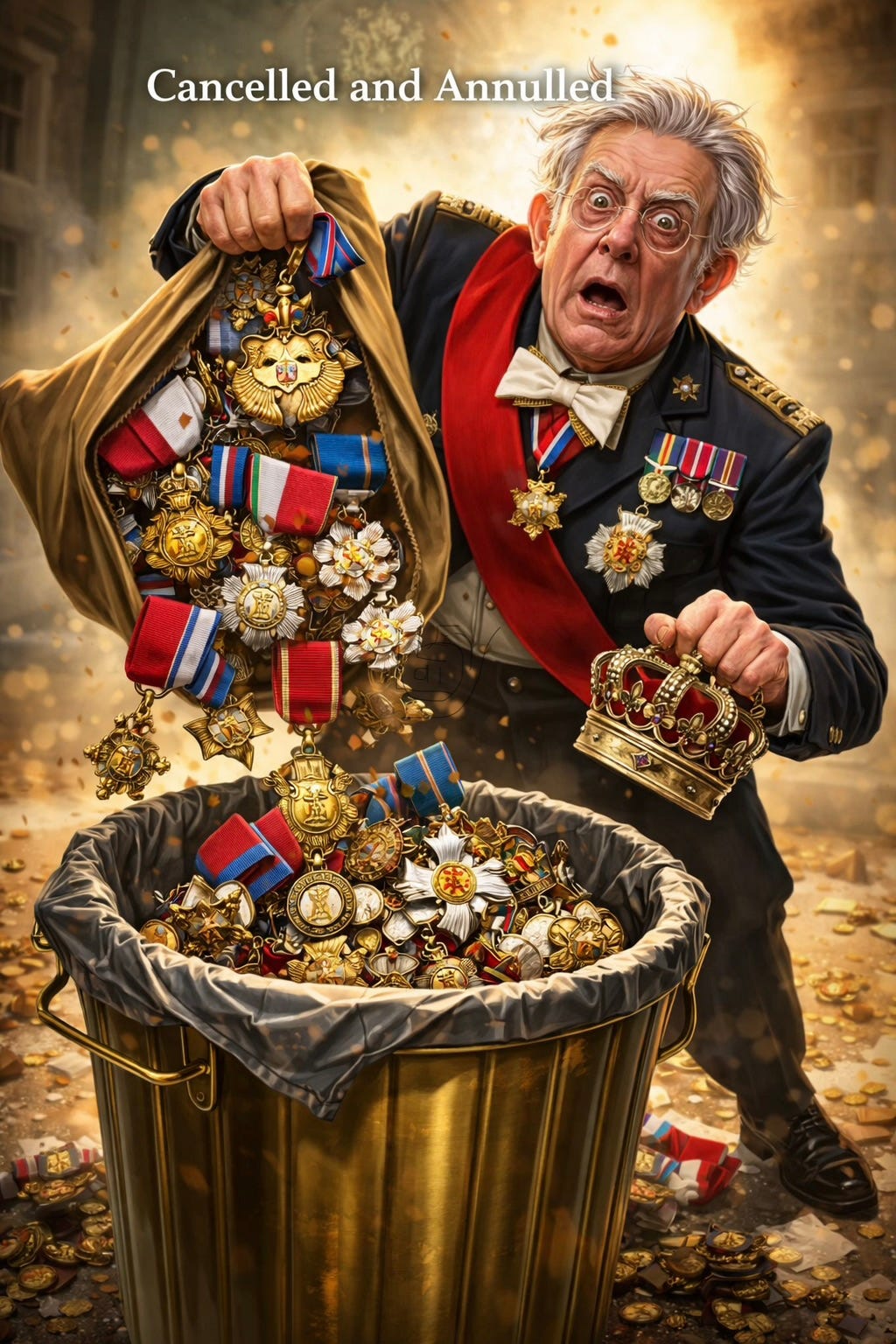
Britain’s honours system is often described as a recognition of service. A calm, dignified process that rewards those who have given something back.
That is the theory.
In practice, it can look rather different.
It can look like a system shaped by status, proximity, and acceptability to the right sort of people. A system that knows exactly who it is comfortable recognising, and who it is not.
No better proof exists than this. Black Sabbath, born in Birmingham, globally acclaimed, culturally transformative, and woven into the identity of the West Midlands, does not have a single honour among its original members.
Not one.
This is a band that helped define a genre, exported British culture across the world, and put Birmingham on the global cultural map in a way few civic initiatives ever could.
Yet the system has found no room for them.
At the same time, it has never struggled to honour the safer tribes of officialdom. College principals, chief constables, councillors, committee figures, and the broader managerial class who move comfortably through institutional Britain are recognised year after year.
Their contribution is not the issue.
The pattern is.
Because once you see it, you cannot unsee it.
That imbalance might be easier to accept if the system were otherwise transparent and consistent.
It is neither.
And that becomes even clearer when you look not at who receives a gong, but at what happens when one is taken away.
Because that is where the real character of the system begins to show.
When honours are removed, the public tends to notice only the largest collapses.
Sir Fred Goodwin losing his knighthood after the Royal Bank of Scotland became a byword for financial excess and failure.
Paula Vennells stripped of her CBE after the Horizon scandal finally broke through years of denial and damage.
Lawrence Nigel Jones, once celebrated as a technology success story, having his MBE cancelled following conviction for serious nasty criminal offences.
These are the moments that reach the surface.
The names that become impossible to defend. The cases that gather such weight that the system has no choice but to act.
But they are not typical.
They are simply unavoidable.
It is worth noting that not every fall from grace follows this formal route. Prince Andrew is often described as having lost his status, but that is not strictly correct. He remains a prince by birth and still holds the title Duke of York. What he has lost are his military roles, patronages, and the right to use HRH in public life.
The distinction matters. His case did not pass through the formal forfeiture process. It was handled institutionally, not administratively.
It is an odd system that can erase an MBE in a line of print, yet leaves untouched titles that require Parliament itself to intervene. The difference is not morality. It is mechanism.
Because beyond those headline cases sits something much quieter.
And much more revealing.
The forfeiture list, such as it is, contains names that almost nobody will recognise. Individuals who were honoured without fanfare and later stripped without explanation. Their stories do not unfold in public. Their removal does not come with scrutiny or debate.
Instead, it appears in the formal columns of The London Gazette.
Before everything moved online, The London Gazette existed in printed form, but not in any way the public would recognise. You were not going to find it in your local library, assuming it was still open. Certainly not somewhere like Acocks Green Library.
You had to go into the centre, into the reference stacks, and ask for it like a document rather than read it like a newspaper. And even then, what you were given was not explanation, but record. Page after page of dense official notices, written to be noted, not understood.
That tells you everything about who it was really for.
It has always been public. It has almost never been visible.
This is not a system that explains itself.
It is a system that corrects itself quietly.
Only recently has anything resembling a consolidated list begun to emerge through the Cabinet Office. Even then, it arrives in batches, often grouping together a dozen or more names at a time, published with minimal commentary.
It feels less like transparency and more like administration.
A periodic clearing of the ledger.
The reasons, where they can be identified, are familiar enough.
Criminal conviction.
Professional censure.
Conduct bringing the system into disrepute.
But again, it is not the criteria that stands out.
It is the timing.
Honours are almost never removed at the point of allegation.
They are not removed at the point of suspicion.
They are not even removed at the point where concern becomes widely known.
They are removed at the point where the facts are settled, the appeals are exhausted, and the reputational cost of doing nothing becomes greater than the cost of acting.
It is not a system of standards.
It is a system of thresholds.
And that distinction matters.
Because it tells you something important about how the system sees itself.
Not as a guardian of merit.
But as a manager of reputation.
That same instinct helps explain something else.
The absence of any meaningful regional picture.
There is no clear way of identifying how many honours have been stripped in the West Midlands, or who they were.
The system does not track it geographically.
The Gazette notices offer no such context.
And so the region, like many others, sits in a kind of administrative fog.
That absence should not be mistaken for absence of concern.
Far from it.
As I have said before, I can think of one or two who should be stripped of their gong.
The point is not to name them.
The point is to recognise the pattern.
Honours are awarded within a system that reflects the values, assumptions, and blind spots of the institutions that control it.
When those judgments prove flawed, the correction is slow, selective, and often hidden from view.
There is no knock at the door from the Palace. No moment of public disgrace. No ceremony to match the one that conferred the honour in the first place.
Instead, the process is handled quietly through official channels. A letter is sent, not from the King in any personal sense, but via the machinery of the Cabinet Office, informing the recipient that their honour has been forfeited following a decision approved at the highest level. The insignia, the medal itself, is expected to be returned, the physical symbol of recognition handed back without fanfare.
With it goes the title. The “Sir”, the “OBE”, the “MBE”, the small but powerful markers of status that attach themselves to a name. They cannot be used again. They are simply gone.
And then the real act takes place, not in public, but in print. In the formal columns of The London Gazette, the honour is “cancelled and annulled” and the name is “erased from the Register”.
There is no explanation beyond the wording. No account of how the original decision was made. No reflection on what went wrong.
That is how a gong disappears. Not with drama, but with administrative finality.
One is obscure.
The other is almost wilfully so.
A gong arrives with ceremony.
It disappears in small print.
And the public is left to trust a system that offers very little reason to do so.
Which is why I respect those who refuse to accept the awards in the first place!