

Lozells Is No Longer Labour’s Safe Seat, Taj Uddin Thinks the Numbers Now Belong to Him
Gaza, council chaos and a strong independent campaign have turned Labour’s old certainty into a very real contest.

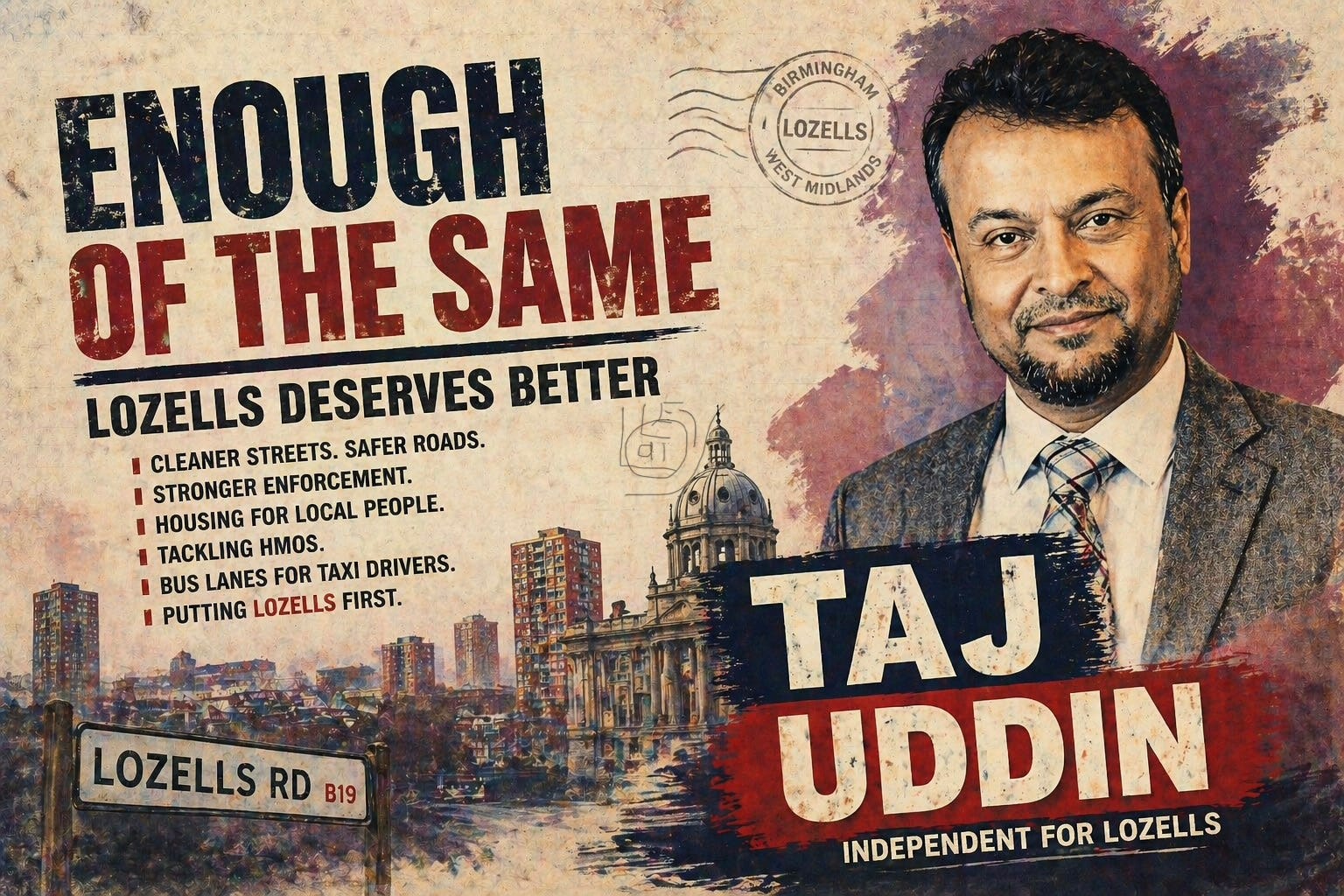
Lozells Is No Longer Labour’s Safe Seat, Taj Uddin Thinks the Numbers Now Belong to Him
There was a time when Labour could walk into Lozells, pin up a poster, nod politely at a few familiar faces and collect the council seat on the way home. Those days may be over. This is no longer a quiet little ward where the red rosette is treated like hereditary title. This is now a live fight, a proper political street contest, with nine candidates chasing one council seat and a very real question hanging over the ballot box: is Lozells still Labour by instinct, or has the mood changed enough for an independent to break through?
The vacancy follows the unexplained death of long-serving Labour councillor Waseem Zaffar, a man whose personal standing often mattered as much as the Labour badge on the leaflet. Waseem was not simply Labour, he was Waseem: known, respected and deeply woven into the local political fabric. Four years ago, Labour barely had to break sweat. In 2022 he won with 1,955 votes, beating the Conservatives by 1,264 votes and holding the ward comfortably on a 38 per cent turnout. But personal loyalty does not automatically transfer with the family surname, and Labour now finds itself defending the seat in very different circumstances, with national headwinds, local frustration and a far more serious independent challenge than it may have expected.
That challenge comes from Taj Uddin, and he is not turning up with a borrowed leaflet, a folding table and vague hopes of civic glory. He is running a serious, organised, properly funded campaign with the kind of confidence that suggests he has already checked the figures twice and likes what he sees. Which, given that he is an accountant, should perhaps surprise nobody. He deals in figures for a living, and in Lozells this election may come down to precisely that: whose figures stack up, whose sums make sense, and who the community believes can stop Birmingham City Council continuing to spend like a drunken uncle at Christmas.
I have known Taj for a number of years through Labour circles, and one thing has always stood out. He is a happy man. Not the artificial grin of a candidate trying to remember your name while looking over your shoulder for someone more useful. Genuinely happy. Bright, positive, buoyant and approachable. He smiles easily, talks openly and seems to enjoy people rather than merely needing them every four years. That matters. In politics, where too many candidates look as though they have just opened their council tax bill and remembered they voted for it, simple good humour is not a small thing.
His campaign literature is polished, properly funded and clearly organised. This is not a vanity project. The printing is sharp, the messaging disciplined and the operation substantial. Forty or fifty people on the ground is not amateur hour. You do not knock on 3,000 doors over the course of a year unless you are serious, and Taj plainly is. He also has something modern politics too often lacks: proximity. He does not commute into Lozells for election season wearing concern like a temporary badge. He works there, lives there, and has done for nearly twenty-five years, right in the middle of the ward. Lozells Road, between Six Ways and Rose Hill, is not campaign geography for him, it is simply home. Voters can smell political tourism from half a mile away. He does not have that problem.
His roots also run deeper than the usual election biography. His father first came to Britain in 1938 as a merchant sailor, later joining the British Army to fight in the second world war, before returning to Bangladesh in 1952. Taj himself was born there in 1973 and came to Britain in 2001 after his father passed away. Even that journey says something about him. When visa difficulties threatened to block his move to the UK, he did not sit still and wait for bureaucracy to decide his life. He wrote directly to Jim Cunningham, then Labour MP for Coventry, asking for help. It worked. There is something revealing in that. Direct, practical, persistent. Solve the problem rather than moan about it. That instinct has stayed with him.
He trained to become certified accountant in Britain, he built his business in Lozells, nowadays serving clients across communities and across the country. He understands figures, but more importantly he understands what lies behind them: the small business under pressure, the family trying to keep a roof over its head, the resident wondering why their council tax rises while the street gets dirtier. Good accountants know every number tells a story. Good politicians should too. Taj believes Labour has stopped listening to those stories, and his campaign reads less like a manifesto and more like a frustrated audit.
Cleaner streets. Safer roads. Stronger enforcement. Housing for local people. Tackling HMOs. Anti-social behaviour. Bus lane access for taxi drivers. These are not ideological crusades. They are balance-sheet politics, practical deficits demanding practical correction. His message is simple and sharp: Lozells deserves representation chosen by the community, not selected through insider arrangements and family networks. It is not subtle. It is not meant to be.
That line lands particularly hard because Labour’s candidate is Samarah Zaffar, sister of the late Waseem Zaffar. Nobody disputes the family connection or the emotional pull of continuity, but questions are already circulating in Lozells about whether this is genuine political succession or something closer to political inheritance. Many locally are asking whether Samarah only recently joined the Labour Party, and whether her selection was accelerated because of family connection rather than long-standing party service. If true, it turns the election into something much sharper than Labour versus Independent. It becomes representation versus inheritance.
Labour has been asked to clarify whether Samarah Zaffar was a party member prior to Waseem’s death, when she joined, and whether any exemption or special process applied to her candidacy. At the time of writing, no response had been received. Silence, in politics, is often its own answer, and Taj clearly sees opportunity in that silence.
His criticism of Labour goes beyond candidate selection. Like many Muslim voters across Birmingham, he is deeply angry over Labour’s position on Gaza. His resignation last year, from Labour made that painfully clear. He accused the party of silence, of moral failure, of abandoning communities it once claimed to represent, and of protecting poverty through decisions like the two-child benefit cap. In places like Lozells, Gaza is not some distant foreign policy sidebar. It is a doorstep issue. People talk about it, families feel it, and trust is shaped by it. Labour knows that. So does Taj.
Add Birmingham’s financial crisis, rising council tax, shrinking services and a public mood that sits somewhere between irritation and outright disbelief, and Labour faces more than routine anti-incumbency. It faces distrust. Residents are paying more and getting less, while the people responsible often seem remarkably relaxed about the whole thing. Taj’s campaign sits neatly in that gap between anger and fatigue. He is not promising revolution. He is offering competence.
And this is where the political arithmetic becomes interesting. Lozells is not one community, it is several: Bangladeshi, Pakistani, Somali, Afro-Caribbean, white, Indian, Muslim, secular, working families, renters, shopkeepers, taxi drivers, older residents who remember a different Birmingham and younger ones wondering whether this version still functions at all. Taj himself is Bangladeshi, and that matters. Around a third of the community shares that heritage, with roughly 2,700 Bangladeshi voters by his own estimate.
He says he has strong support there, alongside 300 to 400 family-linked votes and a campaign team of 40 to 50 people. He is 95 per cent confident of winning. Now, accountants are not generally famous for reckless optimism. If one starts talking at 95 per cent confidence, you assume he has opened the spreadsheet, checked the formulas and perhaps even colour-coded the cells. Still, he is careful not to turn the campaign into ethnic arithmetic. He speaks proudly of his Bangladeshi heritage, but also says clearly that Bangladeshi politics abroad are not the politics of Lozells. That is smart. Identity matters, but drains still need clearing.
There is also a larger Birmingham story quietly sitting behind all this. People forget that Birmingham once had a strong independent tradition. In the late 1940s, 1950s and into the 1960s, a substantial number of the city’s councillors were independents. Local government was often local first, party second. Then the machines took over. Perhaps Taj Uddin is trying to reopen that old ledger. Perhaps this is not simply one independent candidate challenging Labour, but part of a wider reminder that councillors are supposed to represent wards, not function as branch office managers for Westminster brands.
That idea has resonance, especially now, especially here. Labour no longer walks into Lozells guaranteed of applause. The old assumptions are weaker. The city is angrier. Gaza has cut trust. Birmingham’s finances have damaged confidence. And when a seat once held safely becomes open ground, someone ambitious will always step forward. Taj Uddin has stepped forward. He is organised, visible, well supported and politically sharper than Labour may have expected. He is not performing rebellion for effect. He is presenting himself as a competent local professional who believes the books have been badly managed and that somebody, eventually, needs to do the reconciliation.
The numbers, he believes, are on his side. As ever in politics, polling day is the final audit, and in Lozells this time, Labour may find the sums are no longer as comfortable as they once were.
Well good luck to the “happy man” and indeed all who have seriously entered the political contest in Lozells. For completeness, the full declared field of candidates for Lozells is:
Rafael Costa, Independent
Qiam Ud Din, Green Party
Peter Charles John Hinton, Reform UK
Raja Asim Khan, Independent
Andy King, Liberal Democrats
Nufayej Rayean, Independent
Dean Sisman, Conservative and Unionist Party
Taj Uddin, Independent
Samarah Zaffar, Labour Party
Nine candidates, one seat, and for the first time in a long while, no easy assumptions.
Chers Adrian - sometimes you Gota get out and have a face to face - strangely enough I'm doing this right now in Erdington.
Fascinating insight Mike