

Majid Leaves The Machine
Majid Mahmood follows Diane Donaldson out of Labour, turning a strong ward team into two independents and leaving Birmingham Labour with another crack in the machine.

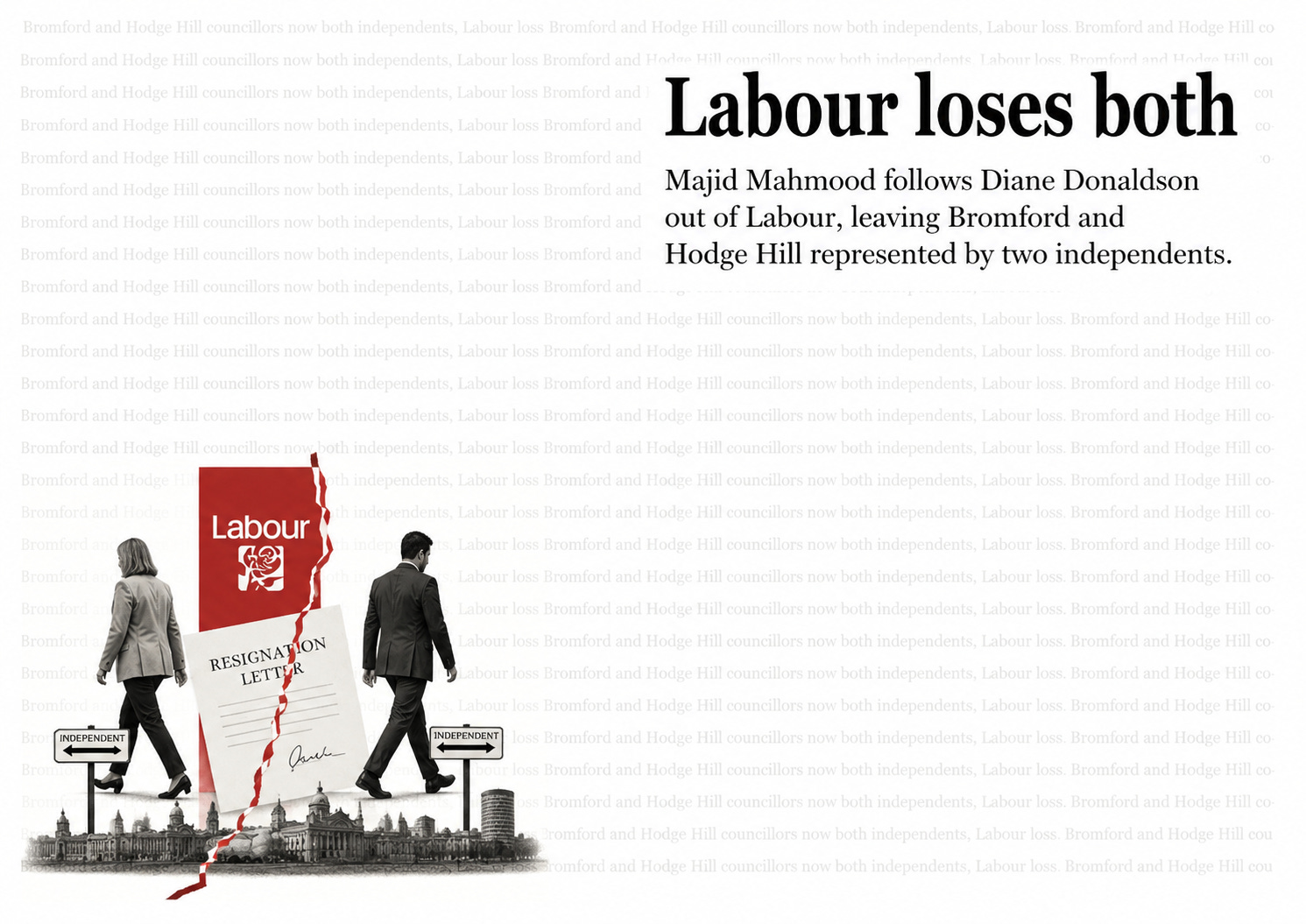
There are political resignations, dramatic political resignations, and then those rare civic explosions that send flakes of plaster drifting down from the ceiling while party officials stand underneath insisting the building is structurally sound. Cllr Majid Mahmood’s resignation from the Labour Party is one of those. Hot on the heels of Cllr Diane Donaldson walking away, Majid has now put his own letter into the Labour machine, and it is not exactly a thank-you note for the sandwiches. It is long, serious, occasionally repetitive in the way only a man with stored-up frustration can be repetitive, and damaging precisely because it comes from somebody who cannot simply be dismissed as a passing malcontent, social media foghorn or political day-tripper.
I have known Majid for a number of years. He is a solicitor, a committed politician, bright, serious, and someone who gets stuck in. That does not mean I am about to cover him in rose petals and carry him shoulder-high through Victoria Square. Good grief, no. When he was in charge of roads, his anti-car instincts were more than a little disappointing, and the pothole legacy he helped leave behind is not something I, as a cyclist, can applaud. Some Birmingham potholes are now so substantial they probably qualify for devolved status. There are craters in this city that have been with us longer than some cabinet members. But politics is not a cartoon. People are rarely all hero or all villain, except in party leaflets, where even the dog bins apparently vote on strict ideological lines.
Majid is more interesting than that. He believes things. He acts on them. He puts time, money and reputation into them. Over the years, I have been aware of his trips, often at his own expense, to offer aid, comfort and solidarity to refugees at the edges of Europe and to people caught in the horror of Gaza. You may agree with him. You may disagree with him. You may think his instincts are right, wrong, sentimental, courageous or politically awkward. But you would be wrong to suggest he lacks sincerity. Majid is not one of those politicians who discovers Palestine when there is a camera nearby and then forgets it when the buffet opens. He lives the issue. It matters to him. He has been prepared to make it part of his public life when silence would have been easier, tidier and far more convenient.
That is why this resignation matters. Parties can survive losing the loud. They can survive losing the ambitious. They can even survive losing the permanently offended, who in politics are less a faction than a weather system. What parties struggle to survive is losing the people who keep turning up. The people with roots. The people who have knocked the doors, answered the emails, carried the casework, taken the abuse, sat through the municipal porridge, and still come back the next morning. Diane Donaldson was one of those people. Majid Mahmood is another. Together they formed a serious ward operation in Bromford and Hodge Hill. They were not merely names on a ballot paper. They were a double act. Residents knew them. Officers knew them. Problems certainly knew them. If Diane’s resignation was a warning light on Birmingham Labour’s dashboard, Majid’s is the engine making a noise no responsible mechanic would ignore.
Naturally, the Labour machine will probably try to ignore it. That is what machines do when they are poorly maintained. They clank forward, leak oil, make dreadful noises and insist the service history is excellent. Modern Labour has become very good at producing language that sounds responsible while avoiding responsibility. Concerns are noted. Feelings are understood. Lessons will be learned. Matters are under review. Processes will be followed. Dialogue remains important. Everyone is valued. Nobody is listened to. It is a strange kind of politics, this, where members are praised as the lifeblood of the movement right up until one of them develops a pulse.
Majid’s letter is damaging because it accuses Labour, locally and nationally, of becoming centralised, cautious, top-down, closed, unresponsive and hostile to internal challenge. That is not a minor complaint. Indeed, the letter says these are not minor administrative issues so firmly that it more or less says it twice, which, in fairness, is sometimes necessary when shouting into the padded room of party management. He talks about dissenting voices being marginalised. He talks about questions going unanswered. He talks about a lack of feedback between leaders and those expected to deliver decisions on the ground. He talks about the Birmingham Labour Group becoming dysfunctional and toxic. He talks about local representatives being expected to support Reform UK councillors moving into influential committee positions. He talks about immigration, internal democracy, political expression being managed and policed, and Labour becoming disconnected from ordinary members and voters.
That is quite a list. In legal terms, and Majid will understand this better than most, it reads less like a resignation letter and more like particulars of claim. The defendant is the Labour Party. The alleged injury is political conscience. The remedy sought is escape. Labour may wish to present this as one councillor’s personal disappointment, but that will not do. Not after Diane Donaldson. Not after the quiet mutterings across the city. Not after the sense, now increasingly difficult to ignore, that Birmingham Labour is losing the people who once gave it local credibility while retaining the structures that made those people despair.
The Gaza section is perhaps the most personally powerful part of the letter. Majid is clearly furious that Labour’s leadership, and many senior figures within the party, have failed, in his view, to show moral clarity about the scale of suffering in Gaza. Others may argue with his language, his figures or his conclusions. That is politics. But nobody sensible should pretend this is some manufactured grievance. For many Muslim members, Muslim voters and others appalled by the human suffering, Gaza has become a deep rupture with Labour, not a fringe irritation. It has become one of those moral dividing lines where party management, cautious phrasing and carefully calibrated statements start to look less like diplomacy and more like cowardice wearing a lanyard.
Majid also says he had hoped there might still be space in Labour for a different direction, mentioning Andy Burnham as someone many once saw as representing a more grounded tradition. Even that hope, he says, has faded. When members stop believing change is possible inside a party, they do not merely leave. They stop lending the party their patience. And patience is an underrated political asset. Labour used to benefit from enormous reservoirs of patience in Birmingham. Working people gave it patience. Muslim communities gave it patience. Trade unionists gave it patience. Local activists gave it patience. Councillors gave it patience. Voters gave it patience. They tolerated the rows, the closed-door decisions, the municipal chaos and the occasional sense that nobody at the top could organise a sandwich without establishing a stakeholder engagement framework.
But patience is not infinite. When a party starts losing councillors like Diane Donaldson and Majid Mahmood, it should not ask how to brief against them. It should ask why people who spent years serving under its banner have concluded they can no longer remain in good conscience. That phrase matters. Good conscience. It is not the language of tactical positioning. It is the language of someone who has reached the end of his internal argument with himself. And once that happens, the usual tricks no longer work. A stern phone call does not work. A regional official sounding disappointed does not work. A rumour whispered into the municipal wind does not work. The person has already gone further inside themselves than the party machine can reach.
There will, of course, be the usual muttering about whether Majid should stand down as a councillor. This is the standard party sulk, wheeled out whenever an elected member leaves the tribe. If parties truly believe councillors automatically belong to the party rather than the electorate, Parliament can change the law. Until then, voters elect human beings, not just coloured rosettes on legs. Majid and Diane were elected by Bromford and Hodge Hill residents. They now have to answer to those residents. That is democracy. Untidy, inconvenient, and far harder to control than a regional office email.
As for Labour, this is not merely another difficult day. It is another crack in the wall. The party has not just lost another member. It has lost another serious local operator, another rooted councillor, another person with credibility in a community Labour cannot afford to take for granted. The danger for Labour is not that Majid Mahmood has left. The danger is that more people will look at his letter and quietly recognise the organisation he describes. They may not all resign. They may not all speak. Some will simply stop working, stop believing, stop defending, stop knocking doors with enthusiasm, stop explaining away the latest absurdity, and eventually stop voting Labour with any conviction.
I do not agree with Majid on everything. I still reserve the right to complain about the roads, the potholes, and any transport philosophy that appears to regard the private car as a moral failing with wheels. But on this, he has done something many politicians talk about and very few actually do. He has taken a stand when it would have been easier to keep quiet. He did not have to do it. He has done it. And in politics, where courage is so often outsourced to anonymous briefings, WhatsApp groups and carefully worded statements, that deserves respect.
Labour has not simply lost another councillor. It has lost another worker, another believer, another person who once thought the party could still be worth the trouble. When organisations start losing people like that, sensible observers do not ask what is wrong with the individual. They start asking what is wrong with the machine. Birmingham Labour may not enjoy the question. But after Diane Donaldson and now Majid Mahmood, it is becoming harder and harder to avoid.