


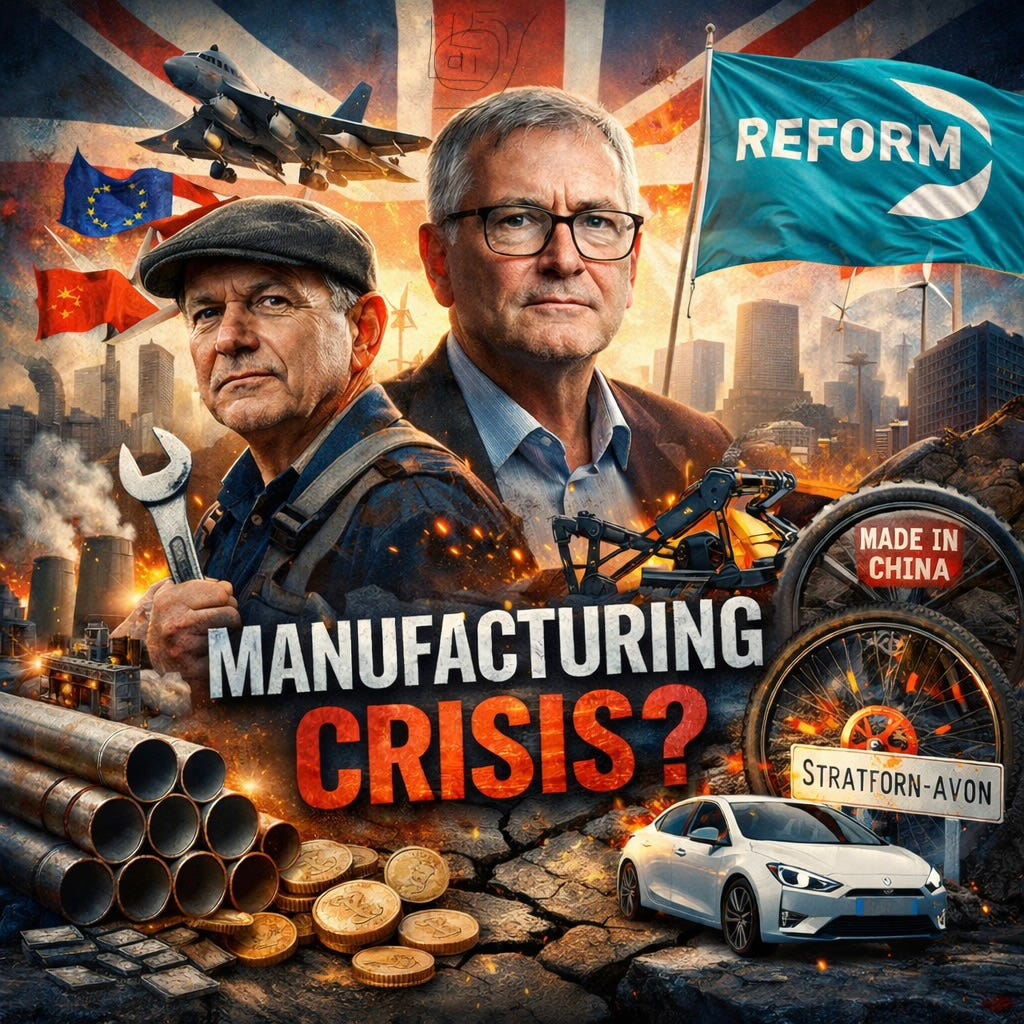
There is something faintly absurd about the way Britain talks about manufacturing.
We speak of it as if it were a museum piece. A sepia photograph. A story our grandparents told.
But Professor David Bailey has been patiently explaining that this is nonsense.
Manufacturing is not heritage. It is infrastructure.
It accounts for around ten per cent of UK GDP, roughly £220 billion a year. It delivers somewhere between forty and forty-five per cent of our exports. It generates two-thirds of private-sector research and development. It directly employs between 2.6 and 2.7 million people, with wages typically higher than the national median.
In the Midlands, the North West, Wales, Scotland and parts of the South West, it is far more than ten per cent. In some places it accounts for fifteen or even twenty per cent of local output.
When manufacturing weakens in those regions, it does not just mean fewer factory jobs. It means weaker supply chains. Fewer apprenticeships. Less innovation. Fragile local economies.
Bailey’s point is not sentimental. It is structural.
Productivity spreads through ecosystems.
Investment depends on predictability.
Competitiveness depends on cost.
Clusters need demand as well as talent.
He is not campaigning. He is analysing.
And if we ignore him, it will not be because the evidence was unclear.
I know what making things feels like
This is not theoretical for me.
I joined the Labour Party when I was working at BSA in Small Heath. BSA Guns. Precision engineering. Proper manufacturing.
Later I ran my own engineering works. Thirty-odd employees. Orders to win. Payroll to meet. Suppliers to manage. Customers who did not care about ideology, only delivery.
Manufacturing is discipline. It is responsibility. It is real.
And Britain has been drifting away from it for decades.
The long Conservative retreat
Let us not pretend this was an accident.
From 1979 onwards, under Margaret Thatcher, Britain pivoted sharply towards finance and services. The theory was elegant: the market would allocate resources efficiently. Capital would move from declining industries to dynamic ones.
In practice, vast swathes of industrial Britain were hollowed out.
Factories shut. Supply chains collapsed. Apprenticeships evaporated. Communities that had built complex industrial ecosystems over generations were dismantled in a decade.
Yes, some high-value sectors survived and modernised. Aerospace. Pharmaceuticals. Advanced engineering.
But much of the manufacturing base was not rebalanced. It was allowed to shrink, sometimes ruthlessly.
To say the Conservatives ran manufacturing into the ground will offend some ears. But in many industrial towns, that is simply how it feels.
And four decades later, there is still no sustained, scaled Conservative industrial renaissance to match the scale of what was lost.
Labour’s promise — and the gap
Now we have a Labour government.
The language is better. “Made in Britain.” Industrial strategy. Green transition. Rebalancing the regions.
But manufacturing does not run on language.
Professor Bailey describes the sector as resilient but constrained.
Constrained by high industrial electricity prices.
Constrained by policy volatility.
Constrained by short-term funding competitions instead of long-term cluster development.
Constrained by a financial system uncomfortable with patient industrial capital.
And then there are the moments that make people raise an eyebrow.
The West Midlands Combined Authority, under Labour leadership, recently awarded a fleet contract for imported bicycles.
At the same time, there is a British bicycle manufacturer in Stratford-upon-Avon capable of supplying domestically, effectively down the road.
This is not protectionism. It is coherence.
If public procurement in the industrial heartland of Britain does not anchor local manufacturing when capacity exists, what exactly is “Made in Britain” meant to signify?
Industrial strategy is not written in conference speeches. It is written in purchase orders.
Miss those opportunities and the signal is unmistakable.
Confidence weakens.
Supply chains thin.
Investment hesitates.
Bailey’s argument about place-based ecosystems suddenly becomes painfully practical.
The energy arithmetic
At the heart of the constraint lies one brutal fact: energy.
If industrial electricity prices in Britain are structurally higher than those of competitors, investment will flow elsewhere.
Not because investors are disloyal.
Because they can count.
Energy-intensive sectors, steel, ceramics, chemicals, glass, operate on margins sensitive to percentage points.
Meanwhile:
The United States is deploying large-scale industrial subsidies.
The European Union is matching strategically.
China continues to align state power, finance and industry with scale and intent.
Britain often treats climate policy and industrial policy as parallel conversations.
Bailey’s view is pragmatic. Align them, or accept diminished domestic production.
That is not ideological. It is arithmetic.
Reform’s clarity
Into this debate steps Richard Tice and Reform UK.
Reform speaks bluntly about cheap energy for industry. It argues that carbon costs and high electricity prices are undermining competitiveness. It frames manufacturing as essential to national wealth and resilience.
It does not hedge.
You may disagree with Reform’s broader platform. You may reject its approach to climate policy. But on manufacturing urgency, it is direct.
And in politics, directness matters.
At the moment, Reform sounds clearer than the traditional parties about the need to lower industrial costs decisively and back domestic production unapologetically.
That perception alone is politically significant.
Clear blue water
It must be said plainly: Professor David Bailey is not aligned with Reform UK.
He is not campaigning for them.
He is not endorsing them.
He is not echoing a party script.
He is an internationally respected industrial economist whose work spans years of regional research and structural analysis.
His argument is about competitiveness, cluster strength, productivity diffusion and long-term capital.
The fact that Reform currently occupies some of the rhetorical ground on manufacturing does not make Bailey part of its platform.
Conflating the two would be unfair, and inaccurate.
But it would also be naïve to ignore the political optics.
If a smaller party sounds more serious about making things than the party historically associated with labour and industry, that is not trivial.
Manufacturing is strategic power
This is not about romanticising smokestacks.
Modern manufacturing is aerospace. Defence systems. Advanced pharmaceuticals. Robotics. AI-enabled production lines. Battery gigafactories.
It is also steel, ceramics and chemicals, the foundations of everything else.
Manufacturing converts research into exports.
It anchors innovation geographically.
It sustains higher wages.
It builds resilience.
If Britain imports the turbines that power its green transition, imports the batteries that drive its electric vehicles, imports the infrastructure of its own transformation, then it has surrendered leverage.
That is not sovereignty. It is dependency.
The political risk for Labour
For Labour, this moment carries risk.
Many of its historic voters come from industrial backgrounds. Many union members work in energy-intensive sectors. Many regions Labour relies on are manufacturing-dependent.
If Reform becomes perceived as the only party speaking unapologetically about making things, that perception will spread.
Manufacturing should not belong to Reform. It should not belong to the Conservatives. It should not belong to Labour.
It should be a national strategic consensus.
But consensus requires action.
Competitive energy pricing.
Aligned procurement.
Scaled patient capital.
Long-term cluster development.
Policy stability measured in decades, not news cycles.
Without that, rhetoric curdles.
This is a fork in the road
The Conservatives presided over a historic contraction of British manufacturing and have yet to present a coherent industrial revival.
Labour speaks the language of renewal but must prove it through execution, particularly on energy pricing and procurement discipline.
Reform occupies the space of urgency, arguing bluntly that Britain must cut costs and back its producers.
Professor David Bailey stands outside this triangle, presenting the economic case without theatrics.
The evidence is there. The warning is clear.
The question is whether Westminster has the will to respond.
Making things is not old-fashioned
There is nothing backward about making things.
There is nothing embarrassing about precision engineering.
There is nothing naïve about wanting a country capable of producing what it consumes.
Manufacturing is applied intelligence. It is national capability made tangible.
It built Britain once.
It can strengthen Britain again.
But only if it is treated not as a slogan, not as a campaign backdrop, not as a nostalgic echo, but as strategic infrastructure.
If only one party currently sounds serious about that, the others have work to do.
Because making things is not about left or right.
It is about whether Britain intends to remain a country that produces, or merely one that purchases.
That is the real choice.
And it will not be made in speeches.
It will be made in energy policy, procurement decisions, investment strategy and political courage.
Professor David Bailey has done his part.
The rest is up to those who govern.