

The West Midlands did not flirt with Brexit, it made a clear decision, voting to leave the European Union by 59.3% to 40.7%, and that settled view still forms the backdrop against which everything now lands, particularly in the run-up to May’s council elections where control of key authorities remains very much in play.
In Birmingham itself the vote was closer, but the city sits within a wider regional mood that was not, and it is that broader sentiment which ultimately determines outcomes when votes are counted and councils change hands.
Against that backdrop, the timing of the current row looks, at best, misjudged.
With Reform UK pressing hard at local level and positioning itself to capitalise on any drift in Labour support, Keir Starmer has found himself drawn into what is being presented as a fresh example of EU alignment, not through a major constitutional shift but through something so apparently trivial that it becomes politically dangerous, the question of how marmalade is defined and labelled.
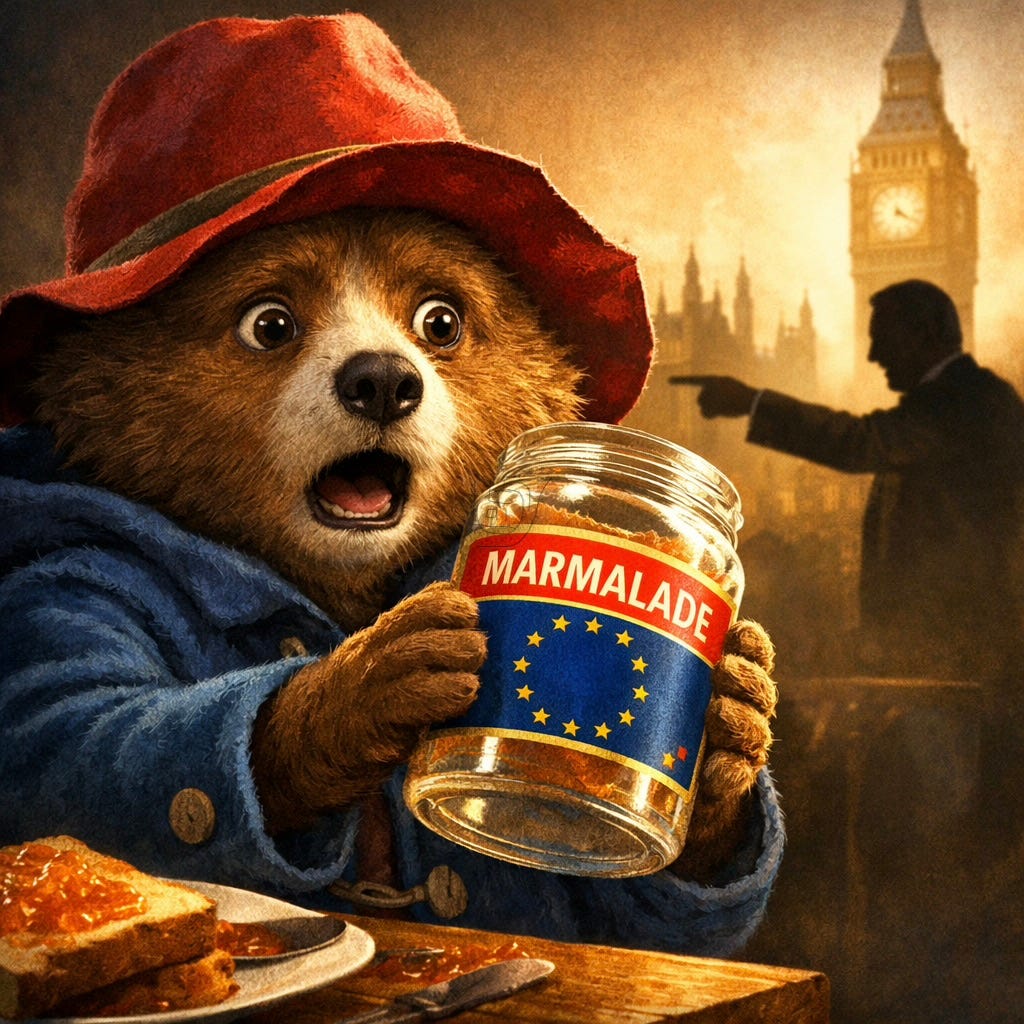
The headlines have done what headlines do, amplifying the idea that marmalade is somehow being banned, renamed, or interfered with, and even drawing in Paddington Bear as a shorthand for something recognisably British being put at risk, when in reality nothing of the sort is happening and marmalade will continue to be called marmalade in the UK exactly as it always has.
Paddington would not struggle to find his marmalade.
Unless he goes shopping in Paris.
That, however, is not the point, because politics does not operate on technical accuracy but on perception, and on whether something appears to confirm a direction of travel that people already suspect may be underway.
In this case it does, because it looks, however unfairly, like movement towards alignment, like a small step in a direction that many believed had been settled by the referendum, and in a region such as the West Midlands that is not a neutral signal to send, particularly at a moment when electoral control is finely balanced.
There was a time when Labour would have recognised that instinctively, without needing to model reaction or test language, because the people making the decisions were drawn from the same world as the people experiencing the consequences, and therefore understood how something like this would be read long before it became a headline.
I say this as someone still in the party, and not with any enthusiasm, but because it is increasingly recognised, even if not always said openly, that this connection has weakened more than the leadership appears willing to accept.
What has taken its place is narrower and more uniform, a political class shaped through advisory roles, think-tanks, universities and professional politics, capable enough in its own terms but operating with a different set of instincts and assumptions, and more prone to seeing decisions in technical terms rather than in the way they will actually be received.
Even the much-praised Morgan McSweeney, often credited as the architect of Labour’s electoral positioning, comes off a victory in Lambeth that owed as much to a Conservative collapse as to any exceptional strategic insight, which is less a criticism of the man himself than a reflection of how readily favourable conditions can be mistaken for transferable judgement.
That distinction matters, because it shapes not only the decisions that are taken but the expectations around how those decisions will land, and it is precisely there that the gap has opened.
In the West Midlands, people do not approach politics by working through policy documents in detail, they read signals, they form impressions based on whether something feels grounded in a reality they recognise, and whether it appears to come from people who understand how their lives are actually lived rather than how they are described in a briefing note.
Labour once operated comfortably within that understanding and did not need to translate itself, whereas now it can sometimes feel as though it is translating from a different language altogether, one that requires interpretation before it can be trusted.
You see that most clearly not in the large, obvious decisions, but in the small ones that are assumed to pass unnoticed, because those are the moments where instinct either aligns or jars, and where trust is quietly reinforced or eroded.
You would have to ask how many Labour MPs today would know what to do with barrier cream at the start of a shift, or reach for the Swarfega at the end without thinking twice, because that is not a throwaway cultural reference but a marker of whether someone understands the rhythm and reality of working life or is observing it from a distance.
This is where the political risk becomes real.
The West Midlands is not simply another region moving through the electoral cycle, it is a region where Labour’s hold on local government is under genuine pressure and where several councils could change hands if the mood shifts even slightly, particularly with Reform UK actively positioning itself to capture that shift and convert it into control at council level.
In that context, timing is everything, and allowing even the appearance of renewed EU alignment, however technical or limited in substance, to surface at this point raises a legitimate question about whether the political sensitivity of the moment has been fully understood.
Because the issue is not the policy itself, which in isolation is minor, but the meaning that is attached to it once it enters a low-trust environment where voters are already inclined to read decisions as part of a broader pattern.
Labour was built on a foundation of working and middle-class support and did not need to interpret working life because it emerged from it, whereas over the past twenty years that balance has shifted, with working-class influence receding and being replaced by a more professionalised political layer that speaks confidently about representation while becoming increasingly detached from the experience it seeks to represent.
That shift is visible in tone, in assumption, and in moments such as this, where something small is allowed to carry a meaning that far outweighs its substance, because the instinct that would once have caught it early is no longer as reliable as it was.
What is then read in places like the West Midlands is not a narrow policy adjustment but a broader sense that decisions are being made at a distance, and that the democratic decision to leave the European Union is being gradually reinterpreted rather than directly challenged, which is a far more politically sensitive perception than the underlying detail would suggest.
In that environment, voters do not need to follow the specifics to reach a conclusion, because they are responding to direction rather than detail, and if that direction no longer appears to reflect their own, they will look elsewhere for representation.
In the West Midlands, that alternative is now clearly defined.
This is why the issue matters, not because of marmalade, which remains unchanged, but because of what it appears to signify when filtered through a region where trust is already fragile and political alignment is contested.
Because once that question begins to be answered in the negative, it is not the detail that determines the outcome, but the direction that voters believe they are being taken in, and whether they are prepared to follow it.
And in a region such as the West Midlands, at a moment such as this, that judgement may not be expressed in argument at all, but in movement, at the ballot box, and in the quiet transfer of control that follows.