
Mayor Making in Birmingham: Chains On, Leadership Missing
As of Tuesday 17:48 council adjourned for further coalition talks.

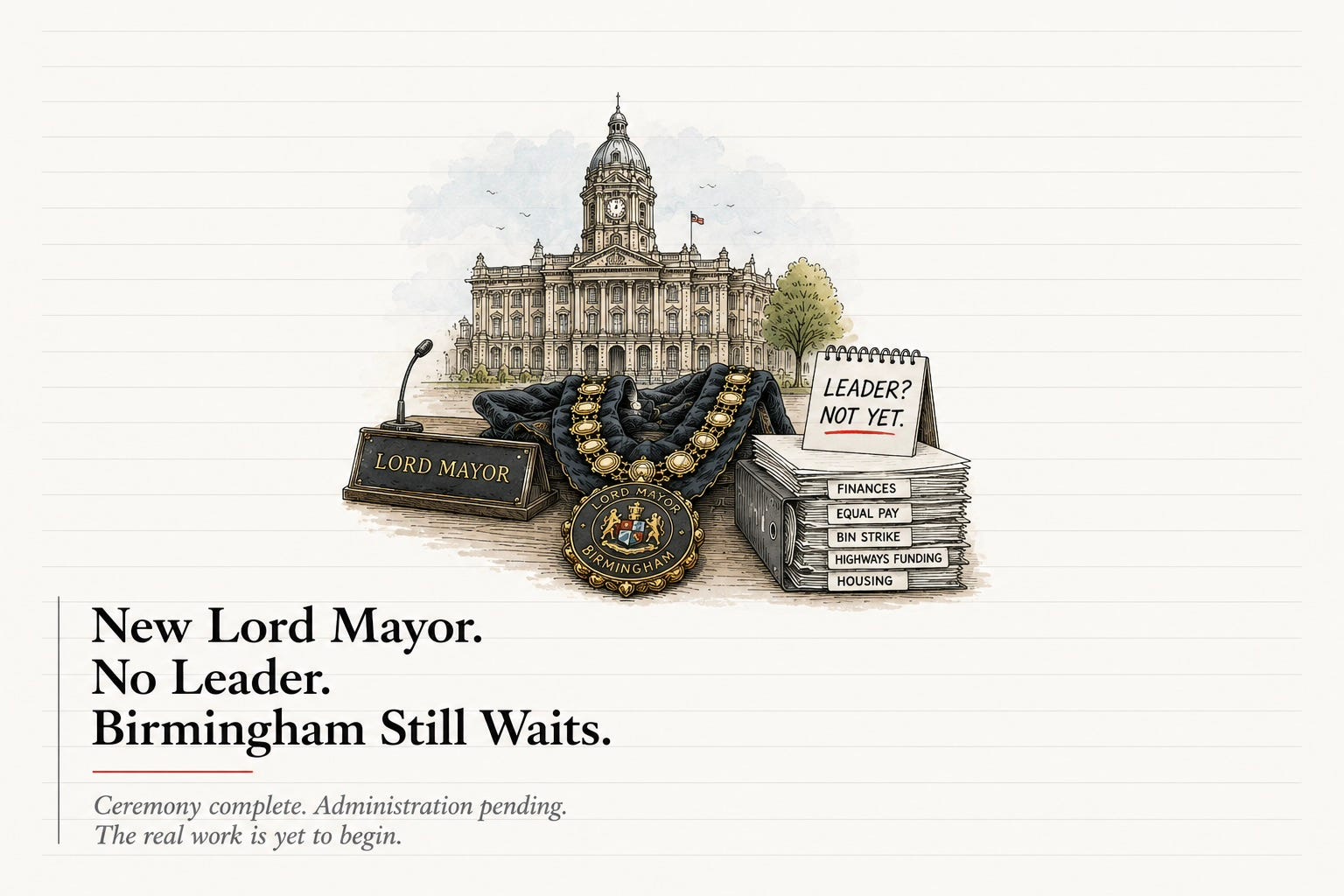
There are few occasions in Birmingham’s civic calendar quite as gloriously over-dressed as Mayor Making. Gold chains, polished wood, ancient ritual, and just enough solemnity to make you wonder if someone, somewhere, ought to be chanting in Latin. And yet, for all the ceremony, this year’s event carried a rather modern twist. We have a new Lord Mayor, the chains have been passed, the speeches delivered, the applause duly given, and still, when the chamber empties and the doors close, one rather obvious question hangs in the air. There is, as yet, no one actually running the council.
Welcome to Birmingham, 2026.
The chains have passed to Cllr Zaker Choudhry of the Liberal Democrats, and he steps into office at what might generously be described as an “interesting” moment. With no overall control of the council, the role of Lord Mayor this year stretches well beyond ceremony. He is not merely first citizen, but in effect the steady hand at the centre of what could become a long, careful, and occasionally untidy negotiation over who governs Britain’s largest local authority. Chairman, referee, ringmaster, at times perhaps all three at once, and always with the expectation that the show continues regardless.
The ceremony itself, as ever, did not disappoint. Familiar faces dotted the chamber, including Mike Whitby, a man who once made a coalition between Conservatives and Liberal Democrats not only possible but functional, which in Birmingham terms is practically a minor miracle. Whitby now occupies the calmer waters of the House of Lords, his years of service translated into a life less troubled by bin strikes and budget lines. His former deputy, former councillor Paul Tilsley, remains on more terrestrial ground with a CBE, a fine honour no doubt, though one suspects the red benches would not have suffered from his presence, and might even have benefited from it.
There were, too, moments when the chamber lifted itself above process and remembered the city it serves. References to Benjamin Zephaniah and Ozzy Osbourne carried real weight, two very different figures, both unmistakably Birmingham, both now gone, both part of a cultural identity that stretches far beyond council agendas and committee reports. For a brief moment, it felt less like a meeting and more like a city reflecting on itself.
Labour’s leader, councillor Nicky Brennan, delivered what was effectively her first major speech in the role with a calm, measured authority. It was exactly what the occasion required, respectful without being overdone, confident without straying into performance. Around her, the modern habits of council life carried on. Councillor Majid Mahmood spent a fair portion of proceedings in quiet communion with his mobile phone, a small but telling reminder that even the oldest traditions now sit alongside the constant pull of the present day. One assumes matters of importance were being attended to, though the optics, as ever, told their own story.
Tradition itself had already taken a slight knock. Councillor Des Hughes would ordinarily have stood to offer thanks, but the electorate of Kingstanding had other ideas. Democracy, in its quiet way, has a habit of rearranging even the most carefully choreographed civic rituals, and so the script adjusted itself without fuss, as it always does.
Then came the appointment that prompted a murmur of interest, councillor Shafique Shah as Deputy Lord Mayor. At first glance, it seemed curious. On closer inspection, entirely logical, though perhaps more revealing than intended. The previous postholder had stepped down, the replacement needed to come from the same party, and not just any councillor but one who had previously held the office. Which meant turning the clock back a full decade to 2014 to 2015.
And so, back comes councillor Shafique Shah, looking, it must be said, remarkably youthful for someone effectively returning from Birmingham’s civic archives. But beneath the gentle humour sits a sharper point. To reach back ten years for a qualifying Labour candidate says something about the present state of the group. The bench is not simply thin, it is beginning to look like a historical record rather than a living roster.
A welcome note of warmth came from former Deputy Lord Mayor Ken Wood, who introduced Shah with brevity, humour, and a sense of ease that cut neatly through the formality. It was a small moment, but one that reminded everyone that behind the titles and procedures there are still individuals capable of bringing a room with them.
Then came Item 11, allowances. Now, this is where Birmingham shows its more understated side. Not secretive, certainly not, but quietly efficient in a way that ensures nothing lingers longer than it needs to. The allowances for the Lord Mayor were agreed, but those watching online were treated to something approaching municipal theatre of the absurd. The item appeared. The microphones did not. Silence filled the gap.
Unless you were physically present, you heard nothing at all.
My own estimate places the figure somewhere between £25,000 and £35,000, though arriving at a precise number requires the sort of persistence normally associated with long-distance navigation. And yet, for a role that can demand seventy or eighty hours a week, representing the city across Birmingham, the wider country, and occasionally beyond, it is difficult to argue that it is anything other than good value. In truth, it feels less like a salary and more like a modest acknowledgement of a very large commitment.
The petitions brought the chamber back to more familiar ground. Councillor Majid Mahmood re-engaged, pledged his full support to the new Lord Mayor, and then turned to the issue of exempt accommodation and HMOs, urging the council to do more. One might, gently, observe that previous opportunities may have existed when he himself held responsibility, but politics is rarely concerned with what might have been. It deals, almost exclusively, in what must now be done.
And then, just as the meeting settled into its rhythm, came the moment that defined the day. Item 17, the appointment of the Leader. Except, not quite. The Lord Mayor moved that the meeting be adjourned. More time was needed. Talks were positive. Progress was being made. The language was careful, the tone reassuring, but the conclusion unmistakable. There is, as yet, no agreement.
Birmingham, Europe’s largest local authority, currently has no settled leadership.
At this point, I am indebted to Conservative press adviser Nathan Brown, who circulated a timely reminder of what is at stake. Councillor Robert Alden, leader of the Conservative Group, was clear in his assessment. The city has not chosen one party to govern, but a mixture, and that mixture now carries a responsibility to work together. His deputy, councillor Alex Yip, set out the backdrop in equally direct terms, financial pressure, unresolved equal pay, an ongoing bin strike, changes to collections, and a widening gap in highways funding.
These are not abstract concerns. They are the mechanics of daily life in a city of this scale.
The Conservative message is straightforward. Stability, cooperation, and a rejection of ideological positioning in favour of practical governance. Whether that message lands, and with whom, remains to be seen.
And so Birmingham finds itself in a curious position. The ceremony has been completed with all the expected dignity. The chains have been placed, the speeches delivered, the chamber has done its part.
But the central question remains unanswered.
Who is actually in charge?
Still, perhaps there is no need to rush. Some might argue the city has been drifting for some time, and a few more days of uncertainty will do little additional harm. If anything, it adds a note of anticipation.
Mayor Making, after all, is only the opening act.
The real performance is about to begin.