
Mayor Richard Parker Was Far Too Generous to Britain’s Fifth City
Manchester’s civic swagger is easy to mock. Harder is admitting that Greater Manchester works because its neighbours grew up, while ours still fight over the headed paper.

West Midlands Mayor Richard Parker was on the train to Manchester and called it Britain’s third city. It was plainly a joke, and a decent one. He was travelling to meet the Prime Minister, not presenting the regional final of University Challenge. Even so, our Mayor was far too generous. On one perfectly respectable population measure, Manchester is fifth. Birmingham should welcome Parker home with a cup of tea and a small badge reading: “I visited Britain’s fifth city and all I brought back was a devolution deal.”
There is, however, an awkward second half to the joke. Manchester may be fifth on that particular table, but it has spent decades behaving like a capital. Birmingham is larger, more central and blessed with an accent nobody from outside the city can imitate successfully, yet we still sometimes enter the national conversation as though we have come to repair the photocopier. Manchester arrives with a plan, a slogan, a bee and three television crews. We arrive with a consultation document and an apology that Coventry could not attend because the meeting was being held in Birmingham.
Manchester’s success did not begin when Andy Burnham bought his first smart jacket. Sir Howard Bernstein and Sir Richard Leese had already spent years building the civic machine, supported by cooperation between the ten Greater Manchester councils. Burnham inherited strong foundations, recognised their value and built upon them. Spotting a working engine and resisting the political urge to dismantle it with a ceremonial screwdriver is a considerable talent. Greater Manchester now sounds natural because its leaders kept saying it until everybody else accepted it.
Notice what did not happen. Bolton did not vanish. Salford was not bulldozed into a Manchester suburb. Stockport was not forced to surrender its crest, its council chamber or its opinions. Those places kept their identities, football grudges and sense of local superiority while presenting government, investors and the wider world with one recognisable front door. Greater Manchester works because it is short, clear and understood. That sounds elementary, but it is several educational stages ahead of the West Midlands when it comes to naming partnerships.
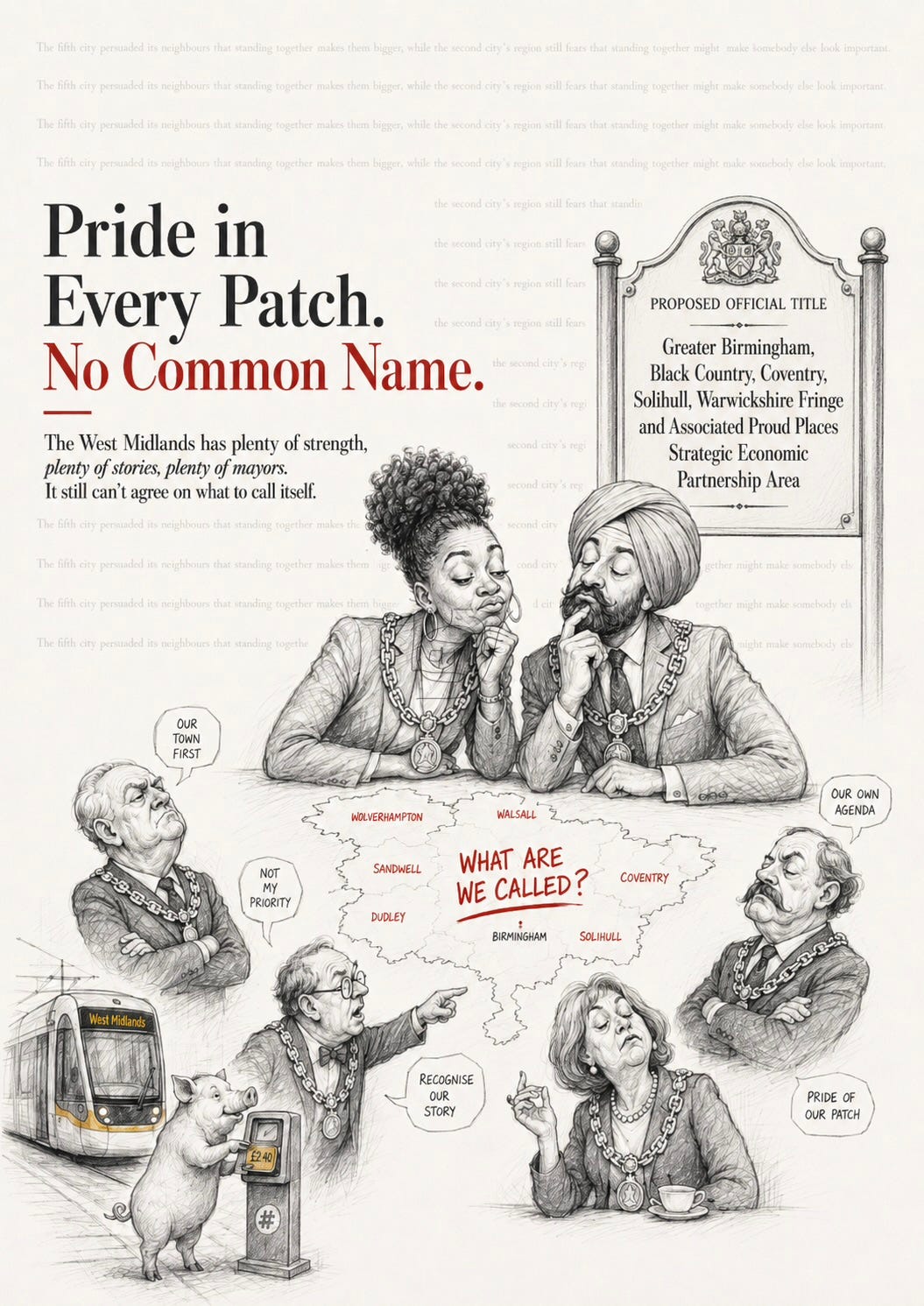
The obvious equivalent is Greater Birmingham. The chances of our councils agreeing to that are somewhere between remote and pigs catching the tram and paying the exact fare. Mention those two words in certain civic circles and chains of office begin to rattle. Wolverhampton suspects annexation. Solihull checks the house prices. Dudley reaches for the Black Country flag. Coventry reminds everybody that it had a cathedral while Birmingham was still deciding where to put the Bull Ring.
By teatime, the compromise name becomes the Greater Birmingham, Black Country, Coventry, Solihull, Warwickshire Fringe and Associated Proud Places Strategic Economic Partnership Area. Its logo requires landscape mode. Its headed paper needs a continuation sheet. The launch is held in a neutral motorway service station because every actual town is considered politically provocative.
Yet Greater Birmingham need not erase anybody. I was born and raised in Shirley. I support a Black Country football team. I have driven a Coventry car, and my nan was born there. Birmingham later made me an Honorary Alderman. None of those loyalties has ever cancelled another. I have been a Greater Brummy all my life. I simply lacked the headed paper.
Ordinary people cross these boundaries constantly. We travel across them for work, shopping, football, hospitals, universities, entertainment and family. Many people living in Solihull work in Birmingham. People from Birmingham visit Coventry, Walsall, Wolverhampton and the Black Country without requiring diplomatic papers. Business understands that the regional economy does not stop at the borough boundary. It is largely our civic institutions that behave as though the old boundary line is electrified.
Birmingham has shown what can happen when it thinks beyond the parish pump. Sir Frank Price and others drove the creation of the NEC, which opened in 1976 beside the airport and railway. It was an act of civic confidence that changed the economic geography of the region. Dick Knowles later helped drive the ICC, Symphony Hall and the opening up of the western side of Birmingham city centre. Brindleyplace then turned derelict canalside land into one of Britain’s most successful regeneration schemes.
These were not timid projects. They were Birmingham saying, “This is where the country should meet,” and then building the place where it could. Later came the current Bullring, New Street and Grand Central, Paradise and the Commonwealth Games. The region can build magnificent things. It can stage magnificent things. It can occasionally astonish the country.
The problem is not that Birmingham and the West Midlands have achieved nothing. The problem is that our achievements too often sit like handsome individual exhibits rather than chapters in one continuing regional story. Manchester built momentum. We built several excellent things and then wandered off to rename the partnership.
This is also where locally rooted business figures matter. Stephen Goldstein built substantial commercial property businesses and played an important role in regeneration work around the Jewellery Quarter. People like Goldstein bring commercial knowledge, contacts, civic memory and the useful ability to remember what was agreed before the latest chief executive arrived. Manchester became good at keeping politicians, officials, businesses, universities and institutions around the same table. Birmingham has often had the right people, but not always the same table for very long.
So here is a gentle challenge to Richard Parker and the leaders of Birmingham, Coventry, Dudley, Sandwell, Solihull, Walsall and Wolverhampton. What do you collectively suggest we call this region when selling it to the world?
The answer must contain no more than three words. No slashes, ampersands, compass points, “wider”, “strategic”, “partnership”, “functional economic area” or explanatory asterisks. It must fit on a road sign and be remembered by somebody who has never attended a scrutiny committee.
If Greater Birmingham is unacceptable, produce something better. “West Midlands” is administratively accurate, but it sounds like the place where the weather presenter points when the rain has become too general to locate.
If our leaders cannot agree, let us at least be honest about why. It is not geography. It is municipal vanity. Are they civic leaders with the confidence to enlarge the region, or municipal mudlarks content to snuffle through the parish pump sludge for one tiny ceremonial pearl bearing their own town’s crest while Manchester walks away with the entire oyster bed?
Local pride is valuable until it starts costing jobs, investment and national influence. At that point it becomes an expensive hobby conducted in mayoral robes.
Richard Parker’s Manchester joke was good. Our correction should be affectionate: fifth city, Richard, fifth. But Manchester deserves the last laugh unless the West Midlands learns its deeper lesson. The fifth city persuaded its neighbours that standing together makes them bigger. The second city’s region still fears that standing together might make somebody else look important.
Greater Manchester got over itself years ago. Greater Birmingham, whatever we finally call it, needs to grow up, choose a front door and stop arguing over whose name goes on the bell.
Excellent and important piece, Mike