

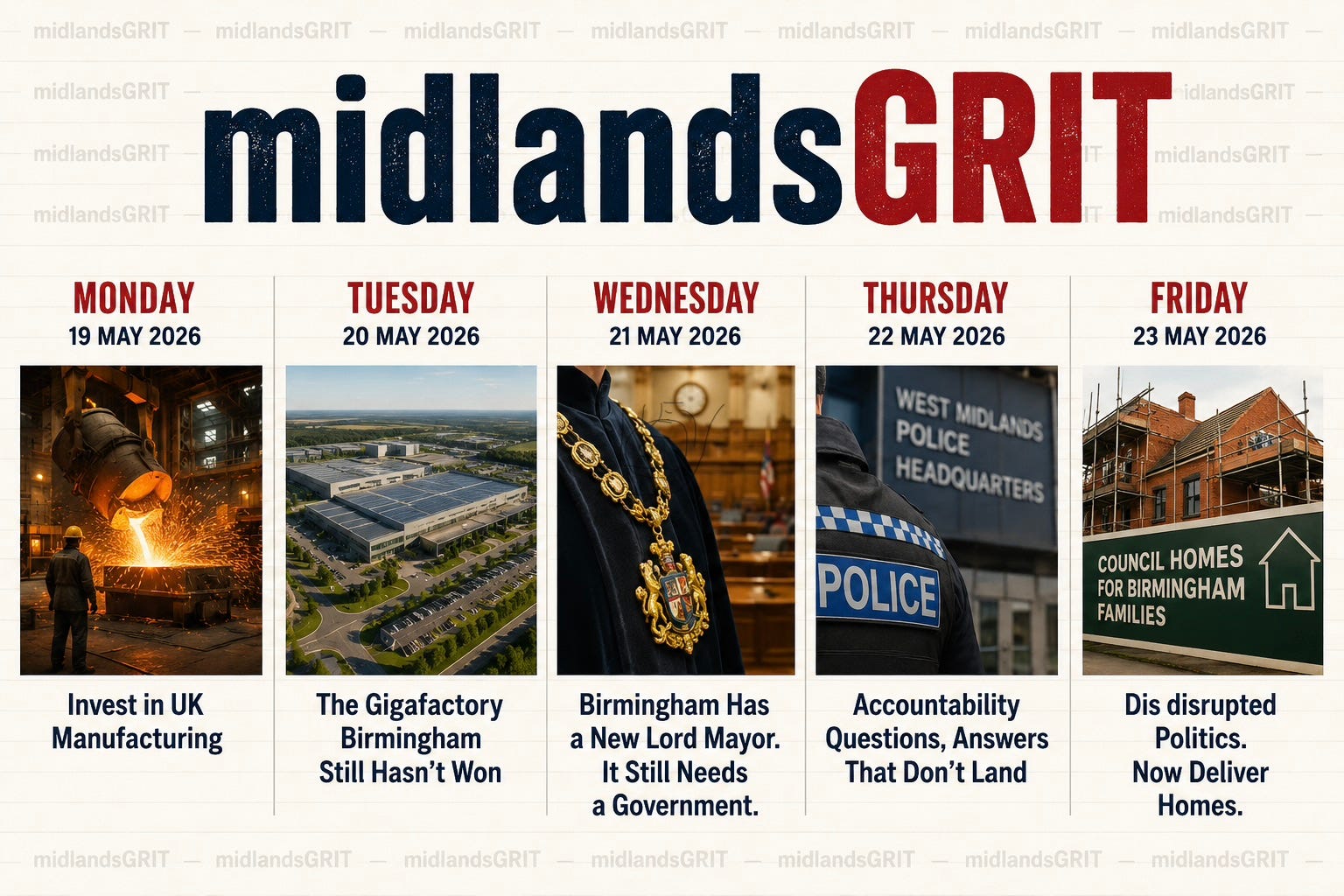
Readership this week edged past 30,000 across platforms. That matters, not as a vanity metric, but because it tells us something simple: people are paying attention. And this week, Birmingham gave them something worth reading.
Friday, 23 May 2026
What the city’s voters did was not routine. They did not just reshuffle seats in the council chamber. They disrupted the political settlement that had settled into something quieter, slower, and far less decisive than it should ever have become.
Labour and the Conservatives were not rejected out of habit or boredom. They were punished because too often they stopped behaving like political leaders and started behaving like custodians. Decisions were delayed, softened, reviewed, parked, or quietly handed over to officers, commissioners, and process. That is how decline embeds itself, not dramatically, but administratively.
Administrators can maintain a system. They cannot renew it. That requires people willing to decide.
And now that responsibility has been handed, conditionally, to a fragmented but newly trusted group: Greens, Reform, independents, and others. It is not a blank cheque. It is a test. The message from voters is not complicated. The old lot stopped deciding, so now you decide.
Which leads to the first real measure of whether this disruption means anything at all.
Not flags. Not motions. Not another round of civic theatre where everyone performs conviction while the city remains stuck. Birmingham has had enough performance. It needs outcomes. It needs homes.
Not “affordable” in the abstract, where the definition stretches so far that ordinary families cannot reach it. Not another polished partnership where the developer takes the margin, the consultant supplies the language, and the council supplies the photo opportunity.
Council homes. Built with purpose. Owned publicly. Let at rents people can actually pay.
So the challenge is simple, and it comes with a date.
By 1 January 2027, show the city something real. Land identified. A route agreed. Work started. And if at all possible, the first keys in the hands of Birmingham tenants.
No strategy refresh. No glossy document. No carefully worded preface. Keys. Doors. People moving in.
That is how disruption becomes delivery.
Thursday, 22 May 2026
The same theme runs through the question of policing accountability, where clarity seems to dissolve just when it is most needed. Questions were put, plainly and directly, about process, about misconduct, about whether officers can step away before accountability catches up with them. At the centre of it sits something technical but critical, Regulation 17, the formal trigger that turns concern into an actual case.
The response confirmed referral to the Independent Office for Police Conduct. That matters. But beyond that, detail faded into process. Scope, timeline, certainty, all left unstated.
And that is where public confidence starts to fray, not necessarily because something is wrong, but because no one can quite see what is happening.
This matters even more when you look ahead. The Police and Crime Commissioner model itself is likely to disappear, folded into mayoral systems where oversight becomes more distant and less directly accountable. However tidy that looks on paper, distance has never been a reliable ally of scrutiny. The ability to ask a named individual a direct question, and expect a direct answer, is not a small thing. Once it is gone, it is not easily replaced.
Distance dulls accountability. That is its nature.
Wednesday, 21 May 2026
Meanwhile, back in the council chamber, Birmingham performed one of its oldest rituals. Mayor Making delivered exactly what it always does, ceremony, history, and a sense of civic continuity. Cllr Zaker Choudhry now wears the chains, and the moment itself was handled with dignity and care.
But as the ceremony ended, the reality returned quickly enough.
There is still no settled administration.
The city has a Lord Mayor, but not a government. That distinction, usually invisible, is now central. Speeches were made, signals were sent, positions cautiously outlined. Labour’s new leadership struck a measured tone. Other voices pointed to the scale of the challenge ahead, finances, equal pay, services under strain.
And yet the central question remained unanswered. Who is actually running Birmingham?
Talks continue. Progress is suggested. But until an administration is formed, the city sits in a holding pattern. That may prove to be a short pause for negotiation, or it may reveal something deeper about fragmentation and the difficulty of turning electoral disruption into coherent governance.
Residents will not wait long for the answer. They rarely do.
Tuesday, 20 May 2026
Set against all of this is a quieter but more consequential failure, the gigafactory that still has not arrived. On paper, the West Midlands is the obvious location. Industry, skills, history, geography, it all points here. And yet, nothing has been built.
Elsewhere, decisions have been made. Sunderland moves forward. Somerset builds. The West Midlands continues to discuss.
The issue is not mysterious. A gigafactory is not a simple assembly plant. It is energy-intensive, capital-heavy, and ruthlessly sensitive to cost and certainty. Investors are not interested in where it feels right. They want to know where it works, reliably, over decades.
Right now, the region is not answering that strongly enough.
And without urgency, logic alone is never enough. Industry follows pressure. Where political, financial, and strategic signals align, investment lands. Where they do not, it drifts.
That drift is the real risk. Not collapse, not sudden loss, but a gradual shift where the highest value parts of manufacturing move elsewhere, leaving behind only the lower-margin work of assembly.
The region still has time. But time, without decision, is easily wasted.
Monday, 19 May 2026
Which brings us back to the simplest argument of the week, one that cuts through ideology and lands squarely on arithmetic.
Investment in manufacturing is not a cost. It is a revenue stream.
A single £40,000 worker returns a substantial portion of their income to the Treasury through direct and indirect taxation. Scale that across thousands of jobs, across a decade, across supply chains, and the numbers become difficult to ignore. A major industrial investment does not merely employ people. It feeds the public finances that sustain everything else.
And yet, government repeatedly finds itself more comfortable funding decline than building growth. Money appears when collapse threatens, but struggles to arrive early enough to prevent it.
Saving British Steel may be necessary. But it is defensive. It holds the line. It does not move it forward.
Building new industry does.
The West Midlands still has the foundation. Skills remain. Capacity remains. The question is whether the political system, locally and nationally, is willing to act with the clarity and urgency that foundation requires.
Because that is the thread running through everything this week.
Voters have disrupted the system. Institutions are being questioned. Structures are shifting. Opportunities exist.
But none of it matters without decision.
Build something. House someone. Fix something. Decide something.
And then, by the start of 2027, hand someone the keys.
And finally, a simple thank you. Just over 30,000 of you followed along this week, which is no small thing given the length, the pace, and the refusal to skim the surface. This only works because you are prepared to read, think, question and stay with it. That kind of attention is rare, and it matters more than you might think.