
MidlandsGRIT Weekly Digest
Week Ending 16 May 2026

Before we get into Birmingham’s political fragmentation, a quick note on something building rather than breaking.
Olleys Live is back, and already finding its audience.
Early indications point to around 40,000 viewers for the return, a serious number for a regional political programme and a clear sign there is appetite for unscripted, straight conversation.
A big thank you to those who have already been in touch.
The programme airs again on Sunday, but you can watch it now:
Now, to the week.
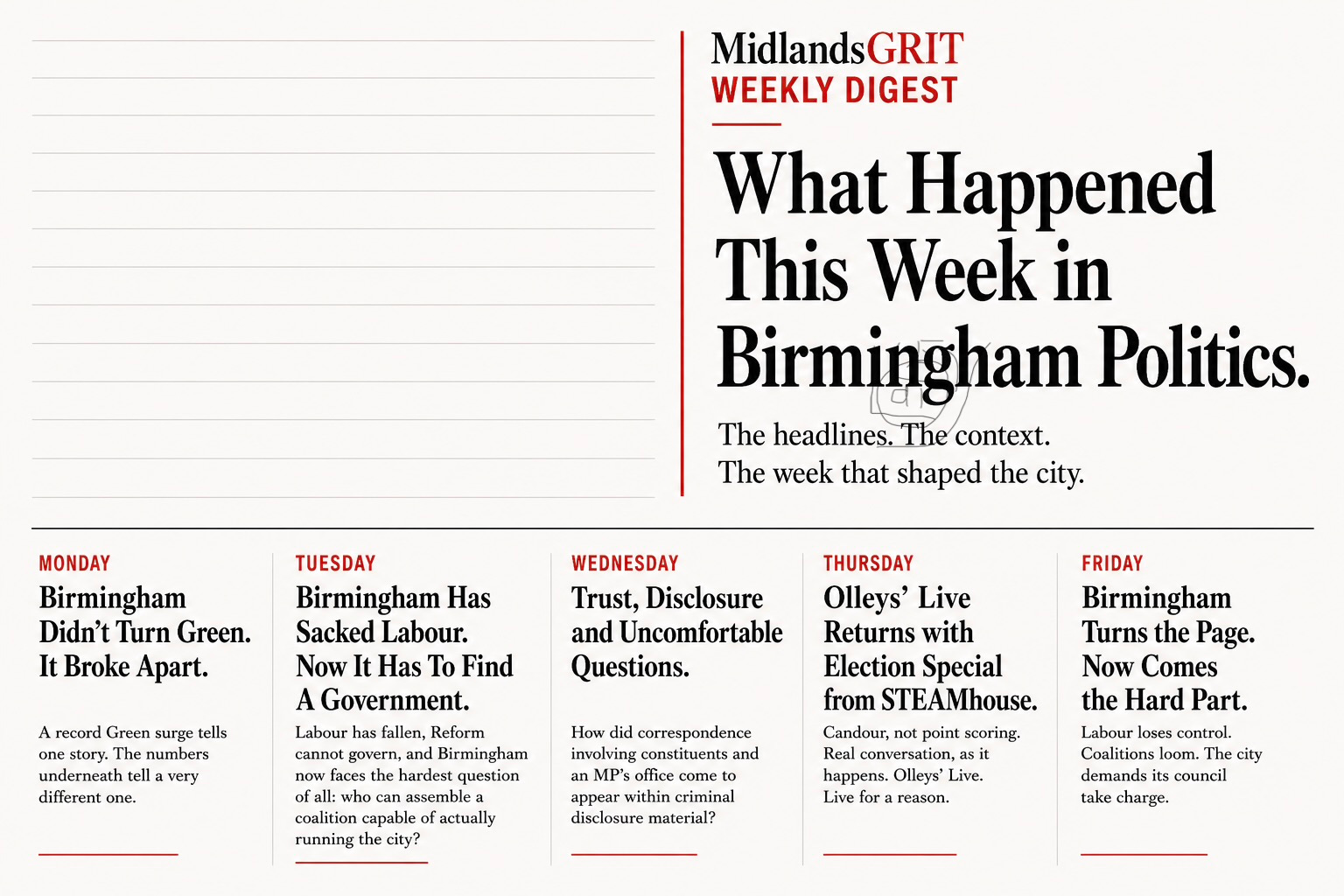
**Monday
A city still catching its breath**
Monday carried the feel of a city waking up after an electoral shock but not yet fully processing what had happened.
There was no clear narrative being settled. No dominant interpretation. Just a growing realisation that Birmingham had not voted for a new direction so much as it had rejected the old one.
That matters.
Because rejecting something is easy. Replacing it is not. And already, beneath the surface, the question was forming: if Labour is no longer in control, who actually is?
**Tuesday
Trust, disclosure and uncomfortable questions**
There are certain roles in public life where trust is not optional. It is the foundation. An MP sits firmly in that category.
Which is why questions now being asked about how constituent correspondence appears within criminal disclosure material carry real weight.
This is not gossip. Disclosure schedules, MG6C documents, sit inside the formal machinery of the criminal justice system. They are structured, accountable and part of due process.
Against that backdrop, references to timelines of contact and email bundles involving constituents and the office of Preet Kaur Gill in connection with a West Midlands Fire Service related matter raise a simple but important public-interest question.
How does that material arrive there?
There may be an entirely lawful and straightforward explanation. At present, none has been publicly set out despite correspondence sent to Preet Kaur Gill, Jonathan Reynolds and regional party officials.
No allegation is made. That point matters. But nor does the question go away.
Because if people begin to doubt where their confidential approaches may end up, trust in the system does not erode gradually. It drops away sharply.
MidlandsGRIT stands ready, as ever, to publish any substantive clarification offered.
**Wednesday
The easy part is over**
By Wednesday the reality had hardened.
Birmingham has done the easy part. It has removed Labour from control. The harder task now is building something in its place.
Reform may have emerged as the largest group, but numbers alone do not confer power in a chamber where cooperation defines governance. With other parties ruling out formal alignment, their likely role is opposition rather than administration.
The centre ground has shifted instead towards experience and pragmatism.
Roger Harmer, leading the Liberal Democrats, has moved quickly into a constructive space, pairing steadiness with an understanding of how local government actually functions. Alongside him, Bobby Alden offers similar institutional weight from the Conservative side.
Between them sits a new reality.
The Greens must now transition from protest to responsibility. Budgets do not bend to slogans. Nor do equal pay liabilities or service failures.
And then there are the independents. A loose but influential bloc, carrying enough votes to tilt decisions in a chamber where margins are thin and alliances fluid.
What Birmingham has elected is not a government.
It is a negotiation.
And the risk is obvious. Government by committee, where accountability dissolves and officers quietly regain control. Birmingham has been down that road before.
It does not need a repeat performance.
**Thursday
Olleys Live returns**
Series 3 of Olleys Live opened from STEAMhouse at Birmingham City University, a setting that reflects a city still trying to build rather than simply argue.
Joined by Khalid Mahmood and Ewan Mackey, the conversation carried something increasingly rare in modern political discussion: candour without performance.
All participants have served. All have stepped away. That distance changes the tone. The need to defend disappears, and what remains is something closer to honesty.
No heavy edits. No manufactured angles.
Just conversation as it actually happens.
Olleys Live.
Live for a reason.
**Friday
Birmingham didn’t turn Green**
By Friday, the narrative that Birmingham had “turned Green” began to look far too neat for the reality on the ground.
Yes, the Greens secured 19 seats and topped the overall vote. But this was not a unified swing. It was fragmentation.
In some wards, such as Bournbrook & Selly Park and Kings Heath, there is genuine depth, a coalition forming over time. In others, results reflect Labour’s collapse more than Green dominance.
And in several places, victory came through division rather than outright support.
One result in particular cuts through the noise.
Cllr Julien Pritchard’s hold on Druids Heath & Monyhull stands out. Demographics that might have leaned towards Reform did not translate into votes. Instead, consistent local work appears to have carried the day.
Compare that with parts of Solihull Metropolitan Borough Council, where Reform surged strongly in similar communities, and the contrast becomes instructive.
Places do not always follow national patterns. Local credibility still matters.
The Greens now speak of collaboration. On paper, entirely sensible in a council with no overall control.
But politics is not conducted on paper.
If Jex Parkin were to offer alignment on shared priorities, would that be accepted?
Or does the quiet reality look more like this:
Yes, all very encouraging… but that light blue really doesn’t go with Green, sorry.
Because the moment of truth in politics is not the press release. It is the vote.
And beyond all of that sits a final challenge for the Greens themselves.
Going from two councillors to nineteen is not just growth. It is transformation. A broader intake brings a broader range of views, pressures and internal tensions.
Holding a clear line across that is now part of the job.
Birmingham has not turned Green.
It has become competitive again.
Closing note
If there is a single thread running through the week, it is this.
Birmingham has moved out of certainty and into contest.
That brings risk. It also brings possibility.
But possibility only counts if those elected can turn fragments into something that actually works.
The voters have done their part.
Now comes the harder bit.
Aston is very interesting and needs to be set in the context of Ayoub Khan MP who has clearly a deal of influence in that ward and that itself in the Perry Barr constituency... any thoughts ?
Well Richard I'm reading with growing and continuing interest, in a few wards and Lozells will be one of them the notion of clubbing the independents together places a veneer on some massively important dynamics. I also feel there is a need to separate the Kashmiri from Pakistani populations. It can be like calling a Cardiff man an Englishman.. but this is sterling stuff and I feel flattered and honoured you are posting these onto my Substack. Once completed let's turn it into a comprehensive article - be fascinating and informative reading.