

This year, and I hate to say this, I think 2026 will mark the active start of the end for both the Conservative and Labour parties as we have known them. Not overnight collapse, not dramatic extinction, just the long, obvious unravelling that everyone denies until it is well under way. With the current direction of travel, I estimate that both parties will remain politically meaningful for no more than five to ten years. After that, they may still exist in name, but not in substance.
Politics, however, is not the main point here.
Because this New Year I have been thinking about something even less forgiving than the British electorate. Impermanence itself. The uncomfortable truth that nothing lasts forever. Not parties. Not institutions. Not civilisations. Not even planets.
Which brings me to my New Year declaration.
“WE ARE ALONE”.
That phrase is usually delivered as … “We Are Not Alone”, with a flourish. It opens documentaries, podcasts, late night television specials and breathless YouTube thumbnails. It is meant to thrill, to unsettle, to suggest revelation just out of frame.
I think it is wrong.
When you strip away the hype, the spectacle and the recycled mythology, the maths points firmly in the opposite direction.
“WE ARE ALONE”.
There is no one out there we can talk to.
That conclusion does not come from arrogance or human exceptionalism. It comes from accepting the parameters of the universe as it actually is, not as we would like it to be.
Let us start with reach.
For life to matter in any meaningful sense, it must be within reach. And reach does not mean a signal that arrives a thousand years after it is sent. That is not communication. That is archaeology. Reach means reply. It means exchange on a timescale that allows both sides still to exist, to remember the question, and to care about the answer.
Be generous and allow a few years. Five years one way, perhaps ten at a stretch. That sets a hard physical boundary of roughly twenty light years. Beyond that, conversation collapses under its own weight.
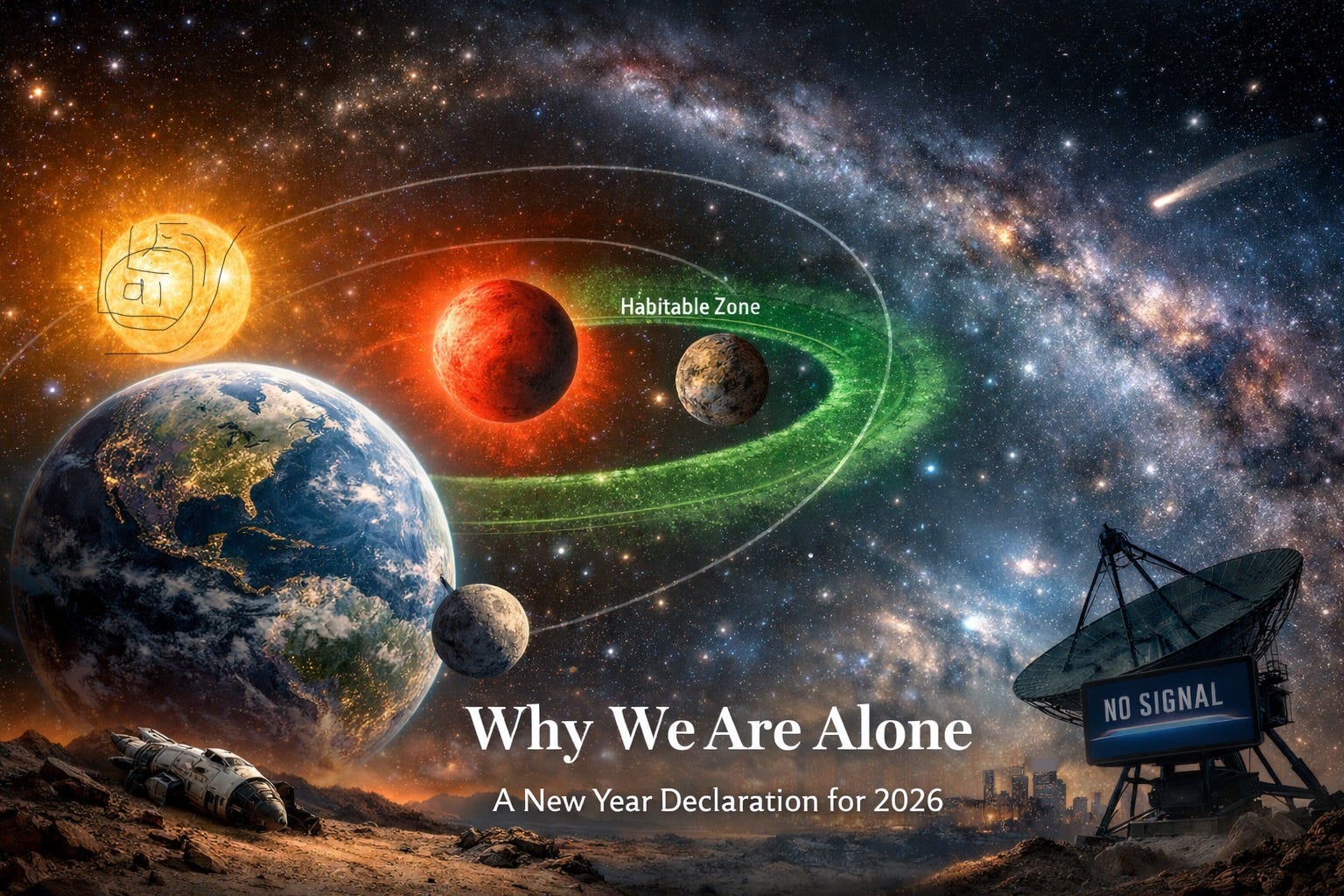
Within twenty light years of Earth there are only a couple of hundred stars, spread across roughly a hundred star systems. Most of them are red dwarfs. A red dwarf is a small, cool star, far dimmer than our Sun. They are the most common stars in the universe and they live for an extraordinarily long time. But they come with problems. Any planet warm enough to host liquid water has to orbit very close, which often leads to tidal locking (meaning the planet like the moon doesn’t rotate), intense radiation exposure and unstable surface conditions.
A handful of nearby stars are more Sun-like. Some of those have planets, and a few of those planets are rocky, meaning they are made of solid material like Earth rather than gas or ice. That matters because only rocky planets can have stable surfaces, continents, oceans and atmospheres where complex chemistry can take hold. Gas giants and ice worlds may be fascinating, but they are not places where cities, tools or civilisations can form.
Then we hit the next filter. The life-friendly zone.
This is the narrow orbital band around a star where conditions are not too hot and not too cold, allowing liquid water to exist on a planet’s surface. Too close and everything boils. Too far out and everything freezes. Even within this zone, atmosphere, chemistry, magnetic fields and sheer luck all have to align.
Already the numbers are collapsing.
Now add the next constraint. Life does not exist everywhere it can. It exists where chemistry, time, stability and chance align. On Earth it took billions of years to progress from simple cells to anything we would recognise as a civilisation. And it happened once.
Once.
That matters. It tells us that civilisation is not an automatic outcome of life. It is an improbable convergence of traits. Hands capable of precision. Long childhoods. Language. Memory across generations. Social cooperation beyond kin. Energy use. Environmental stability. Miss one and you get clever animals, not cities.
Then there is time.
Planets do not last forever. Stars change. Climates drift. Windows open and close. Earth has been habitable for billions of years, but that window is already closing. The Sun is slowly brightening. Long before the planet is physically destroyed, it will become hostile to complex life and then to civilisation.
Which means, in a cosmic sense, Birmingham City Council and its Green policies are absolutely right. We could destroy the planet if we carry on as we are. The council is correct that we should drive less, consume less and take the whole business of stewardship more seriously. We may yet be asked to abandon our cars, strip out our central heating and holiday closer to home. But here is the awkward truth. However virtuous we become, however many sacrifices we make, none of it will ultimately stop the planet itself from becoming uninhabitable. Even if the Leader of the Council and the Lord Mayor were to abandon their chauffeur driven limousines and take the bus, the Sun would still brighten, the climate window would still close, and Earth would still, in time, shut us out.
One Planet. One Shot.
Civilisation does not get multiple attempts on a single planet.
As far as the evidence shows, Earth produced exactly one technological civilisation. Not several. Not a sequence. One. Us. No buried cities in the rocks. No industrial scars predating humanity. No chemical fingerprints of earlier technological epochs. If there had been another, even tens of millions of years ago, we would see it. We do not.
Earth is not a stage where civilisations come and go. It is a one act play.
If we fail (as we will), there is no guarantee of a second act. There may not be time. There may not be conditions. There may not be another evolutionary roll of the dice capable of producing language, memory, tools and social organisation at scale before the window closes.
This is where the observable universe comes back into focus.
Yes, the observable universe is vast beyond comprehension. Hundreds of billions of galaxies stretching out to a horizon we can never cross. But that vastness does not help us here. Distance does not create opportunity, it removes it. Anything beyond our observable horizon might as well not exist, because it can never affect us, reply to us, or rescue us.
Even within the observable universe, civilisation is constrained to single planets, brief windows and narrow overlaps. The universe may host many experiments in intelligence across its history, but each is isolated, fragile and temporary.
There is no cosmic relay race. No handing on of the baton. When a civilisation ends, the light goes out locally, and the universe does not notice.
This is where the narrative quietly cheats.
The exaggerated American hyped up television programmes do not help. They are not designed to. They are entertainment products, not probability assessments. They rely on implication, suggestion and the careful blurring of what is known, what is unknown and what is simply imagined. They sell mystery because mystery keeps viewers watching.
But mystery is not evidence.
There is a reason no serious bookmaker would offer short odds on alien contact. Not because the universe is small, but because the overlap conditions are vicious. The odds are long. Very long. Long enough that silence becomes the expected outcome.
And silence is exactly what we observe.
No signals. No artefacts. No anomalies that survive scrutiny. No neighbours knocking. Just a quiet universe doing what physics predicts it will do.
This is not depressing. It is clarifying.
If we are alone in any sense that allows reply, then responsibility sharpens. There is no elder civilisation to guide us. No cosmic referee. No external correction. There is just us, briefly conscious, capable of extraordinary harm and extraordinary care.
Meaning does not evaporate because it is not shared. It intensifies.
We are the only witnesses we know of. The only custodians of memory. The only place, as far as we can tell, where the universe has learned to ask questions about itself and worry about the answers.
That does not make us chosen. It makes us fragile.
So this New Year, my declaration is simple. I am done waiting for voices from the sky. Done outsourcing wonder to podcasts and hope to grainy footage. Done pretending that probability bends to desire.
“WE ARE ALONE”.
Not forever. Not cosmically unique. But alone enough that it matters.
And if bookmakers were taking bets, that is where the smart money would go. For the avoidance of doubt, again it’s … “WE ARE ALONE”.
Mike Olley ironically is a member of the Labour Party and a member of the Church of England. Make of that what you will 🧐