

New Stations, Old Mistakes: The West Midlands Still Isn’t Building the Network It Needs
New stations are coming, but the network still misses where people live, and delivery too often damages local business.

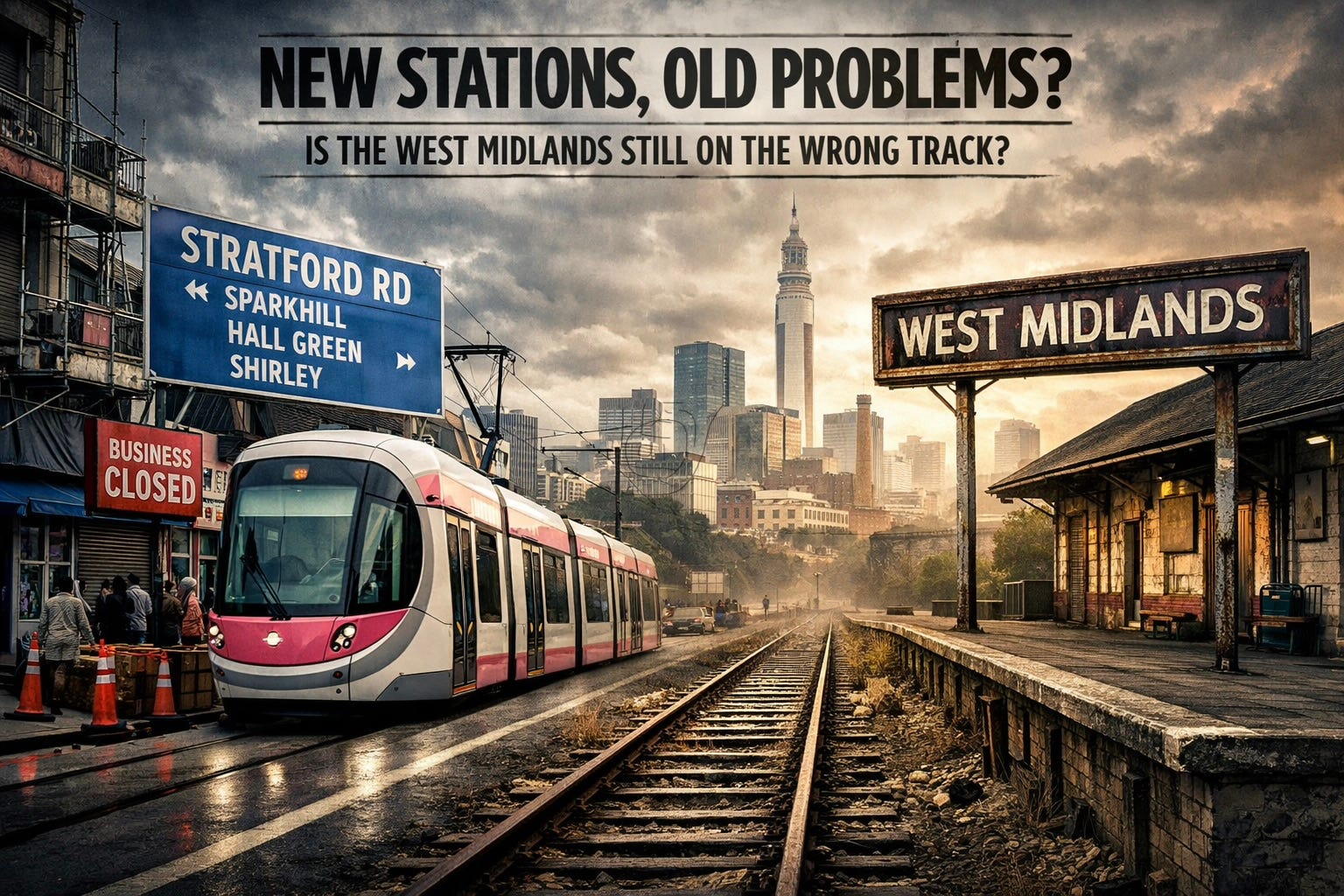
A Start, Not a Solution: What the West Midlands’ New Stations Really Mean
Across the West Midlands, a new round of railway stations has been announced, intended to improve connections and bring parts of the region back onto the rail map. For many people, the detail of this programme will not yet be familiar, so it is worth setting out clearly what is being proposed and why it matters.
Five stations form the core of the current plan: Aldridge, Darlaston, Willenhall, Pelsall and Brownhills. All five serve communities that either lost their stations decades ago or have grown without ever being properly connected to the rail network. In places such as Willenhall and Darlaston, railway lines have continued to pass nearby but without stopping, leaving residents reliant on buses and cars for journeys that could be quicker and more reliable by rail. The intention behind these new stations is straightforward, to reconnect those communities, reduce journey times and encourage greater use of public transport. Taken at face value, that is a welcome and necessary step.
It would also be wrong to suggest that nothing else is happening elsewhere. The reopening of the Camp Hill line, with new stations at Moseley Village, Kings Heath and Pineapple Road, represents a significant development for south Birmingham and is long overdue for areas of that size and density. However, even here the same pattern begins to emerge. The line is being reactivated, but it does not fully align with the busiest parts of the Stratford Road corridor, and large sections, particularly around Sparkhill, remain without a station despite trains passing directly through. What is being delivered is improvement, but not yet full alignment.
To understand why that matters, it is necessary to look beyond announcements and consider how the network sits against the way people actually live and move. Shirley provides a clear example. The town does have a railway station, but it is not where most people would expect it to be. It sits to one side of the area rather than at its centre, away from the Stratford Road, which acts as the main commercial and movement corridor. When I lived in Shirley, the station worked for me. It sat on the right side of the area for a straightforward journey into Birmingham and for a regular commute to BSA Guns, where I worked at the time, it did exactly what it needed to do. It was practical, accessible and part of a daily routine. That convenience, however, depended entirely on where you lived. For anyone on the opposite side of the Stratford Road, the station might as well have been in another town. What appeared local on a map became distant and awkward in practice, requiring time, effort and often a second journey simply to reach it. A station can exist, but still fail to serve the people around it if it is not in the right place.
Shirley is not an isolated case. Across the West Midlands there are stations that exist but do not fully align with the communities they are meant to serve. At Hamstead, the railway is present, but the station sits away from the main flow of the surrounding population. At Sandwell and Dudley, the station carries the names of two towns but is not particularly close to the centre of either. At Bescot Stadium, the station was designed around an event venue rather than everyday local use. Even in places such as the Jewellery Quarter, where a station is active and well used, it no longer fully reflects how the area has expanded and changed. The pattern is consistent: the railway follows one geography, while people follow another.
Nowhere is that more obvious than along the Stratford Road corridor itself. Running from the edge of Birmingham city centre through Sparkbrook, Sparkhill, Hall Green and into Shirley, it is one of the busiest and most densely used routes in the region, carrying traffic, bus routes, businesses and a large residential population. What it does not have is effective rail integration. The Camp Hill line runs through parts of this area, but without enough stops to make it useful for local travel. Sparkhill, in particular, stands out as a densely populated area with no station at all despite trains passing through. If the aim is to build a network that people actually use, this is where attention needs to turn next.
One option is to develop a proper local service on the Camp Hill line, with additional stations, including one at Sparkhill, and a reassessment of how existing stops serve the Stratford Road corridor. A more ambitious option would be to extend light rail or tram services along the Stratford Road itself, placing stations directly within the communities they are intended to serve rather than expecting people to travel away from their daily routes to reach the railway. There are good examples of how this can be done. Cities such as Nottingham and Manchester have expanded their tram networks at pace while maintaining a clear focus on how construction affects the streets they pass through, building where it is needed while managing the impact so that existing businesses are not pushed into decline during the process. The West Midlands has not always met that standard. Recent schemes have shown a pattern of prolonged disruption, reduced access and a lack of effective mitigation for local businesses. For independent traders operating on tight margins, extended works are not a temporary inconvenience, they can mean permanent closure.
There is also a further issue that is rarely acknowledged openly, which is how the cost of delivery is distributed. When major transport schemes are built, the financial burden does not fall solely on the public purse. A significant portion is absorbed, often unintentionally, by the private businesses along the route. Reduced footfall, restricted access and prolonged uncertainty translate directly into lost revenue. For larger organisations, that may be manageable. For independent traders, it can be decisive. In effect, sections of the local economy become an unrecognised subsidy to the project itself, carrying the cost of disruption while the long-term benefits remain uncertain or distant. That contribution is neither formally accounted for nor consistently mitigated. It is simply assumed to be part of the process. If infrastructure is to be delivered in a way that commands public and commercial support, that assumption needs to be challenged, because the burden of improvement cannot rest disproportionately on those least able to absorb it.
Alongside all of this sits a quieter but equally important question about how these stations will be run. The new stations will be modern, functional and built to current standards, with platforms, shelters, ticket machines and digital information systems. What they are unlikely to have is a consistent human presence. That reflects a wider approach in which building infrastructure is prioritised, while the day-to-day operation of that infrastructure is treated as a cost to be managed. In some cases, responsibility is already being spread across multiple sites, with one manager covering several stations rather than being based in a single place. That may look efficient, but it changes how a station functions over time. Without a regular presence, maintenance becomes reactive rather than immediate, small problems take longer to be resolved and standards slip gradually rather than suddenly. Passengers notice, even if they do not always articulate it, and confidence adjusts accordingly.
None of this diminishes the importance of what is being done. Aldridge, Darlaston, Willenhall, Pelsall and Brownhills deserve better connections, and these stations will help to provide them. The same is true of Moseley and Kings Heath. What they also highlight, however, is a wider truth. The West Midlands has shown that it can build new infrastructure when funding becomes available. What it has yet to demonstrate consistently is that it can align that infrastructure with the realities of how people live and move, and then maintain it to a standard that earns long-term trust. Public transport is not defined by what is built on day one, but by how well it works, year after year, for the people who depend on it. These stations are a start, but what matters now is what follows.