

Nosheen Khalid and the politics of getting things done
Warm, rooted and quietly formidable, Independent (Better Birmingham) Cllr Nosheen Khalid brings optimism, practical purpose and a sharp sense of place to Alum Rock.

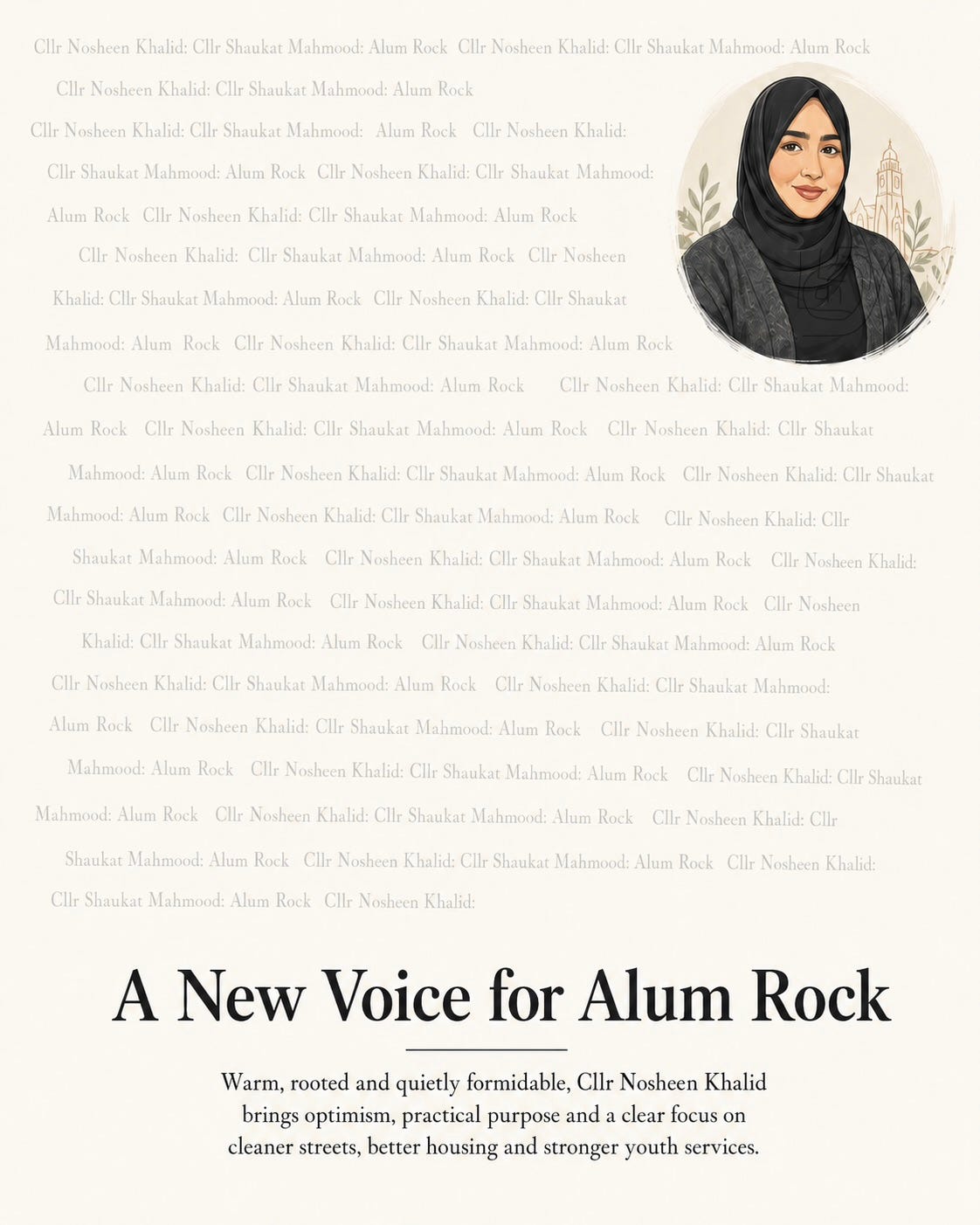
I have seen a fair few politicians in my time. Some very good ones. Some bright, warm, engaging people who understand that politics is not just about winning a seat, making a speech, or collecting a title. It is about people, streets, families, small businesses, pride, pressure, loyalty, grievance, memory and place. I have also seen a few, at council level, where you are left wondering how on earth they convinced a party selection panel to put them forward, and why on earth the electorate then completed the transaction. There are always a few fag-end politicians knocking around local government, along with the occasional bright spark who reminds you why local democracy, for all its absurdities, still matters.
This week I had the immense pleasure of meeting one of the bright ones: Nosheen Khalid, the brand-new councillor for Alum Rock. I knew her father. His name was Khalid Mahmood, not the Khalid Mahmood who became an MP, but another Khalid Mahmood from that fascinating era of inner-city Birmingham politics when the Justice for Kashmir councillors emerged in the 1990s and took a whole sway of Labour seats. They were led by the venerable Allah Ditta, or Allan as I knew him back in the 1980s, when we were both businessmen in Small Heath.
Mr Ditta ran a wedding hall. I was opposite him with my engineering works. Between us, that little piece of Small Heath was reasonably well marshalled. He was a serious man, a community man, and a man who understood something Labour should have understood much earlier: that people do not like being treated as electoral cannon fodder. That, in truth, was one of the great mistakes Labour made with Birmingham’s Kashmiri communities. Too often, it patronised them. Too often, it expected obedience. Too often, it assumed loyalty was automatic, endless and owed. When communities did not behave as meekly as the party machine expected, Labour seemed more irritated than reflective.
Mr Ditta got annoyed with that attitude. So he did something about it. Justice for Kashmir, which became known as JFK, did not just complain from the sidelines. It won seats. It hurt Labour. It sent a message. Yet it seems Labour learned rather less from that episode than it should have done, because here we are again, decades later, watching independents, Greens and Reform UK all taking chunks out of Labour’s local standing. If Labour had learned even a little more from Mr Ditta, it might still be in charge of Birmingham City Council. But political machines are very good at mistaking habit for strength. They confuse inherited votes with earned respect. Then one day the votes go missing, and everybody starts pretending to be surprised.
Nosheen Khalid sits in that long and rather important Birmingham tradition. She is modern, but she is not rootless. She is independent, but not detached. She is political, but not synthetic. She is, in the best sense, a woman of a place. I took her at face value, which is usually the best way to start with people. She wears a headscarf and presents as very Islamic. That puts me off not one jot. Quite the opposite, really. What came across almost immediately was a wonderful smile, a natural warmth, and a kind of radiating confidence that does not need to shout to be noticed.
There are, of course, cultural differences. Birmingham is full of cultural differences. That is not the problem. The problem is usually the people who either pretend those differences do not exist, or treat them as suspicious. What I found in Nosheen was someone who loves Birmingham, loves Alum Rock, and feels entirely at home in the place she now represents. She adores it. That matters. Not in some dreamy tourist-board way. Not in a “isn’t everything lovely” way. She knows Alum Rock needs cleaning up. In fact, she places that at the top of her list. Cleaner streets. Housing. Youth services. That is not a manifesto written by a policy officer trying to impress a committee. That is the list you get from someone who has knocked the doors, listened properly, and understood what life feels like at pavement level.
Cleaner streets should not be revolutionary. It should not require a political uprising. It should not require independent councillors, community campaigns, outrage, leaflets, door-knocking and endless pressure just to get the basics done. Yet in Birmingham, basics have somehow become advanced governance. I asked Nosheen why on earth council officials on lovely salaries, with some at director level enjoying six-figure pay and aristocratic pensions, have to be told that streets should be clean. It is not a trick question. The public pay for a service. The service should be delivered. Bins should be emptied. Streets should not look abandoned. Residents should not have to beg for the most basic signs of civic respect.
Clearly, though, some people in the system do need telling. More than once. Possibly with a loud voice and a very firm stare. I get the impression that with Nosheen around, a few officials may begin to understand that doing the job at a basic level is not optional. It is the minimum. It would appear that previous occupants of the councillor role in Alum Rock did not quite get this clean-streets thing right. Well, they are history now. I put it bluntly to Nosheen that she has a few years to sort matters out. I suspect she will. And I would add this: as much as I enjoyed my time with Nosheen, and I did, very much, I would not want to get on the wrong side of this sweet lady. She is lovely company. She is warm. She is engaging. But there is steel there. The smile is real, but so is the spine.
Housing may prove harder. It always does. Every party talks about housing. Labour talks about housing. The Liberal Democrats talk about housing. The Greens talk about housing. Conservatives talk about housing. Everybody has a document, a policy, a pledge, a vision, a framework, a strategy, an action plan, a taskforce, and possibly a stakeholder conversation with sandwiches. Yet too often, the lived reality does not move. Families remain squeezed. Streets absorb badly managed HMOs. Good landlords get lumped in with bad ones. Bad landlords exploit weak enforcement. Communities are told change is coming, while the paper mountain grows and the practical results remain thin.
That is where Nosheen interests me. When I challenged her on housing, there was a sparkle in her eye. I do not yet know whether she has a plan, or whether she and her colleagues in Better Birmingham have the makings of one. But I got the sense that she understands the difference between talking about housing and doing something about the conditions people actually live in. There is a world of difference between a policy document and a door that locks properly. Between a council strategy and a family not having to live in overcrowded rooms. Between a housing conference and a street that does not feel as if official Birmingham has given up on it. That is the practical ground on which councillors such as Nosheen will be tested.
The same applies to youth services. At first glance, people can reduce that phrase to something small: a youth worker, a hall on a Tuesday evening, a few activities, a bit of diversion. But that undersells the issue. Youth services, when properly understood, run across almost everything. Safety. Confidence. Skills. Belonging. Identity. Education. Crime prevention. Ambition. The ladder of life. A child or teenager with somewhere to go, someone to trust, and something useful to do is not a soft social extra. It is basic civic infrastructure. It is as real as roads, drains and streetlights. Nosheen seems to understand that. Her list is short, but it is not shallow. Cleaner streets. Housing. Youth services. Those are not decorative issues. They are the front line of urban government.
Nosheen is herself a former Labour figure. She is now independent. She is also part of Better Birmingham, a grouping of like-minded inner-core independent councillors who have emerged from communities Labour once assumed it could rely upon without too much effort, too much listening, or too much respect. What makes the group particularly interesting is that many of them appear to have come through Labour at some stage. They are not outsiders who never understood the Labour machine. They are people who knew it from the inside, worked within it, believed in parts of it, and then found themselves bruised, pushed aside, patronised or, in their view, badly treated by it. That gives Better Birmingham a particular edge. It is not simply anti-Labour noise from the margins. It is Labour’s own inner-city inheritance talking back to it.
That matters because Birmingham Labour’s problem is not just policy. It is culture. Too many people who should have been listened to appear to have been managed, disciplined, selected against, spoken down to, or taken for granted. In wards such as Alum Rock, where politics is deeply local and memory is long, people notice. They remember who turned up, who disappeared, who treated them with warmth, and who treated them as voting stock to be rounded up at election time. Better Birmingham seems to have drawn strength from that resentment, but also from something more hopeful: the idea that independent councillors rooted in their own neighbourhoods might get closer to the basics than a large party machine which has forgotten how to hear the streets beneath its own slogans.
From what Nosheen told me, Labour pushed her around, and that was a mistake. You do not do that to this woman. She is not for pushing, unless you are happy to receive the push back. Labour got it. I was also struck by what she told me about the campaign against her and her colleagues. I am not going to pretend I investigated every leaflet, whisper, doorstep claim or political manoeuvre, but one allegation does need calling out plainly. The suggestion that her colleague, now Councillor Shaukat Mahmood, could not speak English was not just absurd. If that was said as reported, it was racist. There is no pleasant form of racism, and it does not become cleaner, cleverer or more acceptable because it is Asian upon Asian, or because it comes wrapped in local political rivalry rather than shouted from the far right. Racism is racism. If someone tries to diminish a candidate by suggesting he cannot speak the language of the country he plainly belongs to, and plainly serves, then they are not making a serious political argument. They are reaching for a dirty old weapon.
For the record, Shaukat speaks perfectly good English, as one would expect from any well-adjusted Englishman. Nosheen, as a delightfully adjusted Englishwoman, speaks perfect English too, along with a few other languages. I only speak one. So perhaps the language test, if there is to be one, should not be aimed at people such as Nosheen and Shaukat, but at those who still cannot speak the basic democratic language of respect. Birmingham is full of accents, histories, faiths, families, migrations and memories. That is not a weakness. It is the city. Those who try to turn that complexity into a smear usually end up telling us rather more about themselves than about their target.
Nosheen also told me that at least fourteen fake or false social media accounts have been created in her name, or around her identity, by people who are plainly not members of her fan club. I have not counted them myself, but if accurate, that is quite something. I can only recall one such site being created in my name over the years, so I confess to being a little jealous. What am I doing wrong? Fourteen in a matter of months suggests Nosheen has made quite an entrance. But beneath the joke sits a darker point. Fake accounts, impersonation, smear pages and spiteful online nonsense have become part of the miserable modern furniture of politics, especially local politics, where personal grievance often dresses itself up as public concern. So perhaps this is her formal welcome to public office: the doors have been knocked, the votes counted, the abuse started, and the fake accounts multiplied. Welcome to the chamber, Councillor Khalid.
Many years ago, former councillor Mike Wilkes, who was an SDP campaigner in the 1980s, gave me advice when I was a very young fellow-me-lad. He said: “Just concentrate on your own campaign.” He was right. That is exactly what Nosheen did. She knocked doors. She delivered leaflets. She reached people. She got to the hearts and minds of her now constituents. While others were apparently making claims, muttering, briefing, accusing and playing games, she got on with the oldest and most effective form of local politics: she asked people for their vote, face to face. There is still nothing quite like it.
This Friday, the council meets to carve up positions, allowances, titles, offices and committee places. That is always a revealing moment. Local government loves its furniture. Chairs, vice chairs, board memberships, outside bodies, portfolios, allowances, nameplates, status. There will be much calculation and plenty of self-importance. My guess is that Nosheen may not get high office. New independents rarely walk straight into the grandest rooms. But Alum Rock may still do well out of it, because representation is not only about titles. Sometimes a ward benefits most from a councillor who is hungry, rooted, visible and impatient.
Nosheen has ruffled feathers getting where she is. No doubt she will ruffle a few more, along with her colleagues in Better Birmingham. That is not necessarily a bad thing. Birmingham has had far too much political smoothness, far too much machine management, far too much taking people for granted. History tells us that Mr Ditta and JFK bloomed for a few years, then faded as Labour won matters back. Mr Ditta has passed on. He lived good years, served Birmingham well, and left behind a lesson that the city’s political class should have remembered more carefully. God Bless you Mr Ditta.
Nosheen Khalid and her Better Birmingham colleagues may yet last a little longer. That will depend on whether they turn protest into delivery, anger into organisation, and personal reputation into practical results. But based on the time I spent with her, I would not underestimate her. She is optimistic, but not naive. Warm, but not weak. Theoretical enough to understand the bigger picture, but practical enough to know that residents judge politics by what happens outside their front door.
And if Alum Rock gets cleaner streets, stronger action on housing, and better support for young people, nobody will care whether the idea came wrapped in the right party colours.
They will simply know that someone finally got on with the job.
As ever Richard thanks for your comment, you're right I do live in the Royal Town and it's very nice. And although you didn't raise the point whilst a Cllr myself I never lived in the area. I didn't think at the time that put me at a disadvantage and upon reflection don't feel that now. Indeed what does local mean. You could live in your ward and be mikes away from some of your constituents... in any event it's up to the voters at the end of day... I never hid my home address. It was Mr Ditta who run the wedding hall in Small Heath not the Cllr's dad and I do feel I covered off her aspirations.
Asked her for double yellows, on a blind spot still waiting on the outcome. #poplardrive