


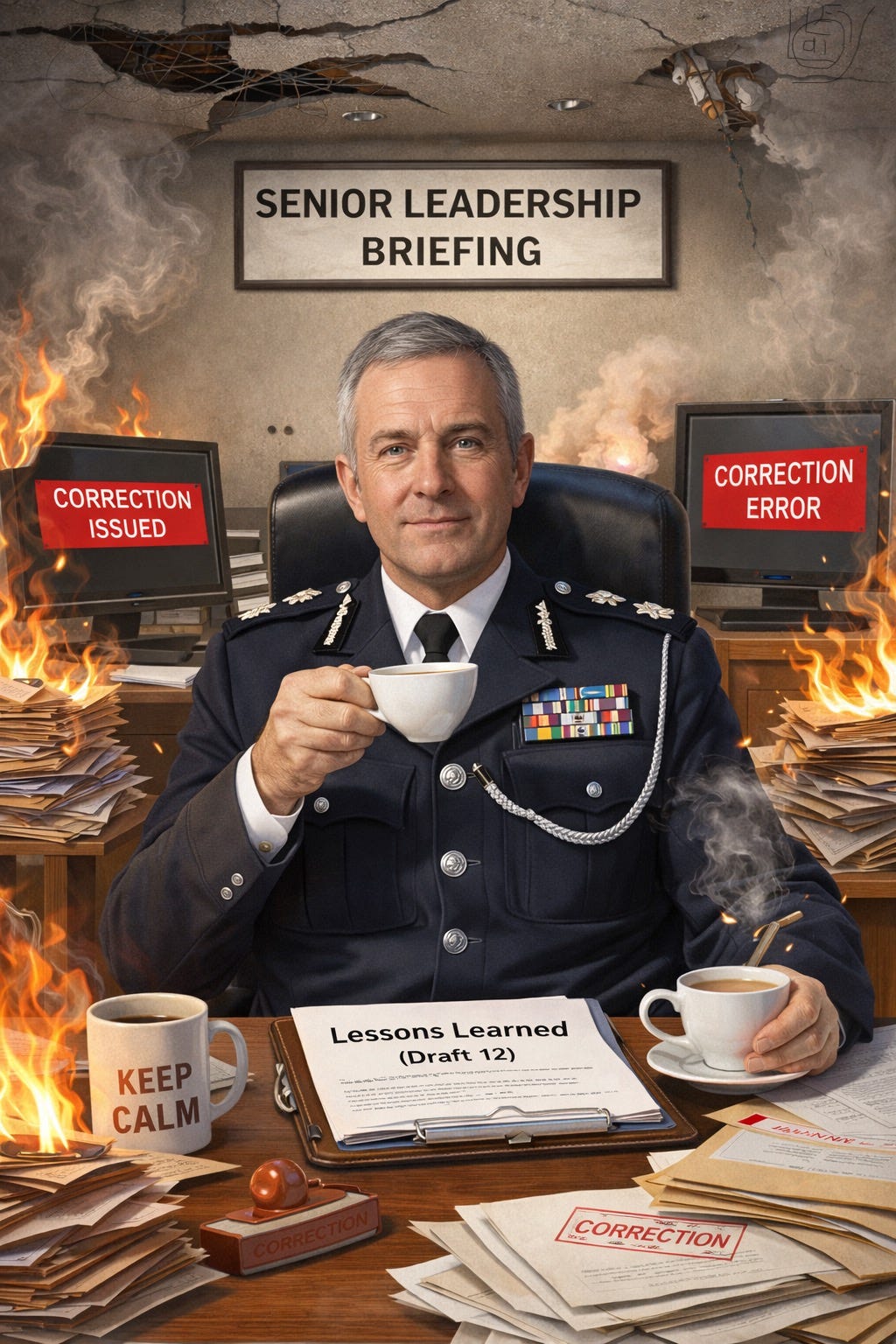
Part One: The Pantomime and Its Cast
With calls now growing for Craig Guildford, the Chief Constable of West Midlands Police, to resign, it would be convenient to believe that the fiasco exposed in Parliament this week was the work of one individual. A single lapse. A lone error.
It was not.
What unfolded before the Home Affairs Committee had all the hallmarks of a pantomime. Multiple senior figures. Shared assumptions. A collective confidence that collapsed the moment MPs began asking basic questions.
Before going further, this needs saying plainly. I am not anti-police. Quite the opposite. I think the police are essential. I have known many excellent police officers and many outstanding Assistant Chief Constables over the years. Calm, capable leaders who understood evidence, proportionality, and restraint. I remain proud to know many of them.
Criticising senior leadership failure is not an attack on policing. It is often the only way to defend it.
Which brings us to Assistant Chief Constable O’Hara.
Part Two: O’Hara Before Parliament, Not One Slip, But Many
O’Hara’s appearance before MPs was not undone by a single mistake. It unravelled because of a series of basic failures, each one small enough to excuse in isolation, but devastating when taken together.
First, there was the confusion between intelligence and assumption. When pressed on the basis for risk assessments, O’Hara repeatedly relied on language such as “concerns”, “understandings”, and “context”, without being able to clearly identify primary intelligence sources. MPs had to ask, more than once, whether claims were based on verified intelligence or second-hand reporting. The answers were vague.
Second, O’Hara mischaracterised community positions, particularly in relation to Jewish community groups. He suggested opposition to certain events that later had to be corrected. This was not a minor detail. It went to the heart of whether policing decisions were being made with communities or about them. The fact that corrections were required after the session speaks volumes.
Third, there was a failure to demonstrate basic factual command. MPs asked about comparable events, historical precedents, and whether similar incidents had actually occurred. O’Hara referenced situations that either did not happen as described or were not directly comparable. Again, this was not malice. It was poor preparation.
Fourth, and most tellingly, O’Hara struggled to explain why escalation was chosen over verification. When asked why certain claims were not tested directly with organisers, intelligence partners, or independent sources before decisions were taken, the answers drifted. Responsibility became collective. Decisions became “processes”. No one appeared to own the judgement.
Finally, there was a visible discomfort when race and sensitivity were interrogated directly. MPs asked whether assumptions had crept in, whether stereotypes or political pressure influenced risk assessments, and whether alternative interpretations had been properly explored. O’Hara did not reassure. He deflected.
Taken together, this was not a bad day. It was a senior officer demonstrating that he did not have firm control over evidence, narrative, or consequence.
And this is where the connection to Ben Walker becomes unavoidable.
Part Three: From Committee Room to Airport Floor, The Cost of Poor Judgement
What happens when senior officers are unclear about intelligence, blur assumption into fact, and prioritise optics over verification?
You get Ben Walker.
Walker was an internationally respected fire safety consultant, a former firefighter, and an author. On 2 April 2023, while returning from an overseas business trip, he was arrested in public at Birmingham Airport, with armed officers present carrying automatic firearms. Walker is also a proud Romany, descended from a line of bargees who navigated Britain’s inland waterways.
He was accused of threatening and harassing by email, it was claimed, Wayne Brown, a senior Black Chief Fire Officer of the West Midlands. That allegation carried political and reputational weight. It framed Walker immediately as a dangerous aggressor.
What mattered less, at the time, was that Brown himself was under investigation for serious misrepresentations, issues that went to professional credibility at the highest level of public safety leadership. Before the full extent of those misrepresentations became public, Brown took his own life.
That tragedy should never be exploited. But it does matter when assessing institutional judgement.
Walker denied the allegation immediately. He provided an alibi. It was not checked for eighteen months. He was charged anyway. Only because Walker insisted on a court date was the truth established. The prosecution offered no evidence. Walker was found not guilty. The emails were not his.
O’Hara was involved in the senior leadership environment that authorised escalation in Walker’s case. That is documented. This is not about personal malice. It is about judgement.
Seen alongside O’Hara’s performance before Parliament, Walker’s experience looks less like an anomaly and more like a pattern. Escalation without verification. Theatre before truth. Sensitivity invoked, evidence neglected.
Which leaves the final question.
How many other cases sit on O’Hara’s watch where race, identity, or political sensitivity was handled this badly. How often has assumption been allowed to masquerade as intelligence. How many lives have been disrupted because senior officers mistook decisiveness for correctness.
This is not about calling anyone a racist. It is about competence in a complex, multiracial, politically charged environment.
And when a senior officer repeatedly demonstrates difficulty navigating that terrain, it is reasonable to ask whether further equalities and decision-making training is not an insult, but a necessity.
Because policing does not exist to look decisive.
It exists to be right.
It has just been announced that Chief Constable Guildford is to retire. Where does this leave Assistant Chief Constable O'Hara then, who would appear to be equally culpable in this mess?