
Not My Party, But One of the Good Ones: Emily Cox and the Shifting Politics of Brandwood & Kings Heath
A former Tory ward, a fractured Labour vote, and a Lib Dem who knows how to knock doors. This one is more open than most think.

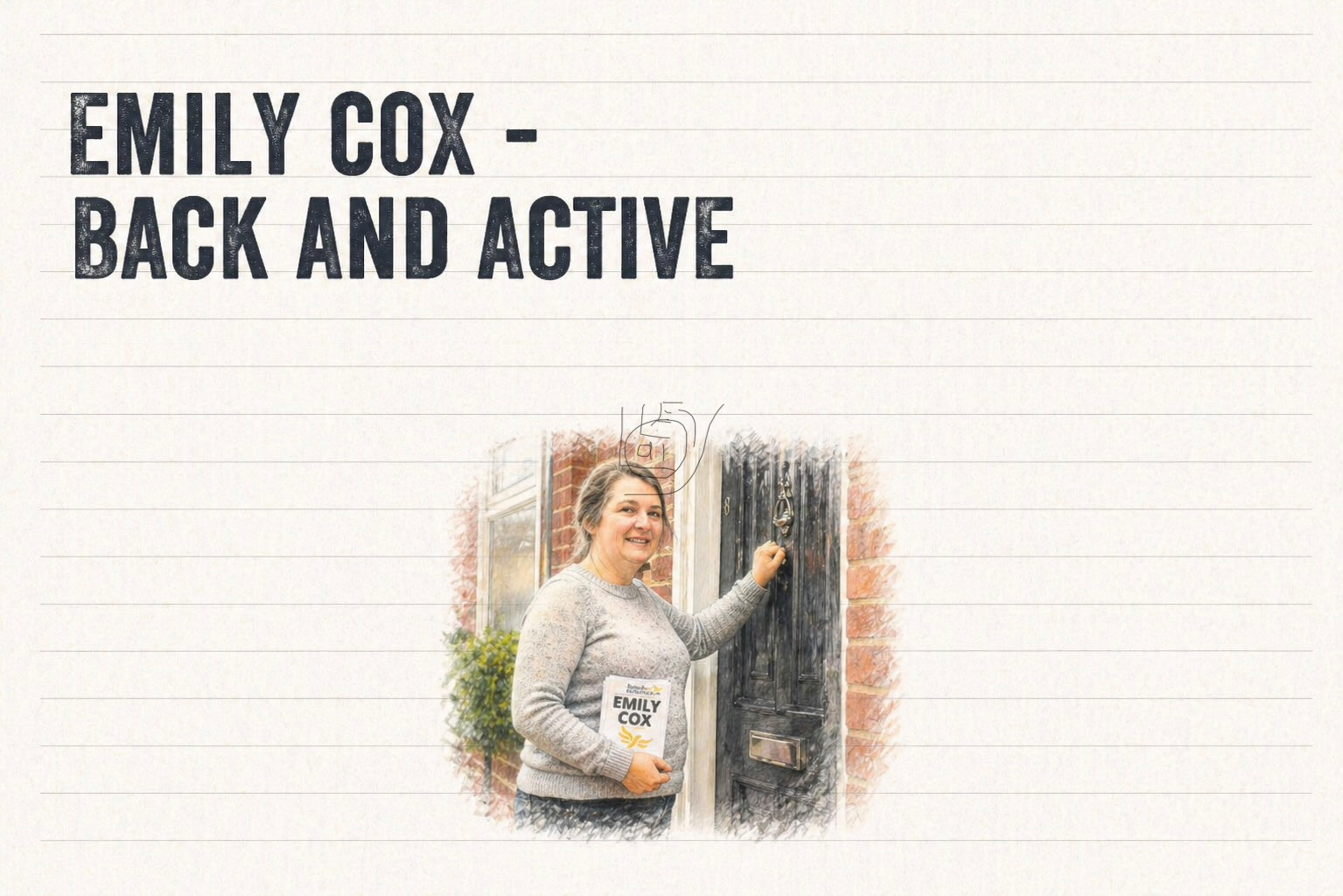
Emily - Not My Party, But One of the Good Ones in Brandwood and Kings Heath
Looking at the hopefuls in the local elections on May 7, I want to focus on one candidate in particular, Liberal Democrat Emily Cox. There are politicians you disagree with, and then there are politicians you respect, and Emily Cox falls firmly into the second category.
I have known Emily for a very long time, longer than either of us might care to admit. The first time she stood for council was back around 2000, in the Tyburn by-election following the death of my fellow ward councillor Stan Austin. At that time, I was already the sitting Labour councillor for the area and acting as agent for the campaign. Emily was the Liberal Democrat challenger, starting out on what would become a long and serious engagement with local politics.
The Labour candidate in that by-election was Ann Holtom, a lovely local lass from Pype Hayes and well known across the area. She won, as expected, under the Labour banner, with the strength of the local organisation behind her. We had seen off Emily’s early challenge, and Anne went on to serve with real distinction for many years, building the kind of reputation that only comes from proper local service rather than party slogans.
And then, as politics so often does, the story took a turn. After I resigned my own seat, Labour insisted on imposing a women-only shortlist to select my replacement. Now, I have no issue with capable women in politics, quite the opposite, and in truth the local party would almost certainly have selected a woman anyway. The strongest candidates were women, everyone knew it, and the outcome would likely have taken care of itself. But Labour could not resist imposing the process from above.
And for what? The outcome was already obvious. Yet they still felt the need to stage-manage it, to demonstrate their virtue rather than trust their own members. It split the local party, and it did so unnecessarily. People who had worked together for years suddenly found themselves at odds, not because they disagreed on the likely result, but because they resented being told what that result should be before the process had even begun.
And here is the irony. Anne Holden, who had helped us defeat Emily’s Liberal Democrat challenge, eventually defected to the Liberal Democrats herself. After years of service under Labour, she crossed the floor to join the very party we had once fought off together. That tells its own story, and it is a reminder that sometimes the damage done inside a party is far greater than anything your opponents could ever achieve.
Through all of that, one thing remained consistent. Even at the beginning, Emily was never a lightweight candidate. There was seriousness about her from the start. She understood that local government mattered. She understood that being a councillor was about the work, not the badge, not the leaflet, and not the performance.
And she proved it. After her early defeat in Tyburn, she moved on, built her base, and went on to win in Moseley and Kings Heath, where she became one of the best local councillors in the city. During periods when Liberal Democrat fortunes were not just poor but dreadful, she still held her ground. That tells you everything you need to know about the difference between a name on a ballot paper and a proper local representative.
A good councillor survives bad national politics because people know them, trust them, and have actually seen them working. Residents are not interested in Westminster slogans when the roads are broken, fly-tipping is spreading, and local services are stretched. Emily knew the patch, she worked it, and she delivered. She was not performative, she was present, and that is a rarer quality than it should be.
Eventually, the national tide turned. The Liberal Democrats were swept away across the country, and even strong local figures were caught in that wave. Emily was one of them. She lost her seat, not through lack of effort or ability, but because sometimes national politics overwhelms even the best local work, and when that tide comes in, it takes good people with it.
But now she is back.
She is standing again in Brandwood and Kings Heath, alongside Cat Wagg, and she is making one thing very clear: she is not a paper candidate. In fact, she jokes that once upon a time she probably was. Back then, she was bringing up her family, juggling life, and politics could only ever be part-time. Even so, she laughs that she was a very good paper candidate, securing just 27 votes in Druids Heath and Monyhull in 2018.
Most people would quietly disappear after that, close the chapter, and move on. Not Emily. She treats it as proof of persistence. The family are grown up now, life has moved on, and she is back in what can only be described as deadly serious mode. As she put it to me, she has had enough of sitting down and moaning, now she intends to stand up and moan, which may be one of the most honest political statements you will hear in this entire election.
And she means it. She is back, she is standing, and she is knocking.
Hundreds of doors already, with hundreds more to come. Delivering leaflets, listening to residents, hearing the same frustrations repeated again and again: housing pressures, HMOs, fly-tipping, pollution, education, and that growing sense that nobody is listening. Politicians often say, “people told me on the doorstep,” and usually that should be treated with a degree of caution. With Emily, I would believe it.
She is one of the most sincere people you could meet. If she says she is hearing frustration, she is hearing it. One of her sharper observations concerns Labour’s decision to deselect David Barker, one of the current councillors and, by broad local consensus, one of the strongest. Even opponents describe him as effective and respected. Emily is openly puzzled by his removal and admits, quite candidly, that it makes her job easier. That is not a small point in a ward where personal reputation still carries real weight.
Her leaflet is equally clear. Labour, she argues, has let people down locally and nationally. Roads are poor, fly-tipping is rising, council tax is up, and people feel ignored. The message is simple: Labour is weak, Reform is noise, and the Liberal Democrats are the practical alternative. Interestingly, the Greens barely feature in the leaflet at all, despite Emily privately recognising them as a real threat, and that in itself tells you something about how campaigns are being framed.
Brandwood and Kings Heath is shaping up to be a proper contest. Twelve candidates, two seats, and no guaranteed outcome. That means turnout, organisation, and personal reputation will matter far more than party branding.
Do I think Emily is entirely right in her assessment? Perhaps not. But I am just a commentator. She is the one doing the work, and in the end that is what tends to matter most.
I remain a Labour member, and that has not changed. But politics should still allow enough honesty to recognise quality when you see it, even across party lines. Emily Cox is one of the good ones.
Not my party, but a very good candidate.
And personally, I wish her well.
Olley’s View (for what it’s worth)
Brandwood and Kings Heath: this has never really been a natural Labour ward, and that matters more than most people are admitting.
Within living memory it has been Conservative-held. It has seen periods of Liberal Democrat strength. Only more recently has Labour come to look like the default setting. That tells you something important. The ground here is not fixed, it shifts.
What Labour gained here may simply be unravelling.
They are now being squeezed from both sides. Traditional working-class voters drifting away, some towards Reform, while more middle-ground and professional voters are looking again at the Greens or the Liberal Democrats. That is not a comfortable place for any party to be.
And then there is the local factor.
The decision to deselect David Barker may yet prove significant. By general consent, he is one of the stronger local councillors, visible, effective and respected across party lines. Removing that kind of personal vote in a ward like this is not without consequence.
That said, Labour are not without assets. Lisa Trickett remains a very popular local councillor, with deep roots in the area and a long-standing connection with residents that still carries real weight. Personal reputation still matters here, perhaps more than party branding.
The Liberal Democrats, with Emily Cox on the ground, have history and credibility to draw on. The Greens have momentum in this part of the city. Reform will not win, but they will take enough votes to matter.
Put all that together and you do not have a stable Labour hold. You have a competitive, shifting ward with more than one path to victory.
So no, this is not a straightforward contest. And no, Labour cannot assume anything.
If the squeeze hardens, they may find themselves not leading the race, but fighting to stay in it.
But what do I know. I am just a commentator.
You know what Liz, I would have a right old struggle with my concience as voting anything other than Labour is so difficult for me, despite them making it very easy for me. Bit like Satruday I'm off to football, Bromley to watch Walsall (I know its very sad..) and suipporting Bromley - they are a superiour team to us, but i beleive i have to stick with my team. But yes i could well sneak a cross in for Emily, she really is a dleight to be with and so good a local counicllor.
Well now, if I was a voter there, I'd vote for Emily.