
Olley’s Live, Back on Birmingham TV
From a pub with purpose in Birmingham’s Great Western Arcade, Professor Carl Chinn MBE brings the real story behind the Peaky Blinders to life.

Peaky truths, proper Birmingham, and a pint with purpose
There is a rhythm to Olley’s Live now. Not polished studio rhythm, not the choreographed exchanges you see elsewhere, but something more grounded, more recognisable. Conversation that breathes. Conversation shaped as much by where you are as by who you are speaking to.
Episode 2 of Series 3 took us into one of those places, and it could not have been better chosen.
The Good Intent.
Tucked inside Birmingham’s Great Western Arcade, it is a pub with real presence. Not just character, though it has that in abundance, but purpose. It is widely regarded as the only pub in the country that gives its profits to charity. That alone sets it apart, but step inside and you realise there is more to it than that. It has warmth. It has ease. It has the kind of atmosphere where people settle, talk, and stay.
And at the centre of it all is the gaffer, Haig, a modern publican in the best sense of the word. Welcoming, attentive, and clearly well liked. The sort of landlord who knows his customers and is part of the fabric of the place. The name may echo a famous whisky, but here it stands for something altogether more local and more human.
That is where we sat down with Professor Carl Chinn MBE.
And if Birmingham has treasures, he is one of them.
Carl is not an academic who stands apart from the city. He stands within it. Born of it, shaped by it, and still deeply connected to its people and its history. He carries authority, but wears it lightly. When he speaks, it is not to impress, it is to explain. And what he explains better than most is Birmingham itself.
The focus of our conversation was his latest book, Peaky Blinders: The Real Gangs and Gangsters. The title will be familiar to many. The television series has travelled the world, and now a major motion picture has added further gloss to the legend. Sharp suits, stylised violence, a kind of cinematic mythology that has taken hold far beyond the streets that gave rise to it.
Carl’s book does something different.
It strips that mythology away.
What emerges is not glamour, but reality. The Peaky Blinders were not romantic figures. They were young men shaped by poverty, overcrowding and limited opportunity. And alongside the gang rivalries and street violence, there were darker truths that are often overlooked. These were not nice people. There were serious crimes, including sexual assaults, behaviour that sits a long way from the polished image portrayed on screen.
Carl does not sensationalise this, but he does not shy away from it either. He places it in context, and in doing so, restores a sense of honesty to the story.
There is, too, a remarkable personal thread. A quirk of fate that links past to present in the most unexpected way. Carl’s own great grandfather was, in fact, a Peaky Blinder. And more than that, he was convicted of stealing a leg of bacon from my own great great grandfather’s shop.
Birmingham, it seems, has always been a small world in the most extraordinary ways.
Having read the book, I can say without hesitation that it is a highly recommended read. Not because it feeds the legend, but because it corrects it. It is detailed without being heavy, accessible without being simplistic, and rooted in a deep respect for the truth. It gives the city its history back, properly told.
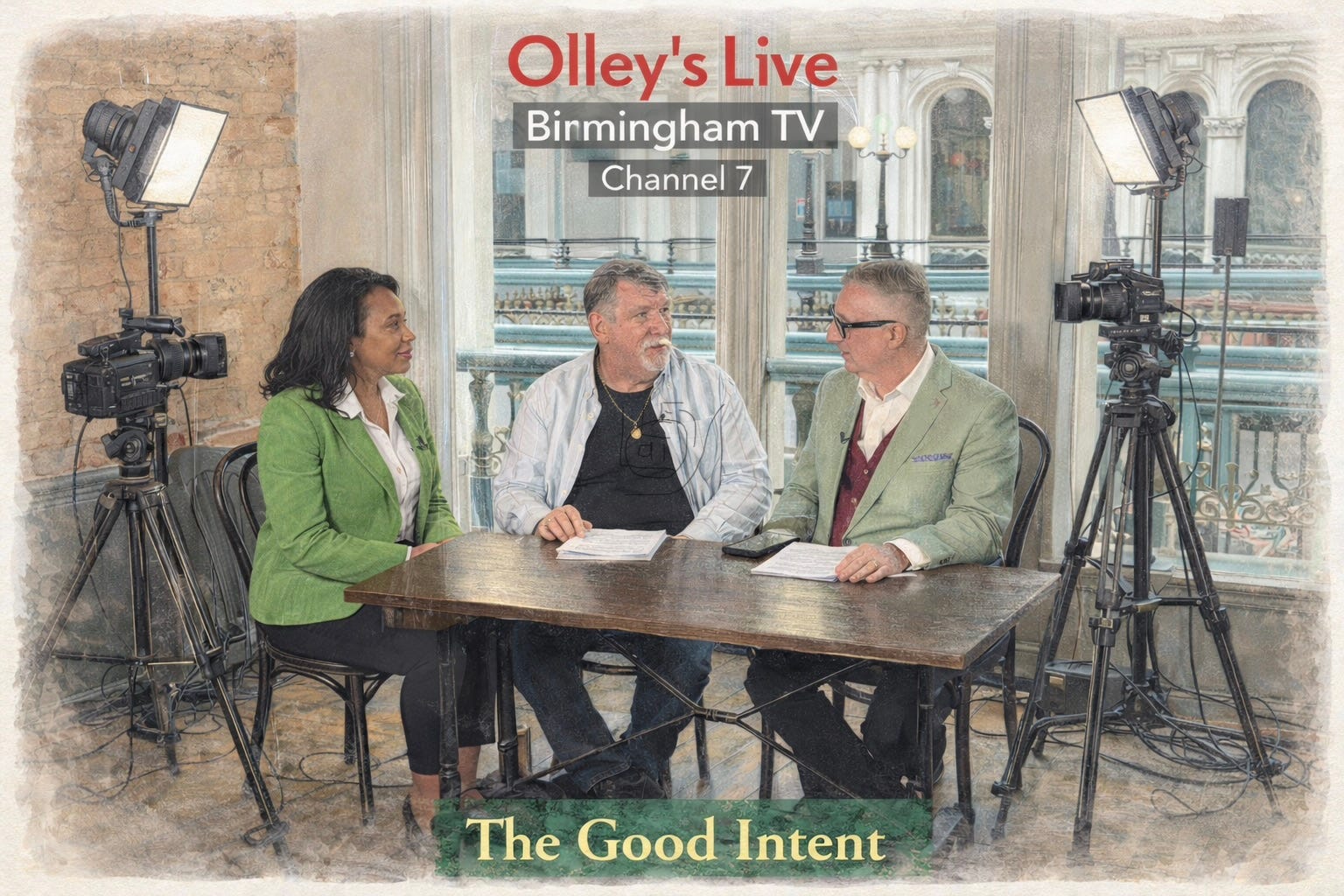
As with all Olley’s Live episodes, this was filmed as live. That matters. It is not stitched together afterwards to create a narrative. It unfolds in real time, with all the natural pace and pressure that brings.
Lorraine Olley and I present the programme together, as a happily married couple who bring that familiarity and balance to the table. It allows for a conversation that is both structured and open. The questions are there, but so is the space for the unexpected. Carl responded to that, speaking freely, telling stories that would never survive a tighter, more controlled format.
The setting added something as well. You could feel it in the room. Patrons aware of what was happening, respectful of it, and then, once the cameras stopped, keen to engage. Several came over to speak with Carl, to thank him, to share their own memories.
That does not happen in a closed studio.
It happens in places like The Good Intent, where conversation is part of the culture.
Olley’s Live continues to grow. Broadcast on Birmingham TV, Channel 7, it reaches between 40,000 and 50,000 viewers across Birmingham, and up to 250,000 across the wider Local TV network. Increasingly, one in four programmes goes out nationally on a weekly basis, taking these Midlands-rooted conversations into a broader UK audience.
This episode will be broadcast in the coming weeks.
That matters, because the stories told here are not just local colour. They are part of the national story.
Carl Chinn MBE understands that better than most.
A Brummie voice, grounded, informed, and still deeply connected to the city he writes about. Sitting in a pub that gives its profits to charity, talking about a history that belongs to everyone, it felt exactly right.
If you have not read the book, read it. If you have not been to The Good Intent, go. And if you want to understand Birmingham properly, listen to the people who have lived it.
Olley’s Live. Live for a reason.