

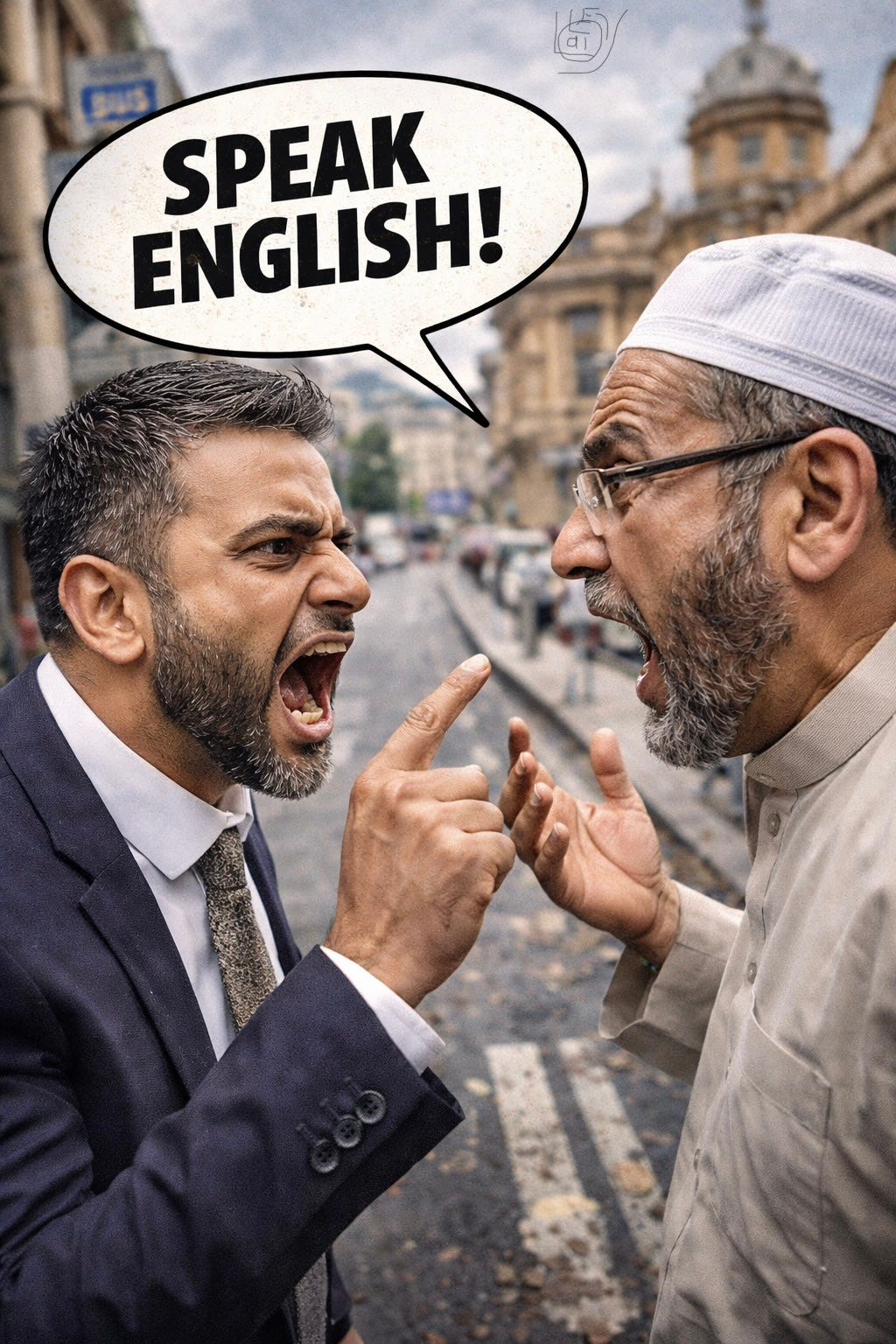
For more than half a century, Birmingham’s political establishment has lived with a contradiction that everyone recognised but no one challenged. Councillors were selected and elected who struggled to communicate effectively in English, even though English remained the working language of council business. From the early 1970s onwards, this reality was absorbed into the system, managed around, and eventually treated as impolite to acknowledge.
It was not confined to one party. Labour, Conservatives and Liberal Democrats all participated in the same avoidance. The unspoken rule was simple. Do not draw attention to language competence, because to do so might invite controversy. Over time, what began as caution hardened into taboo.
The consequences were subtle but real. Scrutiny weakened. Meetings became more stage-managed. Officers increasingly filled gaps. Debate narrowed. Residents noticed, but were quietly discouraged from saying what they could plainly see.
That silence is now breaking.
A Line Is Finally Drawn
The shift did not begin with a manifesto or a policy paper, but with a straightforward proposition gaining traction in local political discussion. If English is the working language of Birmingham City Council, then councillors should be able to speak it confidently.
This idea has been circulating with increasing force among independent networks frustrated by the quality of local governance. It sounds obvious, yet its implications are profound. It challenges decades of avoidance and forces parties to confront whether representation has been confused with symbolism, and tolerance with lowered standards.
Only after this argument had properly percolated did a prominent voice give it public expression.
The Voice That Broke the Silence
That voice belonged to Shakeel Afsar, one of the most prominent figures associated with the Independent Candidates Alliance. In a recent television interview, Afsar articulated the position calmly and without provocation. Councillors, he said, should be able to speak English properly if they are to do the job expected of them.
Two facts matter here.
First, Afsar is not a councillor. He was not defending his own position or excusing personal shortcomings. He was articulating a standard he believes should apply across local government.
Second, Afsar is himself of Kashmiri descent. That matters because it dismantles the most predictable accusation. This was not an outsider targeting minorities, but a British Asian political figure challenging a practice he believes has weakened democracy and patronised communities.
His intervention mattered because it made the previously unsayable sayable, and did so without heat.
Not a Religious Bloc, Not a Dog Whistle
In response, the Independent Candidates Alliance has been lazily characterised as a pro-Muslim organisation. The Alliance rejects that description, and the facts support them. They are preparing to field up to 66 candidates across Birmingham, including Muslim, Jewish, Christian and atheist candidates.
Their unifying principle is not faith or ethnicity, but competence. One of the minimum standards they now insist upon is a strong working command of English.
Accusations of racism have followed, predictably. What is striking is how little substance accompanies them. Requiring elected representatives to operate confidently in the council’s working language is not exclusionary. It is a basic requirement of public office.
Accent is not the issue. Identity is not the issue. Comprehension, debate and accountability are.
Gaza-Inspired Independents and a Divided Opposition
This moment sits within a wider political realignment. Birmingham has seen the rise of Gaza-inspired independents, candidates motivated by anger at the main parties’ stance on Gaza. These candidates are not the Independent Candidates Alliance, but there is clear overlap in support and political energy.
At the same time, a Jeremy Corbyn-inspired grouping, often referred to as “Your Party”, aligned with Jeremy Corbyn MP, is also emerging from similar ground.
Two movements. Broadly similar aspirations. Largely overlapping voter pools.
Which leads to an uncomfortable electoral reality.
When Opposition Splits, Labour Benefits
Birmingham has already seen how this dynamic plays out.
At the last general election, Tahir Ali MP retained his parliamentary seat not because opposition was weak, but because it was divided. Two Gaza-inspired independents stood against him, one of them Shakeel Afsar. Both candidates polled strongly. Taken together, they secured more votes than Labour. Taken separately, they split the challenge.
The result was a comfortable Labour win on a reduced share, delivered by arithmetic rather than enthusiasm.
That precedent matters.
If Independent Candidates Alliance candidates campaigning on standards and English fluency end up competing directly with Corbyn-aligned or Gaza-inspired independents in the same wards, Labour may once again benefit from fractured opposition, even as dissatisfaction grows.
Standards Are One Thing. Strategy Is Another.
Many Birmingham residents will welcome the call for English-speaking councillors. To them, it feels like common sense returning after decades of avoidance.
But politics is unforgiving. Without coordination, movements seeking change can entrench the status quo they oppose. That would be the final irony.
Still, something fundamental has shifted.
A 60-year taboo has been broken.
The argument is now public.
And once that happens, it cannot be unspoken.
In Birmingham politics, even the longest silences eventually come to an end.