

Oracle, Birmingham, and the habit of missing deadlines
A disciplined organisation keeps a watching brief. It controls scope. It tests brutally. It listens to bad news early. It does not treat optimism as a delivery strategy. Birmingham did the opposite!!

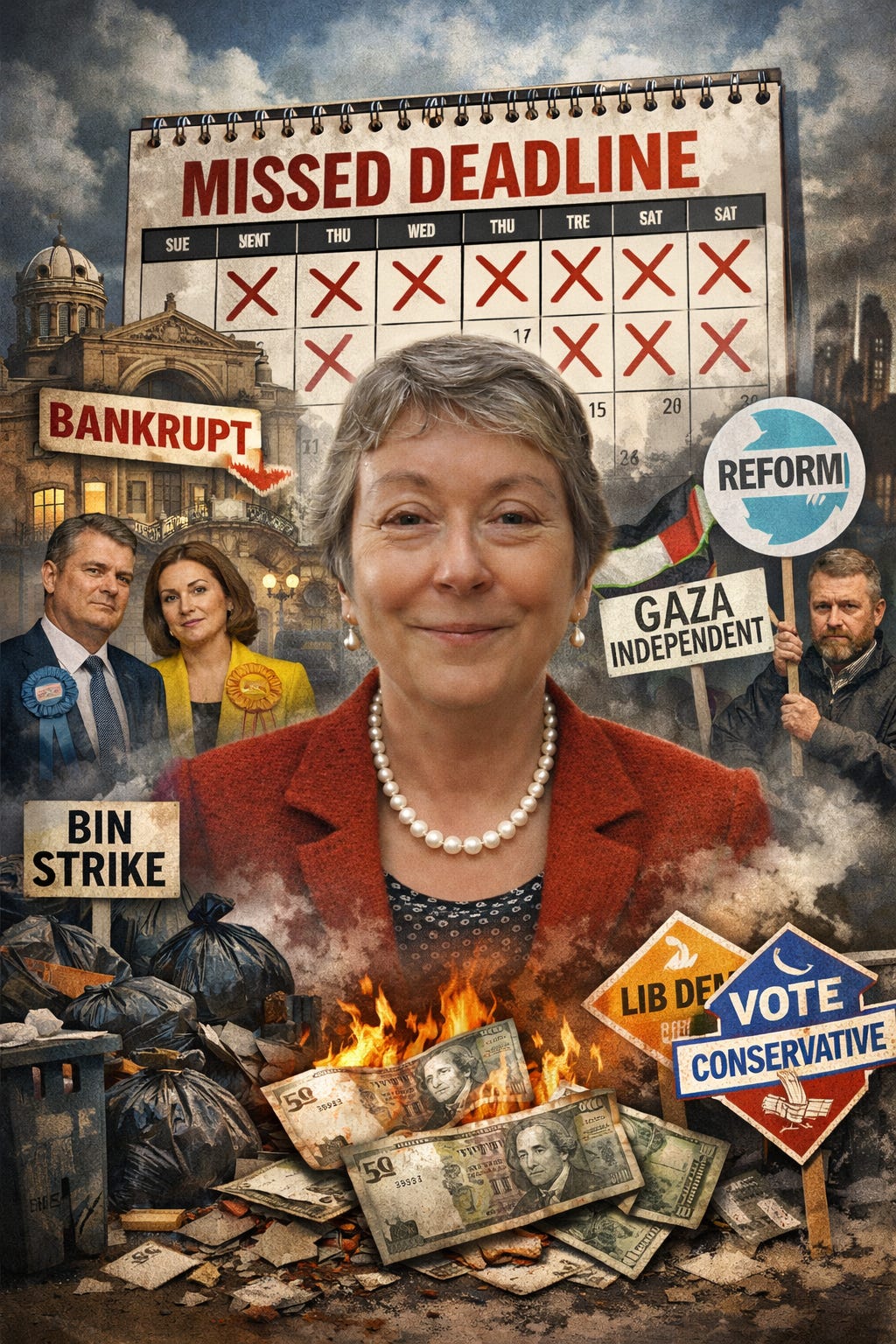
Birmingham is drifting into an election year with its bins uncollected, its finances still being patched together, and a £170 million technology programme that cannot yet do the one job it exists to do, tell the city where its money is. This week, the council quietly admitted that the Oracle finance system will miss another deadline, pushing full functionality beyond April 2026 and into the long grass of summer. Opposition parties immediately pounced, residents barely raised an eyebrow, and inside the council there was a familiar silence. In a city that has normalised delay, even failure now struggles to shock.
The Conservatives say Birmingham is heading into a fifth year without a fully functioning finance system, while the Liberal Democrats describe the latest Oracle slippage as continuing chaos. That is not partisan theatre, it is the political weather Birmingham Labour is now operating in.
At the centre of this sits the long running Oracle programme at Birmingham City Council, originally sold as a modernisation project and now widely regarded as a case study in how not to run complex change. What began as a technology upgrade has hardened into something more serious, a test of whether the city’s leadership understands accountability when it is no longer abstract.
I offered the council’s finance lead a right of reply for this article. Councillor Karen McCarthy, Cabinet Member for Finance, was invited to comment. She did not respond. So yes, the line writes itself, and it belongs in the piece, offered a deadline, missed yet another deadline.
That line matters, because deadlines are the story here. Not just one deadline, not just this week’s embarrassment, but a pattern that now stretches back years. By any fair count, Birmingham’s Oracle programme has burned through at least five major target dates since it was first meant to go live, plus a missed auditor deadline, and the council has now confirmed that the latest promised milestone will also slip. This is not bad luck. It is behaviour.
What Oracle was meant to do, and what Birmingham asked it to become
Oracle Cloud ERP is not experimental software. It is widely used across the public sector. NHS bodies use it. Government departments use it. Other councils use it. The technology is known, its strengths are understood, and its limits are well documented.
Which makes Birmingham’s experience uncomfortable, because it points away from the vendor and back towards the organisation.
It is reasonable to speculate that the council fell into a familiar trap. A base system is selected, then internal stakeholders insist it should also do this, and that, and something else entirely. Each request sounds sensible in isolation. Taken together, they create a monster. Add bespoke workflows, heavy integrations, local exceptions, and a belief that scale somehow justifies complexity, and the system stops being a platform and starts being a hostage.
At that point, technology is no longer the main risk. Governance is.
A disciplined organisation keeps a watching brief. It controls scope. It tests brutally. It listens to bad news early. It does not treat optimism as a delivery strategy.
Birmingham did the opposite. It trusted its own confidence. It assumed problems would resolve themselves. It allowed deadlines to become aspirational rather than binding. And when things went wrong, it reached for workarounds instead of resets.
That is how you end up with manual processes, temporary staff, and auditors raising red flags while public assurances continue as if nothing fundamental is broken.
The political context Labour cannot wish away
This failure lands at a terrible moment for Labour locally.
Labour currently controls 54 of the council’s 101 seats. That sounds comfortable until you remember that in 2022 it held 65. Eleven seats have gone. Some through by elections, some through Labour councillors walking away on principle, opposing cuts, some through selection battles where sitting councillors where dropped by Labour. So they also walked.
That matters, because it shows this is not just voters drifting. It is Labour people themselves losing faith.
Former Labour councillors have cited unnecessary cuts, poor leadership, and a loss of direction. Others have simply decided they cannot defend decisions they do not believe in. When your own side starts leaving the room, it is no longer just opposition noise.
Then there is the wider electoral weather. Gaza focused independents have already demonstrated that Labour’s coalition can fracture sharply and suddenly. Reform is fishing in the same pool of disillusionment from a different angle. Voters who once defaulted to Labour are now shopping around, or staying at home.
Against that backdrop, competence matters more than slogans. Delivery matters more than reassurance.
So why promise April 2026 at all
This is the question that refuses to go away.
If the council knew, as it surely did, that Oracle would not be ready, why allow April 2026 to sit there as a public milestone, parked just days before a make or break election.
Why not say, plainly, that the system would be ready in summer.
Why not take the hit early.
Why not avoid yet another episode of looking unprepared.
There is only one credible explanation. The leadership believed it could manage the narrative. That it could carry the deadline until after the election. That the public would not notice, or would not care.
That is a dangerous assumption in a city already tired of excuses.
Cllr Karen McCarthy and the finance brief
Accountability requires names.
Cllr Karen McCarthy has been Cabinet Member for Finance since May 2024. That is long enough to understand the state of the programme. Long enough to insist on realism. Long enough to refuse to front deadlines that were unlikely to be met.
In council and cabinet meetings, confidence is rarely in short supply. But confidence is not delivery. And delivery is what is missing.
I approached Cllr McCarthy with straightforward questions that any resident has a right to ask. Why another deadline slipped. What progress has genuinely been made. Whether the continuing absence of a stable finance system undermines confidence in governance. What will actually be delivered before May, and what will not.
She was offered a clear deadline.
She did not respond.
Again, the symmetry is hard to ignore.
This is no longer about IT
Oracle is not a glitch. It is not a teething problem. It is not an unfortunate distraction.
It is a verdict on how Birmingham is being run.
A city that cannot reliably run its own accounts cannot convincingly argue that everything else is under control. A governing group that repeatedly chooses pre election deadlines for projects it cannot deliver is not unlucky. It is reckless.
As Birmingham moves towards the first Thursday in May, Labour faces a simple choice. Carry on managing decline and hoping voters shrug. Or confront failure honestly and change how it governs.
Because if this feels like the council has quietly thrown in the towel, voters will notice.
They already are.