

Paradise and the Price of Progress
Any direct acknowledgement that public money supports private development tends to provoke ideological arguments about subsidies and state intervention.

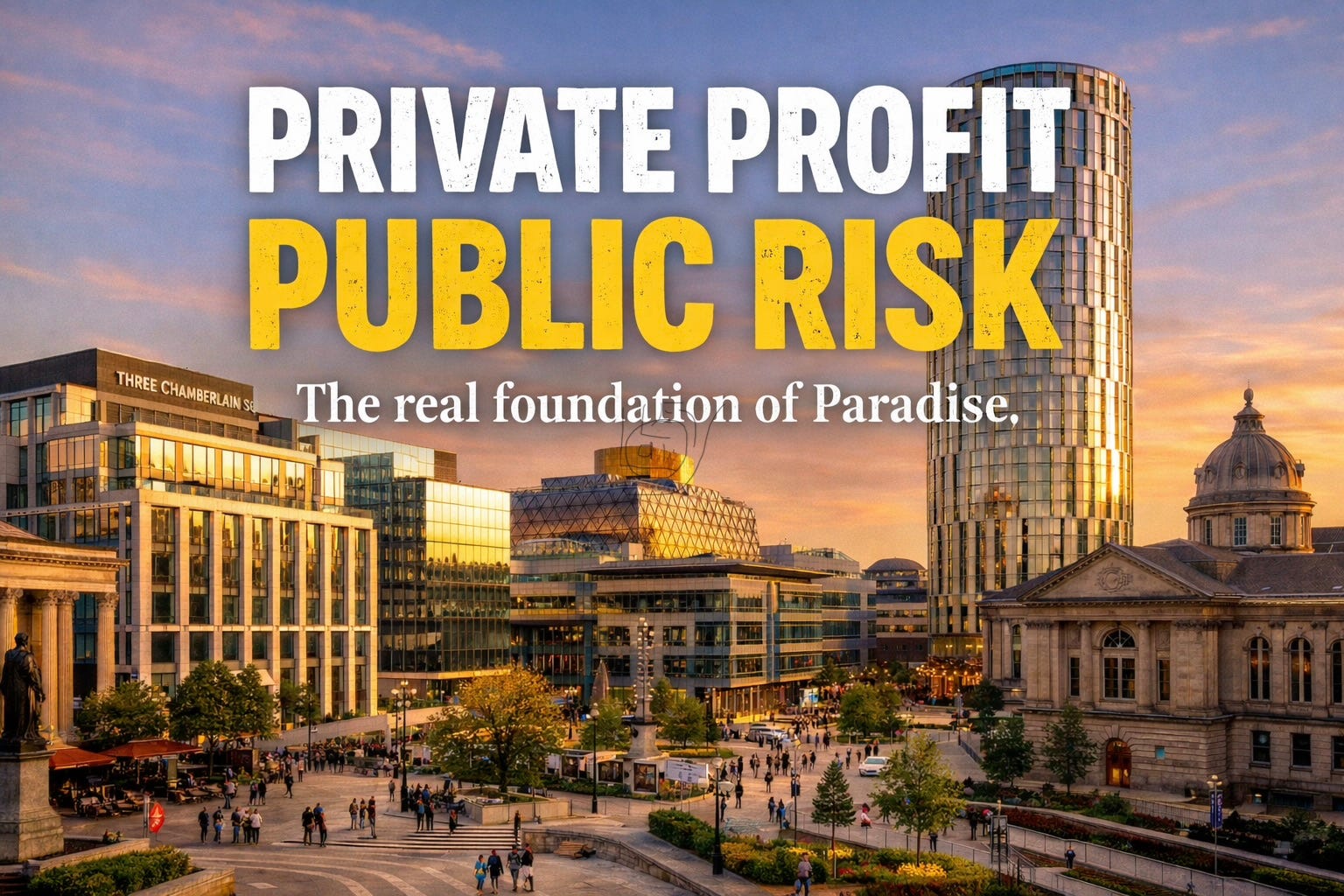
There are moments in the life of a city when cranes begin to rise and the skyline changes, and everyone senses something important is happening. Birmingham has had several such moments. The latest sits in plain sight between Chamberlain Square and Centenary Square, where the Paradise development has steadily replaced concrete relics with glass, steel and a vision of metropolitan confidence.
If you stand there today, coffee in hand, watching office workers stream past the newly paved squares, you might reasonably conclude that something impressive has happened. The buildings are handsome. The public spaces feel open and deliberate. Corporate tenants have arrived with reassuringly international names. Birmingham looks, for a moment, like a city that knows exactly what it is doing.
But beneath the polished granite and reflective glass lies a story that Birmingham has been telling for forty years, and it is not quite the story we usually hear.
Because if Paradise represents a triumph of capitalism, it also represents something else entirely. It represents a triumph of social capital, the quiet financial backing of the public purse that makes so many supposedly private developments possible.
And it is time we started being honest about that.
The Cost of Paradise
The immediate trigger for the latest round of questions is a rather awkward figure uncovered in the council’s accounts.
The Paradise scheme now appears to have a £60 million working capital gap, half of which Birmingham City Council may ultimately need to cover. That is not quite the financial apocalypse some headlines might suggest, but it does raise an obvious question: how did a project billed as a £1.2 billion private-sector triumph end up needing more public money?
To understand that, we have to step back and look at the full picture.
Public contributions to the wider redevelopment around Paradise have included the £188 million Library of Birmingham, built partly so the previous Central Library could be demolished. Add to that the £25 million relocation of the Conservatoire to Eastside and roughly £61 million in early infrastructure borrowing, and the public investment connected with the redevelopment edges towards the sort of figure that makes Treasury officials sit up straight in their chairs.
Depending on how one counts the various infrastructure commitments and enterprise zone funding streams, the public exposure associated with clearing and enabling the site has often been estimated at close to £300 million.
That does not mean £300 million has been handed to developers. It means the public sector has funded the groundwork: the demolition, the roads, the public squares, the infrastructure that makes private investment viable.
Without those things, the private buildings simply do not appear.
The Honest Truth About Regeneration
And this is where the conversation in Britain has always been slightly dishonest.
Urban regeneration is routinely presented as a triumph of entrepreneurial capitalism. Developers take risks. Investors deploy capital. Cities transform themselves through the magic of the market.
Except that is not really what happens.
In practice, large urban regeneration schemes operate through a partnership that might be described, less romantically, as capitalism with a public safety net.
The public sector assembles land, pays for infrastructure, relocates displaced tenants, and builds the public realm. Private developers then step in to construct buildings that generate profit once the groundwork has been laid.
It is a marriage of convenience between public ambition and private capital. One might even say it is a rather British compromise between ideology and practicality.
But we rarely talk about it in those terms.
A Familiar Birmingham Pattern
Professor David Bailey has long pointed out that Birmingham’s development model has followed this pattern for decades.
The International Convention Centre in the late 1980s, the National Indoor Arena, the Mailbox, Brindleyplace, the Library of Birmingham, and now Paradise all share the same broad DNA.
Each was presented as a transformative project that would reposition the city, attract global business and generate new economic momentum.
And in fairness, many of them did.
Brindleyplace, which opened in the early 1990s, is still one of Birmingham’s most successful urban quarters. Its canalside walkways remain busy three decades later. Its architecture has aged gracefully. It is a place people enjoy spending time.
But the part of the story that tends to fade from memory is that Brindleyplace itself collapsed financially during construction. The development company went into administration in 1992. The project had to be rescued by a restructuring backed in part by public intervention.
Today, nobody talks about that. We simply admire the finished product.
The Brutalist Elephant in the Room
It is also worth acknowledging the rather uncomfortable truth about the site Paradise replaced.
The old Central Library may have been architecturally significant in the eyes of historians and brutalist enthusiasts, but it was never widely loved by the public. To most residents it resembled a concrete fortress dropped into the city centre by a visiting alien civilisation with a fondness for grey.
It was monumental, certainly. It was rare, yes. But it was also widely regarded as oppressive and awkward.
The redevelopment of the area was therefore not some reckless act of civic vandalism. It reflected a broad desire to reconnect Victoria Square with Centenary Square and create a more coherent civic space.
Paradise has largely succeeded in doing that.
The question is not whether regeneration was desirable. The question is who paid for it, and how openly that payment was acknowledged.
The Nervousness Around Public Money
For reasons that are partly ideological and partly political, British governments have always been reluctant to describe regeneration projects as what they often are: publicly supported investments in private economic activity.
Instead, the language tends to become slightly evasive.
Developments are described as “private sector led.” Public contributions are framed as “enabling infrastructure.” Loans become “facilities.” Subsidies become “incentives.”
The result is that the public role becomes invisible, even though it is often crucial.
It creates the curious impression that gleaming new office blocks simply materialise out of the free market, like mushrooms after rain.
In reality, they are usually standing on foundations funded by taxpayers.
Why Cities Take the Risk
There is a practical reason councils agree to these arrangements.
Without early public investment, many major regeneration schemes simply would not happen. Private developers are rarely willing to absorb the costs of land assembly, demolition, transport infrastructure and public realm improvements on their own.
Cities therefore step in to “prime the pump.”
The hope is that once the groundwork has been done, private investment will follow and the city will benefit from:
increased business rates
new employment
higher property values
a stronger international profile
Paradise was expected to generate hundreds of millions of pounds in business rate growth over 25 years, money that could be reinvested across Birmingham.
That is the theory.
When the Theory Meets Reality
Unfortunately, long-term property forecasts have a habit of colliding with reality.
Paradise was planned in an era when office demand appeared almost limitless. Global corporations were expanding, city centre employment was growing, and interest rates were comfortably low.
Then several things happened.
A pandemic altered working patterns. Hybrid working reduced demand for traditional office space. Interest rates rose sharply, making development finance more expensive. Commercial property valuations softened.
Suddenly the tidy financial model underpinning many regeneration schemes looked rather less tidy.
Which is how a £60 million funding gap can emerge in a project that once appeared bulletproof.
The Real Lesson
The point here is not that Paradise has failed. It has not.
The area has been transformed. Major companies have moved in. The public spaces work. Birmingham’s skyline looks more confident than it did fifteen years ago.
The real lesson is something else.
Urban regeneration is rarely a simple story of heroic private enterprise. More often it is a shared endeavour between public resources and private ambition.
The working people of a city contribute through taxes, infrastructure investment and long-term borrowing. Developers contribute expertise, construction capacity and financial capital.
Together they reshape the urban landscape.
There is nothing shameful about that arrangement.
What is strange is the reluctance to acknowledge it openly.
Capitalism with a Civic Backstop
If we were being completely honest, we might describe developments like Paradise as examples of civic capitalism.
They are market-driven projects supported by public investment because the broader economic benefits are expected to justify the risk.
In other words, society invests collectively so that private enterprise can generate growth.
Sometimes it works beautifully. Occasionally it produces a financial wobble.
But pretending the public is merely a spectator in the process is simply inaccurate.
A Cultural Problem
Part of the problem lies in the way political debate has framed economic policy for decades.
Any direct acknowledgement that public money supports private development tends to provoke ideological arguments about subsidies and state intervention.
So politicians often prefer to avoid the conversation altogether.
Yet the irony is that many of the most admired urban transformations in Britain were made possible precisely because the public sector was willing to invest.
Brindleyplace is one example. The redevelopment of Manchester’s city centre after the IRA bombing is another. London’s Docklands would never have existed without massive state investment in transport and infrastructure.
Paradise belongs in the same category.
A More Honest Conversation
Perhaps what Birmingham needs now is not a retreat from regeneration but a more mature conversation about how it works.
If public money is helping to fund the transformation of a city, that should not be hidden in footnotes. It should be recognised as a collective investment in the city’s future.
After all, the benefits are meant to flow back to the public as well: through jobs, business rates, improved public spaces and a stronger economy.
There is no reason to pretend otherwise.
Paradise, Reconsidered
Walk through Paradise today and you will see the results of that investment.
Glass towers reflect the sky where once there were concrete terraces. Office workers queue for lunch beneath buildings that would not look out of place in Frankfurt or Amsterdam. Visitors drift between the library and the museum along broad new pavements.
The transformation is undeniable.
It is not purely a triumph of private capital, nor purely a product of public planning. It is the outcome of both.
And perhaps that is the real lesson.
Cities are not built by ideology alone. They are built by partnerships, compromises and occasionally a little financial improvisation.
Sometimes the sums work perfectly. Sometimes they wobble.
But if the end result is a city that looks forward rather than backwards, perhaps the investment was never quite as outrageous as the headlines suggest.
Even if, every now and then, paradise turns out to be a little more expensive than expected.
Sensible reflections on developments over the last 50 years, that would not have happened without Councils "hidden hand" in CPOs and land assembly.