

Pension Lord Baffled?
Lord Hutton came, advised, left. The pension questions remain.

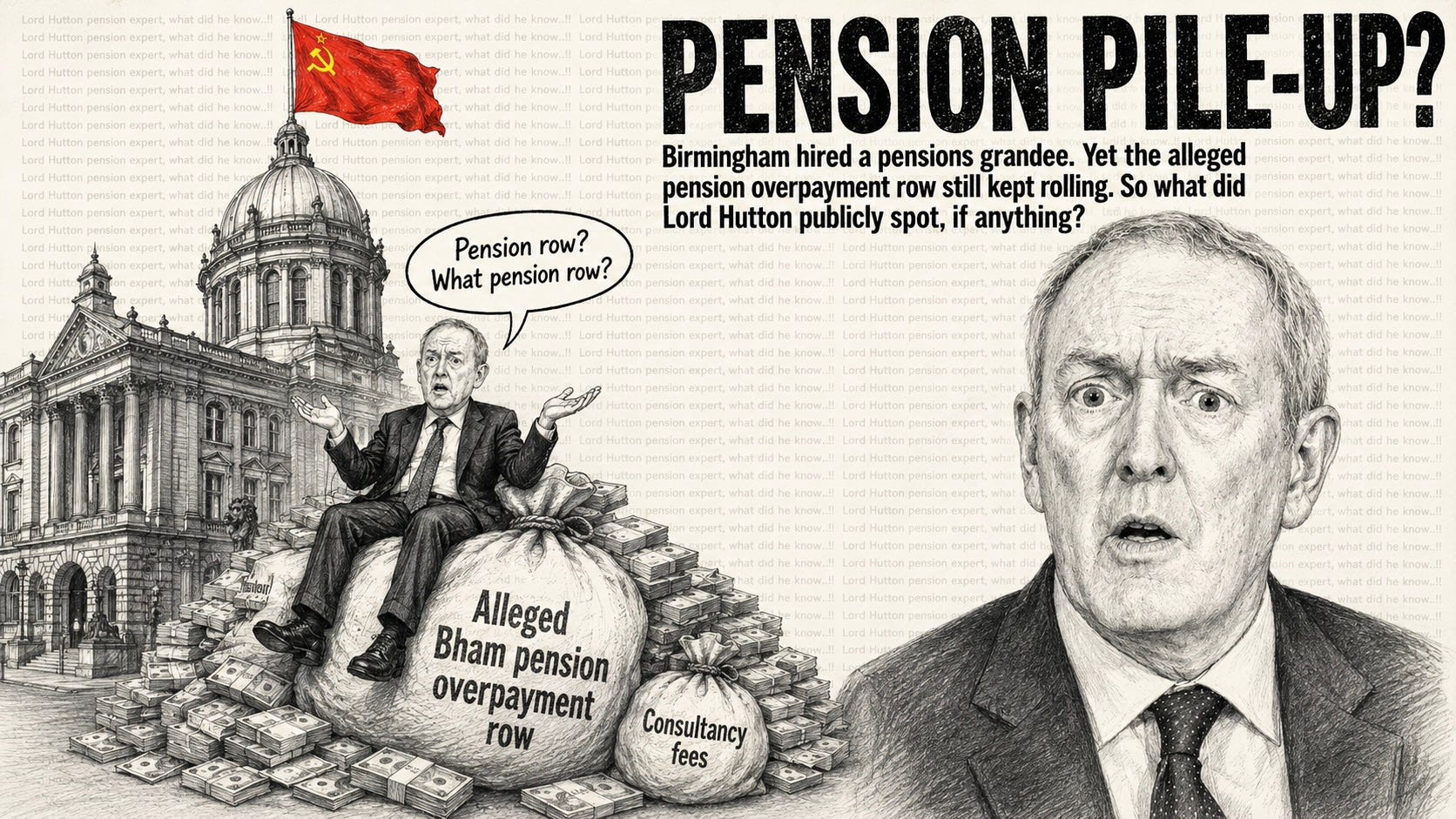
Birmingham did not just get commissioners. It got commissioners, political advisers to the commissioners, advisers around the advisers, and enough supervision to make democracy feel like it had been put on a behaviour contract. This week, looking again at the people who really run Birmingham, I found myself back with Lord John Hutton of Furness. Not Lord Hutton of Barrow, as I keep wanting to call him, and not Lord Hutton of Luton Airport, although that comes into the story. Furness. Former MP for Barrow and Furness. Former Cabinet minister. Former public pensions grandee. Birmingham’s briefly installed political adviser to the commissioner machine.
He was appointed on 5 October 2023, at the same time as John Biggs, the London Labour lad. Yes, two political advisers. Because apparently the unelected commissioner operation needed not one political mind, but two. Once you have diluted local democracy, appointed outsiders, and told the city the grown-ups are now in charge, it is only sensible to appoint political advisers to make sure the grown-ups do not trip over the politics of the people they have just semi-replaced. It has a faint whiff of Soviet municipal theatre. “Good news, comrades. Your democracy has been improved by being watched more closely by people you did not elect.”
To be precise, Hutton was not a statutory commissioner with formal commissioner powers. That matters. But he was part of the commissioner team, paid by Birmingham, brought in to support the council’s political leadership and expected to take an interest across the authority. His published rate was £1,100 a day, plus reasonable expenses, up to 150 days a year. That gives a ceiling of £165,000 a year before expenses. For that, I would expect more than warm words, polished shoes and a sympathetic nod over the biscuits.
Hutton did not last long. His resignation was accepted on 22 October 2024. In round numbers, he was around for a year. A year in which Birmingham residents were lectured about cuts, council tax, assets, savings, discipline and transformation. The question is not whether expertise can be useful. Of course it can. The question is whether Birmingham has been allowed to see enough of what that expertise did, cost, spotted or quietly walked around.
And with Hutton, the awkwardness has a very particular shape. It is pension-shaped. This was not Lord Anybody. He was a former Work and Pensions Secretary, Business Secretary and Defence Secretary. He chaired the Independent Public Service Pensions Commission, whose final report shaped modern public service pension reform. If public-sector pensions had a Mount Olympus, Lord Hutton had a reserved parking space. So when Professors John Clancy and David Bailey began arguing that Birmingham may have paid far too much into the West Midlands Pension Fund, one might have expected the great pension eyebrow to rise.
That £547 million figure has now reached Hansard. In a Commons debate on the Pension Schemes Bill on 3 December 2025, MPs were told that research by Bailey and Clancy showed Birmingham City Council had paid £1.2 billion in employer contributions over ten years, and was calculated to have overpaid the West Midlands Pension Fund by roughly £547 million. The Fund disputes the criticism. It says contributions are set in line with legislation, professional advice and employer consultation, and that its investment costs are broadly the same as comparable LGPS funds. Fine. Let us have the argument in daylight. Bring the actuaries, auditors, sandwiches and a calculator with enough digits.
But this is where Hutton becomes politically delicious. If the professors are even partly right, Birmingham had one of Britain’s best-known public pension men sitting in the commissioner orbit while one of the biggest pension questions in local government was waiting to be dragged into the open. Maybe he did spot it. Maybe he raised it. Maybe he wrote a beautiful memo that caused jaws to drop from Victoria Square to Westminster. If so, publish it, and I will bring the bunting. But if he did not, the polite question becomes irresistible. Was Lord Hutton too busy being Lord Hutton everywhere else?
To be fair to him, his Lords allowance claims do not suggest a man wringing the red benches dry. From the figures checked, they look modest. This was not obviously a peer turning up, signing in, pocketing the allowance and vanishing into the afternoon like a duchess with a train to catch. No, the more interesting trail is the portfolio. His register of interests reads less like retirement and more like a grand business breakfast that never ends. Make UK. Pearson Engineering. Infrastructure investors. Cornwall Economic Forum. London Luton Airport Operating Company. Scottish Power. Public speaking. Birmingham. One feels tired reading it, and he was the one doing the meetings.
Now, here is one of the splendid little jokes of modern transparency. The Lords register tells us the roles are remunerated, but usually not how much they pay. The public may see the menu, but not the bill. So let us be careful. I am not saying Lord Hutton earned a particular sum from these roles. I do not know. The declarations do not tell us. That is the point. Looking at the type of roles declared, a broad and cautious floor-to-ceiling estimate for outside income, excluding pension, might reasonably run from the low hundreds of thousands to several hundred thousand a year, depending on the fees, Birmingham days, speaking and board work. Perhaps £150,000 at the modest end. Perhaps £500,000 or more at the busy end. It could be lower. It could be higher. That uncertainty is what happens when the public register opens the curtain six inches and calls it sunlight.
Luton Airport is not a charitable coffee morning. Scottish Power is not a bring-and-buy sale. Pearson Engineering is not a parish raffle. Make UK is the national manufacturing body, not three men in a shed arguing about spanners. These are serious positions. Serious positions tend not to pay in luncheon vouchers and commemorative mugs. And over all that sits the near-certain reality of substantial parliamentary and ministerial pension rights, although the figure is not published. Again, I am not guessing his bank balance. I am asking why citizens have to guess at all.
None of this makes Hutton a villain. It makes him a symbol. Birmingham was told expertise had arrived. The city was told the grown-ups were in the room. Yet one of the largest financial questions now hanging over Birmingham, the pension fund, was not publicly brought to the front by the commissioner operation, at least not in any way residents can see. At £1,100 a day, Birmingham residents deserve receipts. How many days did Hutton bill? What did he produce? What advice did he give on pensions? Was he asked to look at the West Midlands Pension Fund? If yes, what did he say? If no, why not?
Because Birmingham did not need another grandee with a headed notepaper habit. It needed someone to turn over the financial stones. And if the man with perhaps the finest pension CV in Britain walked past the biggest pension row in Birmingham without getting his shoes muddy, then the problem is not just Lord Hutton. The problem is the whole strange system that tells us experts are in charge, hides too much of what they earn, hides too much of what they do, then looks terribly hurt when the rest of us ask for the receipts.
Richard some fascinating comments and observations - I urge everyone to read Richard's comments in full. And I certainly await the publication of your analysis...🧐
I know very little about the council and its pension fund. However it is clear Mike that the Commissioners act outside the democratic process. Their continuing existence here probably reflects the failure of the government to break the City up. Elsewhere councils taken over by Commissioners, such as Northamptonshire, have been broken up and the commissioners have left. Democracy is important but only if one person one vote is respected and equitable. My complete analysis of the 2026 will go on line next week. I hope that it will be of interest to you. However while I was going through the data I began to wonder about the wards themselves. Are they equitable? Does a person’s vote in one ward have the same electoral weight as in another ward? The electoral Register size of one ward ought to approximate to the size of another. Of course there will be some variation up to say 5-10% But what happens when the electorate of one ward is eg 50% larger than another ward. Of course, the Boundary Commission is independent and responsible for boundaries and electoral sizes. But what happens when they get their estimates completely wrong, as happens to be the case with Birmingham. It means that one person’s vote in one ward is worth less than in another ward. This can effect the actual result of the election. In my Analysis of 2026 I go into detail how this affected the result. Here I can simply illustrate the argument. The average electorate for a single member ward in 2026 was 7,796. The average electorate in a double seat ward for a single councillor was 7,516. Already there is a small but manageable discrepancy. But within these averages are huge discrepancies. Here below is the greatest variations from the biggest and smallest electorates for the single and double electoral wards in 2026:
Single member ward.. biggest 10,005… Bordesley and Highgate
smallest 6,806 Castle Vale
Double member ward biggest 18,148. Ladywood
Smallest 11,500. Edgbaston
This discrepancy is way outside the 10% allowed. It border on gerrymandering though I do not believe that it was deliberate to benefit one party or another, though it did. It was caused by a legal requirement to forecast the size of the electorate in ten years time for each ward. This is simple guesswork. The prediction of the boundary commission for 2021 was 813,981 (a bizarre specific number) while this year 2026 the electorate was only 769,445 when it was predicted to be around 840,000. In my analysis I examine this in detail and thus the value of each vote for each party.