

Perry Barr And The Cars That Came Anyway
A handsome Games legacy meets sermon-like street names, anti-car theory, and the quiet rebellion of residents who brought their cars anyway.

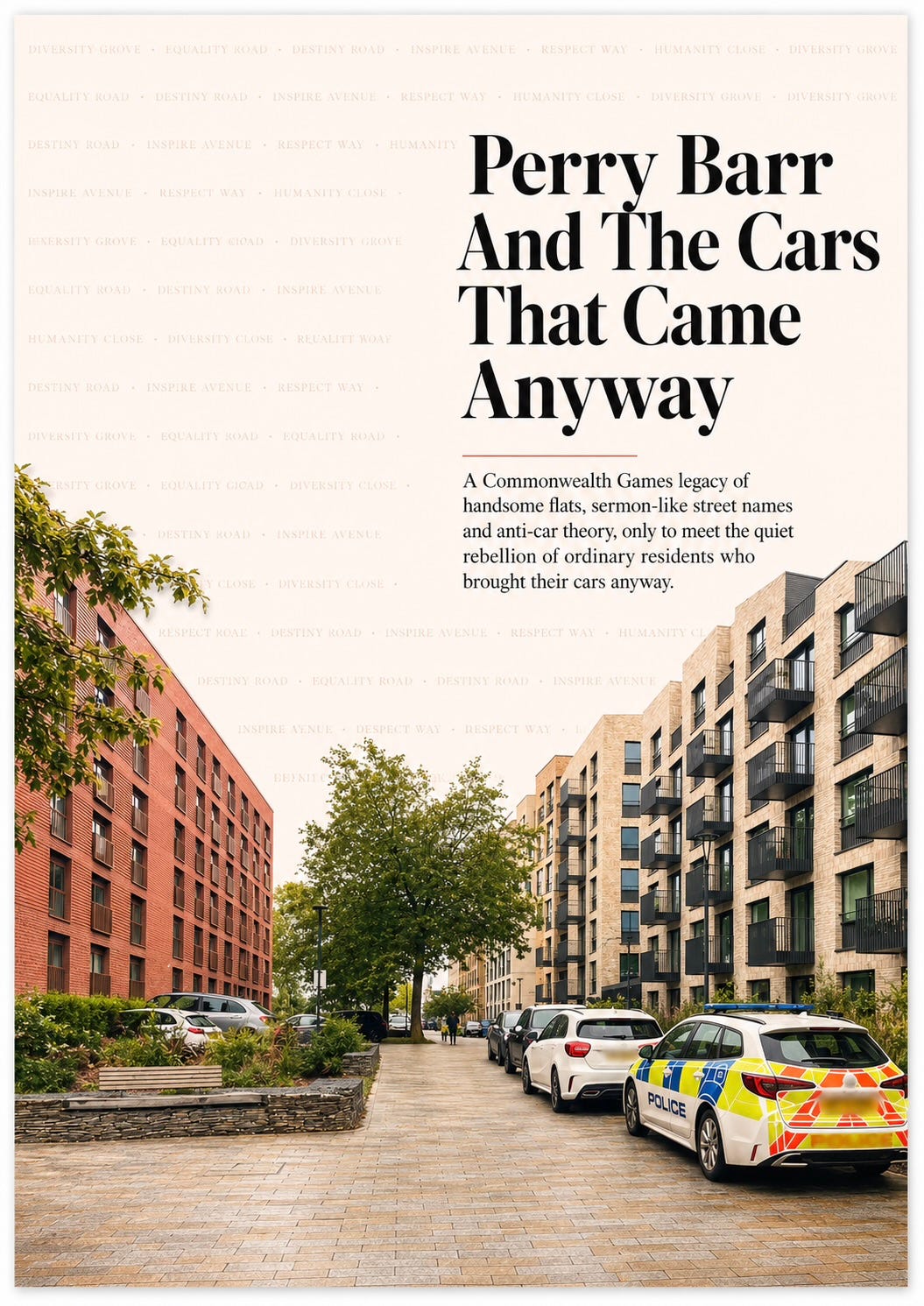
There is a photograph of the Perry Barr Commonwealth Games flats that does something rather inconvenient. It makes the place look good. Really good, in fact. Handsome apartment blocks, clean paving, careful landscaping, proper balconies, neat planting and the sort of modern finish that normally appears in glossy regeneration brochures just before somebody from the council uses the word “transformational” and everyone in the room quietly loses the will to live.
But here is the thing. It is handsome. It is solid. It is clearly built to a high standard. It is not the usual beige box of apologetic municipal housing, flung up with all the architectural imagination of a filing cabinet. These flats look as if somebody cared about design, materials and finish. They look expensive because they were expensive. They look high specification because they are high specification. They look, in short, like housing that did not begin from the grim assumption that ordinary people should be grateful for whatever they are given, so long as the roof does not actually fall in before the defects period expires.
And on that point, bravo.
Because nothing is too good for the working class. Nothing. Not decent brickwork. Not proper balconies. Not attractive public space. Not paving that looks like somebody chose it rather than apologised for it. Not a place where a person can step outside their front door and feel they live somewhere that has been designed, not merely processed. The old attitude, still hanging around some corners of British public life like damp in a cellar, is that entry-level housing should look entry-level. Utility blocks for utility people. Keep it cheap, keep it plain, keep expectations under control. Well, no. Good homes are not a luxury prize for the already comfortable. They are the foundation of a civilised city.
So let us be fair. The Perry Barr flats themselves are not the villain of this story. The buildings in the photographs look good. The setting looks good. The public realm looks good. If the argument were simply whether Birmingham should ever build good quality homes for people who are not already swimming through inherited wealth and artisan coffee, the answer is yes, yes, and yes again.
The awkwardness is that Perry Barr does not look like a failure. It looks like a success that has had its balance sheet mugged in a side street. It looks like the disaster put on a clean shirt, straightened its tie and turned up at the auditors hoping nobody would ask about the numbers. It is finished. It is shiny. It is resplendent. It is the sort of place that can photograph beautifully while quietly carrying a financial headache in the basement, sobbing into a council lanyard.
The Commonwealth Games themselves were magnificent. I went to the opening ceremony. I went to the closing ceremony. I saw almost nothing in between, which is possibly the purest Birmingham way to experience an international sporting event, but I was proud. Birmingham looked alive. Birmingham looked confident. Birmingham looked like a city that had remembered it was allowed to enjoy itself without first submitting a risk assessment to a directorate of managed enthusiasm.
There was also, at the time, a feeling that Birmingham had stepped up almost as a favour to the Government. The Commonwealth mattered. The late Queen cared deeply about it. The country needed the Games to happen. Birmingham, with all its usual muddle, swagger and civic appetite, looked at a large complicated challenge and said: go on then, we’ll have a bash. There was also the understanding, spoken or unspoken, that Government would be paying the bill. And this, of course, is where local government becomes like a man in a hotel bar with somebody else’s credit card. At first it is one glass of house red. Then it is the second bottle. Then it is a cheese board, a brandy, a suite upgrade and a speculative conversation about whether the hotel might sell him the piano.
If someone else is footing the bill, half-cocked ideas begin to look like statesmanship. An athletes’ village? Excellent. A housing legacy? Even better. New homes, new streets, new public realm, new confidence. Wonderful. Who could object? Only a miserable person, and Birmingham had enough misery without importing more of it.
The problem is that the word “legacy” is one of those words that arrives carrying a clipboard and leaves with your wallet.
I remember writing about the Games legacy for the Birmingham Mail and finding it hard work. I was proud of the Games. I wanted them to work. I was not going to sit there while Birmingham was having a rare moment of civic delight and announce, “Excuse me, everybody, but I suspect some of this legacy talk may be municipal blancmange.” That would have been rude. Also, nobody likes the person who turns up at a party with a spreadsheet, especially when they are probably right.
But the actual legacy argument was thin. There was uplift, regeneration, opportunity, skills, pride, visibility, confidence and all the usual words that appear when nobody wants to say: “We are hoping this all works out somehow.”
Perhaps that is because we have become embarrassed by enjoyment. We cannot simply say: the Games were magnificent, we loved them, they lifted the city, and sometimes a great civic moment is worth having because people need joy as well as bin collections. No, we have to dress pleasure in the grey cardigan of accountancy. We must have outcomes. We must have metrics. We must have legacy units. We must have an economic impact assessment with a foreword by somebody called the Director of Inclusive Acceleration.
We are a bunch of silly sausages. We cannot even enjoy ourselves without trying to put the fun through procurement.
The original idea sounded grand enough. A Games village. Athletes. Flags. Commonwealth sparkle. Then, after the medals had been awarded and the television cameras had gone away, the village would become housing. A perfect story. Sport into homes. Celebration into legacy. Running tracks into front doors. Civic poetry with planning consent.
Except the athletes did not end up living there for the Games. The village became a village without the villagers. A Games village that missed the Games is not so much a legacy as a very expensive case of arriving at the station after the train has left, waving a commemorative ticket.
Then came the street names.
The new Perry Barr roads were not simply named after local history, old landmarks, Birmingham characters, lost factories, athletes, musicians, reformers, workers, inventors, pubs, churches, farms or the sort of actual human material from which places normally get their memory. No. They were given names that sound as if a council equalities workshop escaped from a flipchart and started issuing postcodes.
Diversity Grove. Equality Road. Destiny Road. Inspire Avenue. Respect Way. Humanity Close.
Humanity Close. Imagine giving that address to your car insurer.
“Yes, that’s Humanity Close.”
“Sorry, did you say Humanity Close?”
“Yes.”
“And is that near Reality Bypass?”
The council said the names came from a competition. Well, perhaps they did. A competition, maybe, but one suspects not the sort of competition in which Virtue Signalling Avenue would have been allowed anywhere near the shortlist. Which is a shame, because if the public had been given a proper open vote, Virtue Signalling Avenue would have won by a landslide, followed closely by Pious Close, Committee Crescent, Inclusivity Mews and Please Applaud Our Values Way.
That is the trouble with civic consultation when it becomes theatre. The public is invited to participate, but only inside the vocabulary already approved by the people running the show. It is democracy with stabilisers, a public vote in which the public is gently steered away from anything too funny, too honest or too likely to win.
There is, of course, nothing wrong with diversity, equality, respect or humanity. They are good things. But once you staple them to road signs, they stop sounding like values and start sounding like the stationery cupboard has developed a conscience. It is not placemaking. It is slogan deployment.
And then, gloriously, beautifully, inevitably, came the cars.
Look closely at the photographs. The flats may have been designed in the spirit of modern urban planning, but the residents have brought their own reality with them. Cars are there. Cars are parked wherever they can be fitted. In bays, on edges, along roads, tucked into corners, squeezed into the built environment like common sense forcing its way through a policy document.
The public, as usual, has listened politely to the sermon, nodded in the right places, gone home, and done what it needed to do.
This is where Perry Barr becomes more than a story about housing. It becomes a story about the governing class and its little fantasies. For years, politicians and planners have grown increasingly anti-car in tone, while remaining, in many cases, deeply fond of their own vehicles. The public are told they do not need cars. There is a railway station over the road. There are buses. The future is walkable, sustainable, connected, integrated and probably wearing ethically sourced trainers.
Then real life arrives.
People have jobs in places not conveniently arranged around a transport strategy. People have children. People have elderly relatives. People have shopping. People have late shifts. People have weekend commitments. People have hospital appointments, football matches, school runs, tools, bags, pushchairs, rain, tired legs and relatives in places where the bus service appears once every seventeen years under a blood moon.
So they buy a car.
That is not selfishness. That is not moral failure. That is not a refusal to embrace the future. That is life refusing to be laminated.
The same political world that imagines car ownership can be designed out by aspiration also seems surprised when the cars do not vanish. They lurk. They gather. They occupy. They appear in photographs like a peaceful uprising of hatchbacks.
This is the democratic genius of the British public. They may not march. They may not write consultation responses. They may not attend cabinet meetings, largely because life is too short and most cabinet meetings feel like a punishment for crimes committed in a previous existence. But give them a development with too few parking spaces and they will conduct civil resistance one Ford Focus at a time.
Even the police car in the photograph finds a spot. There is a whole sermon in that police car. The state itself has turned up at the state’s own anti-car sermon and parked outside.
Marvellous.
This is not an argument against public transport. Good public transport is essential. Birmingham needs better buses, better trains, safer walking routes, proper cycling routes and genuine integration. But good public transport gives people choices. Bad ideology removes them and then congratulates itself for doing so.
And this, perhaps, is the real Perry Barr lesson. The flats may be good homes. They may be very good homes. In appearance, finish and ambition, they may even be better than the sort of housing too many people assume is “good enough” for those starting out, renting, working, saving, struggling, rebuilding or simply trying to get a decent place to live in a difficult city. On that, I will not sneer. I will cheer. Build well. Build beautifully. Build for dignity. Build as if ordinary people matter, because they do.
The problem is not that the buildings are too good. The problem is that the thinking around them was too smug. The problem is not quality. The problem is fantasy. The problem is not that working people got handsome flats. The problem is that civic leaders wrapped a complicated housing and finance gamble in Games bunting, gave the roads the names of motivational fridge magnets, underplayed the reality of car ownership, and then seemed surprised when real people turned up with real lives.
A Games village became a housing legacy. A housing legacy became a financial problem. A financial problem became a political embarrassment. A set of streets became a vocabulary test. A planning theory became a parking problem. And through it all, the ordinary resident turned up with the one thing the theory had tried to airbrush away.
A car.
Perry Barr looks built. The business case looks demolished. The legacy looks complicated. The road names look like a diversity seminar got lost on the way to the stationery cupboard. The parking looks like the public quietly sticking two fingers up at the idea that their lives can be planned by people who confuse aspiration with infrastructure.
Still, let us be fair. The Games were wonderful. Birmingham was wonderful. The city shone. We should do big things again. We should host, build, celebrate and occasionally behave as if we are more than a spreadsheet with potholes.
But next time, perhaps we should be honest. If we want a party, call it a party. If we want homes, build the homes people actually need. If we want quality, do not apologise for quality. If we want public transport, make it good enough that people choose it, not so mediocre that politicians have to bully them into pretending it works. And if we want to name new streets, for heaven’s sake let the public have a proper go.
Because I still maintain Virtue Signalling Avenue would have won.
By miles.
Probably in a car.
Long long ago … well 12 years ago I suggested the way to solve the car problem in Birmingham but the politicians ignored it and spent vast sums of money on the metro… costing in places 1 million £s a metre, as eg at five ways £50 million cost to move the end of the line 50 yards from Morrisons to an office block and that cost does not include the land bought up. Of course the metro was designed to go to Quinton but can go no further than 5 ways. The metro is a vanity project because Manchester, Croydon, Nottingham have one. It is excessively expensive. My solution would have cost less than a 1/4 of the price per mile. It would have not interfered with the road system and it would have been carbon neutral and built near Oxford. Moreover it would ensure transport every 20 seconds into and out of town. I drew up plans for a gondola system ie large cable cars running eg above the Hagley Road to Quinton… another one running from where the Hagley Road joins the Wolverhampton Road to Dudley and beyond… to which was added driverless small buses to go to the “stations” en route as for example in our twin of LYON in France, Oakland in Oregon US and in La Paz in Bolivia. Added to this I envisaged as in many German towns and cities underground car stacking, where cars are robotically stacked uNderground near these station hubs or under them… it is one of the tragedies of Birmingham that can best be seen from google overhead camera footage online that 40% of the city centre is designed for the sole use of the car… be it roads, car parking lots, car parks, garages and car workshops. This is a nonsense. Car stacking rather than multi storey carparks or car park plots of land would release 25% of land. Instead politicians were fixated on an expensive metro system. I produced a scheme for 2 billion £ that would have incorporated the whole of the West Midlands. Instead that sum has gone on an incoherent metro system that will never reduce car traffic. As to Perry Barr it is a mess…
Hooray for Virtue Signalling! And better houses for everyone. With parking areas.