

Racism Is Too Serious For Football To Get It Wrong
Conor Wilkinson of Solihull Moors was cleared by the FA. Racism must be punished hard, but football must also correct its mistakes.

Conor Wilkinson is not a household name, unless your household follows the National League, Walsall (my club and Mrs Olley), Solihull Moors, or the old football habit of knowing who came off the bench in the 65th minute. He is a professional striker, a player who has been around proper football, including Bolton Wanderers, Gillingham, Leyton Orient, Walsall, Motherwell, Colchester United and now Solihull Moors. That is the hard country of the game, where a reputation still matters, a ban still hurts, and legal bills are not paid with loose change.
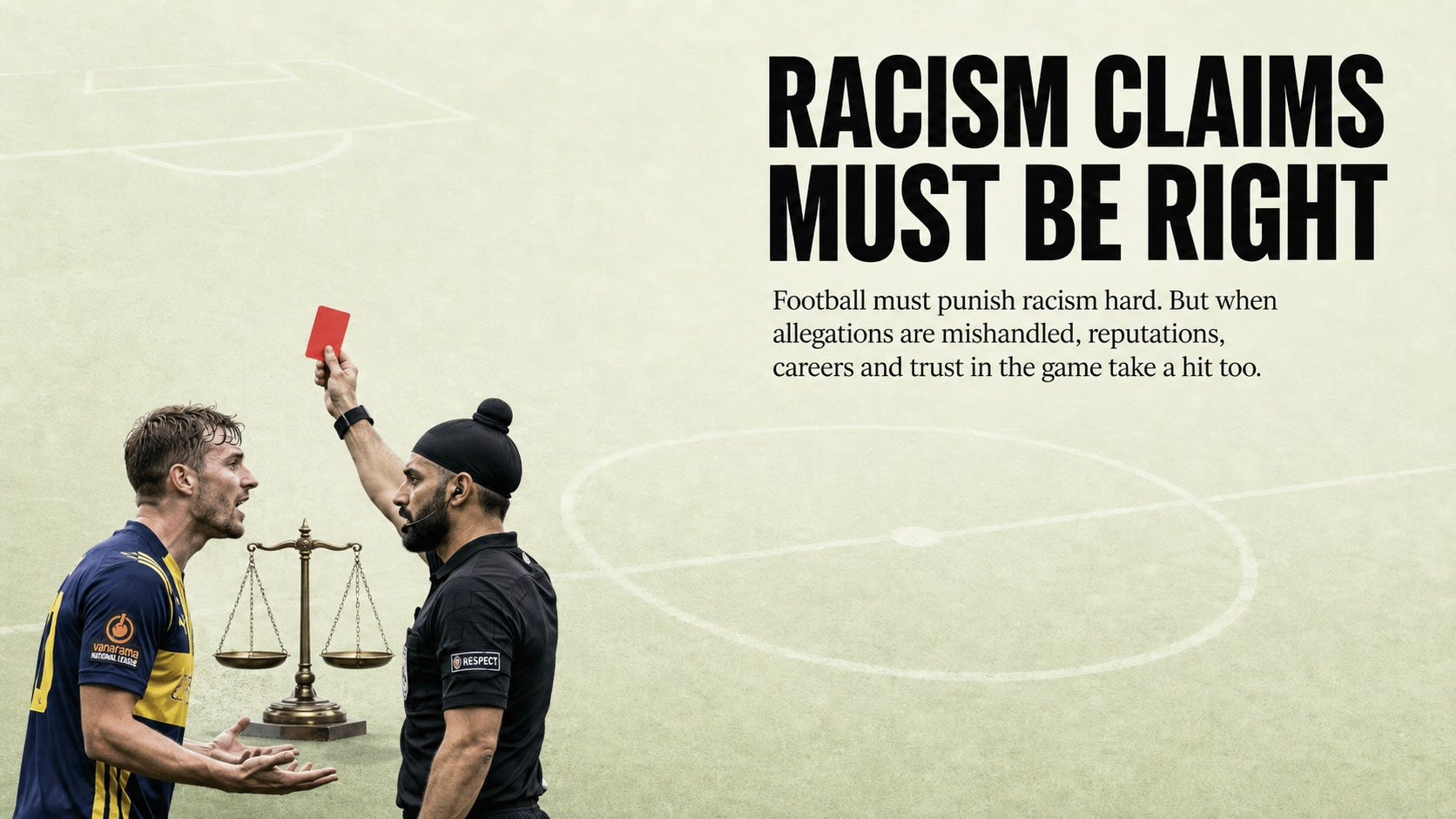
On 18 April, during Solihull Moors’ National League game against Boston United, Wilkinson was sent off after an alleged racist comment towards referee Sunny Singh Gill. Play was suspended. The allegation went public. His name was attached to racism. In modern football, that is not a routine disciplinary matter. It lands like a flare in a dry haystack. Before any final finding, the stain is spreading: online abuse, whispers and the brutal modern punishment of being half-convicted by public suspicion. Now the FA has taken no further action. Solihull Moors say Wilkinson’s innocence has been confirmed. The club says players closer to the incident denied that a racist comment was made. It says the allegation came via the assistant referee, some distance away. It also says Wilkinson has suffered reputational damage, legal costs and remains under a two-game suspension unless the FA rescinds it and expunges the sending off.
That is why this matters. Not because racism in football should be treated less seriously, but because it should be treated more seriously. If racism can end careers, shame families and rightly chase people out of the game, football has a duty to make sure such allegations are handled with care, evidence and fairness. A racist should be punished hard. A knowingly false or malicious allegation should be punished hard too. Where an honest mistake has caused damage, the system should not just shuffle away muttering about protocols.
I should declare a memory. I knew Solihull Moors chairman Darryl Eales long before Solihull Moors existed, back when Solihull Borough and Moor Green were still separate clubs. In the 1980s we played rugby together at Camp Hill RFC. I was a captain and, being a forward, considered backs to be a mysterious species who appeared now and again to drop the ball after the pack had done all the work. Darryl was a back, a very good one: sharp, balanced and already thinking three phases ahead while the rest of us were wondering where the oranges were. Even then, it was obvious he was unusually able and level-headed. So when I saw his statement, I looked properly.
The first principle is simple. Racism in football must be punished hard. Not politely tutted at. Not hidden behind the old dressing-room rubbish of “heat of the moment”. Sport is about winning. It is about pressure, edge, niggle, gamesmanship and, sometimes, the dark arts. I played rugby in an age when a player might get a sly dig in the loose, not because he was auditioning for the Royal Ballet, but because it might put an opponent off his game or, on a bad day, out of the game. That was not noble. It was just sport before cameras, lawyers and fourth officials multiplied like rabbits. The punishment, if you were even caught, was modest.
Racism is different. It is not banter. It is not sledging. It is not a clever way of unsettling someone. It is an attack on the person, not the player. It tells a man, woman or child that they do not belong. That is why the punishment has to fit the crime. If racist abuse carries only a minor sporting consequence, the cynical message is obvious: take the risk, unsettle the opponent, pay the price later. Football cannot allow that. Bans, fines, education, public findings and, in serious cases, exclusion from the game are not excessive if the conduct is proved.
But the second principle matters just as much. Because racism is so serious, the accusation must be treated seriously too. A careless, reckless or knowingly false allegation is not a harmless administrative mistake. It can damage a reputation, destroy confidence and make genuine victims less likely to be believed. It also gifts ammunition to every pub bore, online crank and professional grievance merchant who wants to pretend racism is invented. A false racism allegation does not fight racism. It feeds racism.
That is why the Solihull case is important. It appears, on the club’s careful wording, more likely to be a misunderstanding or honest error than malice. Darryl Eales’s statement is measured. He asks for an apology from the assistant referee, but says the club is not doubting his integrity. That matters. We should not casually accuse an official of bad faith any more than we should casually accuse a player of racism. The problem is not that the allegation was investigated. It should have been. The problem is what happened before the investigation had done its work: the sending off, the public stain, the suspension, the legal cost, the social-media pile-on and the damage.
The numbers also deserve calm handling. Kick It Out says total discrimination reports reached 1,398 in 2024/25, up 5 per cent from 1,332. Yet its same figures say overall reports of racism fell by 9 per cent across all levels of the game, while racist reports in the professional game rose 10 per cent, from 223 to 245. In other words, this is not a cartoon where everything is always worse or everything is secretly fine. Racism remains real. Reporting remains vital. But football still has to separate what is reported, what is charged, what is proved and what is mistaken. Otherwise the system becomes heat without light.
Nobody sensible wants officials frightened to report discrimination. If an official hears, or honestly believes they have heard, racist abuse, it must be reported. But there is a difference between reporting and punishment, and between recording an allegation and effectively branding a man before the facts are tested. That is the line football must now get right.
So what should happen? If the FA has concluded no further action is appropriate, the two-game suspension should be rescinded and the sending off removed from Wilkinson’s record. That is not special pleading. The FA should review whether match protocols allowed punishment to run ahead of proof. If the evidence was indirect, circumstantial and disputed by players closer to the incident, the right response may have been to report, investigate and protect all parties, not create a public verdict in the middle of a match. Costs should be addressed too. The old legal idea that costs follow the event exists for a reason. If a man has spent money clearing his name after a process which produced no case against him, the body running it cannot simply shrug.
This is not about weakening anti-racism. It is about strengthening it. Real racists should be chased out of football. People who knowingly make false or malicious allegations should face serious consequences as well. Honest mistakes should be acknowledged and corrected, with apologies where appropriate and costs where justice requires it. Football cannot kick racism out by being casual with the truth. It cannot protect victims by creating new victims. Conor Wilkinson’s case should be used to make anti-racism better: tougher, fairer, more trusted and less vulnerable to the people who would love to see it fail.