

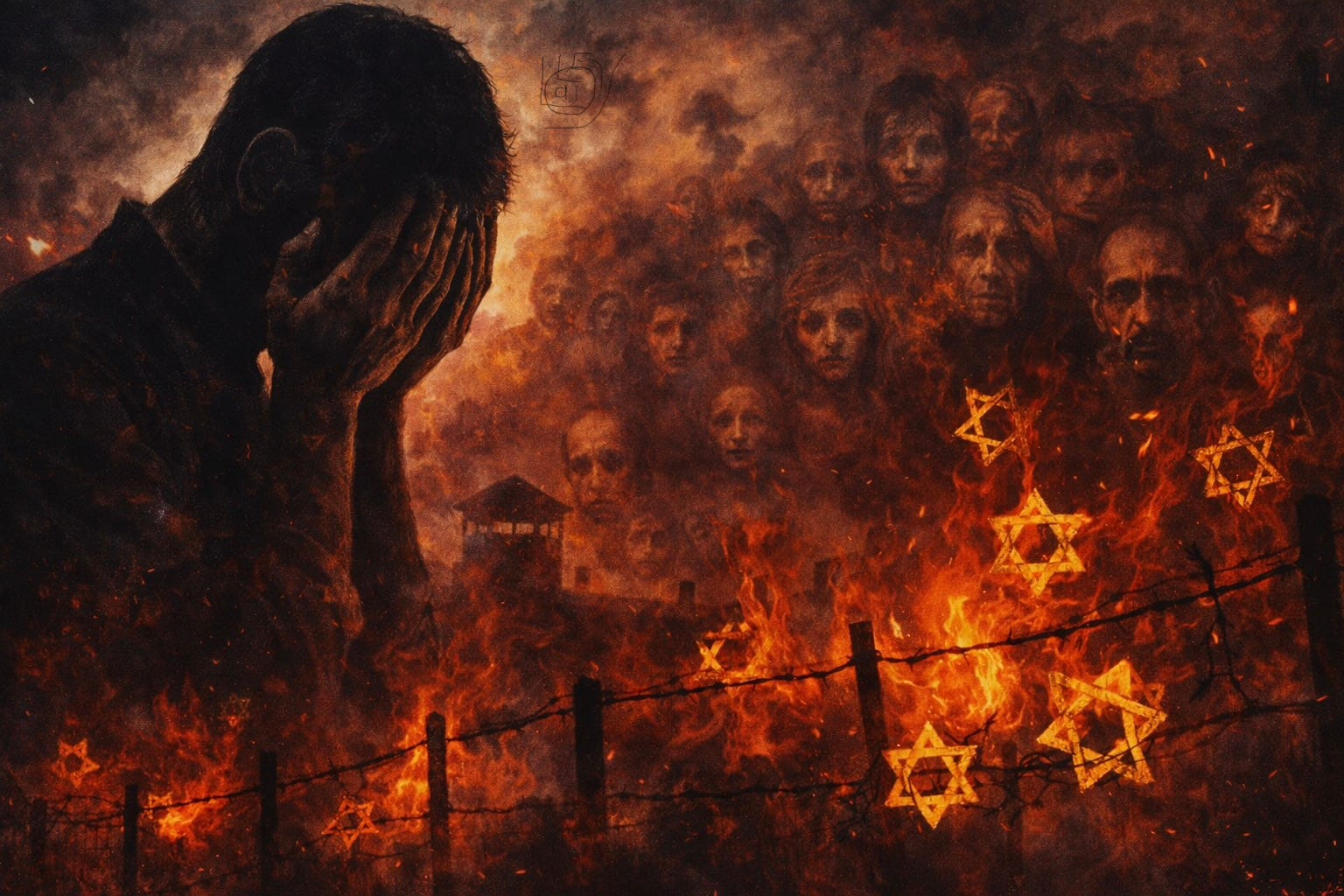
There are moments when remembrance stops being abstract and becomes personal, uncomfortable and morally unavoidable.
Birmingham City Council’s Holocaust Memorial Day (26th January) ceremony does precisely that. Not by spectacle or sermonising, but by placing real lives, real loss and real responsibility at the centre of civic space. In doing so, the city performs one of the quiet duties of democracy, to remember clearly, honestly and without evasions.
As a practising Christian, Holocaust Memorial Day forces me to confront an uneasy truth. The Holocaust was not carried out by some distant, godless civilisation. It was perpetrated within Christian Europe, by people who identified, however falsely, as Christian. That reality cannot be shrugged off or softened. If faith means anything at all, it must include the courage to face where it failed catastrophically.
At the same time, Christianity itself is inseparable from Judaism. Jesus was a Jew. His faith, his scripture, his moral world were Jewish. For Christians, Holocaust remembrance also invites humility. Christianity does not stand apart from Judaism, it emerges from it. Jesus was born into Jewish tradition, shaped by it and taught from its scriptures. Remembering that connection matters, because when faith forgets its own roots, belief can drift into something unrecognisable, and sometimes dangerous.
That reflection became sharply personal during this year’s ceremony when Adrian Goldberg spoke.
Adrian is an old pal of mine. We occasionally go to the football together, talk rubbish, talk politics, talk life. Ordinary things. Which is precisely why his story lands with such force. Adrian never knew his grandparents. Not because of illness or chance, but because a political system chose to murder them at Auschwitz.
I was lucky. My grandparents lived into the 1970s. I knew their voices, their warmth, their love. Those relationships help shape who you become. Adrian was denied that inheritance entirely. Not abstractly, not symbolically, but absolutely.
Standing there, listening to him, it struck me again that the Holocaust did not only take lives. It took futures. It took ordinary joys. It severed family lines that should have stretched naturally across generations. The absence is still there, carried quietly by people like Adrian, even as they live full, productive, generous lives.
That is why remembrance matters.
The presence of Mindu Hornick MBE, a survivor of Auschwitz-Birkenau who later rebuilt her life in Birmingham, anchors memory in living testimony. Her story needs no amplification. It simply needs space and respect. Alongside her, the Kol Kinor Choir reminded us that Jewish culture, language and faith endured even where genocide sought to erase them.
This year’s theme, Bridging Generations, is not a slogan. It is a warning. As the programme itself notes, distance from the Holocaust brings risk. Memory fades. Horror becomes abstract. Facts are questioned not because they are uncertain, but because they are inconvenient.
I am also the son of a Second World War veteran. My father never walked through the gates of the death camps himself, but many of his friends did. I remember speaking to those men decades later. You could feel that what they had seen never left them. Thirty years on, the horror still sat in the room.
From them, and from my father, I learned something immovable. There is no honest doubt about what happened.
Six million Jews were murdered. Whether the precise figure is marginally higher or lower does not weaken the truth. It strengthens it. The number is horrifyingly, uncomfortably real. Close enough to certainty that denial becomes not scepticism, but moral cowardice.
The Statement of Commitment, led by the Lord Mayor, recognises something essential. Genocide, antisemitism, racism and discrimination did not end in 1945. They persist. They adapt. They wait for indifference. Education, remembrance and civic responsibility are not gestures, they are safeguards.
Humanity is capable of astonishing brilliance. It is also capable of extraordinary cruelty. Holocaust Memorial Day demands that we hold both truths at once, without flinching.
That is why Birmingham City Council deserves recognition for hosting this event with seriousness and continuity. By giving remembrance civic weight, the city is saying that history is not negotiable and memory is not optional.
Understanding the worst of our past does not weaken society. It strengthens it. It makes repetition less likely, not impossible, but less likely.
And who in their right mind would want a repeat of the Holocaust?
Memory is not a burden. It is a responsibility. Birmingham understands that. We should be grateful it does.
There is a palpable anti-semetic sentiment in the Birmingham district of the West Midlands that isn't evident in the Black Country. One wonders if the reluctance of West Midlands Police to address it, has given it tacit endorsement and empowered those groups and individuals who perpetrated and perpetuate it.
My husband visited there as a soldier. He said he would never forget it. The total silence, no birds, no sounds at all. Bleak, empty, terrifying. He later discovered, and was helped by our daughter doing a short family map, that his great-grand parents were Jewish people who had come to England and changed their surname into a British one. He had always wondered why his mother enjoyed several Kosher fish recipes, and realised that they would have been part of the regular family meals. Leeds has always had a large Jewish community, with their own shops, plus supermarket aisles to cater for them. I first discovered matzos when I came to Leeds.