

Roy Hattersley: The Sheffield Man Who Became Sparkbrook’s Champion
The national obituaries will remember Westminster. Birmingham should remember Sparkbrook, Sabir Mirza and the politics of trust.

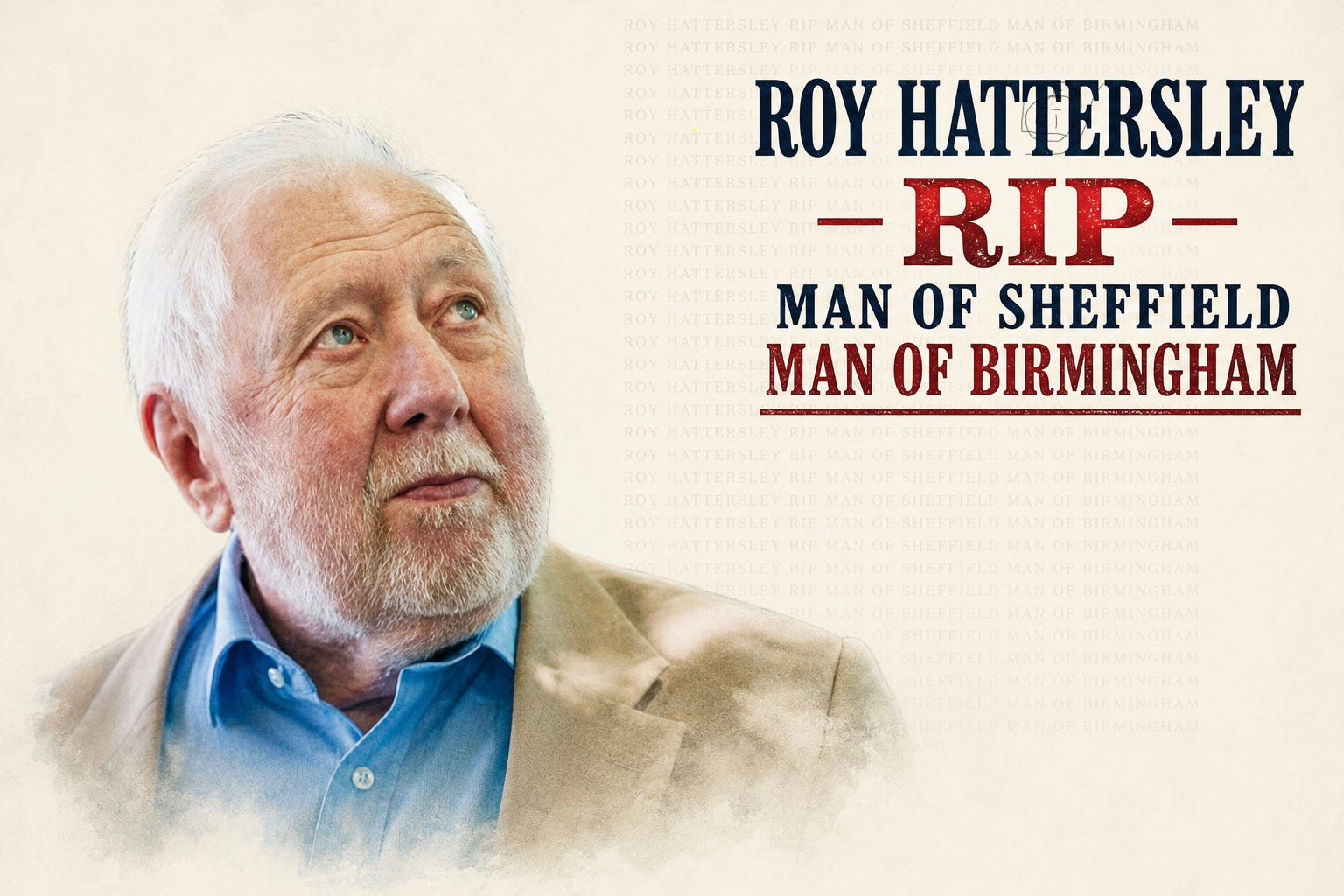
When Roy Hattersley died at the age of 93, the national tributes were immediate, respectful and entirely deserved. Former Deputy Leader of the Labour Party. Cabinet Minister. Writer. Historian. Broadcaster. One half of the Kinnock-Hattersley partnership that dragged Labour back from the political wilderness after some of the worst internal warfare in its history.
All true. All important. But none of it quite explains why Roy Hattersley mattered so much to Birmingham. Nor does it explain how a blunt Yorkshireman from Sheffield came to represent Birmingham Sparkbrook for more than three decades and remain respected long after he had left Westminster.
I knew Roy only slightly. I make no grand claim to intimacy. I was not his political adviser, confidant or late-night plotting companion. Occasionally, I was simply the bloke who picked him up from New Street Station when he came back to Birmingham. That was my exalted constitutional role. Driver to the Deputy Leader. Very grand if you say it quickly, rather less grand if you were the man checking which platform the London train had arrived on.
But sometimes those small encounters tell you something about a politician. The first thing to understand about Roy Hattersley was that he never pretended to be something he wasn’t. He never invented a Birmingham accent. He never suddenly discovered a lifelong passion for Birmingham City or Aston Villa. He did not indulge in the sort of political cosplay where a politician acquires a football club, a regional identity and a sentimental childhood memory roughly ten minutes after selection.
Roy was Sheffield through and through. He remained proud of his Yorkshire roots. He supported Sheffield Wednesday. He spoke like a Yorkshireman. He thought like a Yorkshireman. And yet Birmingham accepted him because Birmingham recognised something important: authenticity. People can forgive almost anything in politics except being phoney. Roy wasn’t phoney.
To understand Roy in Sparkbrook, I asked Khalid Mahmood for his memories. Khalid, of course, later became MP for Birmingham Perry Barr, but his connection to Roy went back much further. More importantly, his father, Sabir Mirza, was one of the key community figures who helped keep Roy connected to the people and politics of Sparkbrook.
That is why Khalid matters in this story. He is not being parachuted into the article as a convenient former MP with a quote. He and his father were part of the local political and community machinery that helped make Roy’s Birmingham career work. Westminster saw the speeches. Sparkbrook saw the graft.
Khalid first met Roy in about 1982. His impression was wonderfully simple. Roy was a good bloke. A good old stick. A bit like a favourite teacher, perhaps with more grounding in real life and a sharper sense of humour. That may be one of the most revealing descriptions of Roy Hattersley I have heard.
Sabir Mirza was rooted in the community. In the 1970s and 1980s, many families had recently arrived from Kashmir and other parts of South Asia. Many were still learning English. Many were navigating British bureaucracy for the first time. Sabir helped them with forms, interviews, appointments and the daily business of surviving in a country whose systems were often completely unfamiliar. Today we reach for neat administrative words. Migrants. Integration. Community cohesion. In those days, it was often more human and more immediate than that. People needed help. Sabir helped.
That practical service built trust. And trust is the currency of politics. It meant Sabir and, increasingly, Khalid could recruit people into the Labour Party who broadly supported Labour’s aims, bring them into the room, expose them to Roy’s politics and let them make up their own minds. It was open politics. Persuasion politics. Not clever tricks. Not fixing. Not regional office democracy by appointment letter.
This mattered because Labour politics in Birmingham at the time was far from gentle. The Militant Tendency was active. Black Sections were growing. It is important to remember that the language of the period was different from today. In those years, Black Sections generally referred to organised political groupings involving both Asian and Afro-Caribbean activists. Some saw them as a necessary challenge to under-representation. Others saw them as factional vehicles used by the harder left to apply pressure inside the party.
Roy was a target. In parts of Moseley and the wider Sparkbrook constituency, attempts were made to undermine him through these internal routes. Khalid’s view is that his father and others helped build resilience against those pressures by organising ordinary local members who supported Labour’s broad aims and were prepared to listen to Roy’s arguments.
This is also where Labour First is relevant. Labour First is an organisation within the Labour Party broadly associated with the party’s moderate, democratic Labour tradition. It has remembered Roy as a titan of the Labour movement, tribally Labour, opposed to Militant, hostile to the SDP breakaway and committed to the idea that Labour itself remained the only serious vehicle for social democracy in Britain.
That matters because Roy’s Labour loyalty was tested not only by the Bennite left but also by the SDP split. Roy Jenkins, himself a Birmingham MP earlier in his career, became one of the leading figures in the breakaway. Alongside Shirley Williams, David Owen and Bill Rodgers, Jenkins helped create the SDP. Roy Hattersley did not follow. He stayed. He fought the left inside Labour, but he also rejected the argument that Labour should be abandoned. He believed Labour could recover, reconnect with voters and govern again. In 1997, Tony Blair’s landslide proved that judgement right, whatever later arguments people may have about New Labour.
There was another issue which tested Roy’s relationship with sections of the local community: Salman Rushdie. Many local Muslims regarded Rushdie’s language as deeply offensive. Roy understood the depth of feeling. But he never accepted book burning. He simply could not get past it. For Roy, books represented ideas. Ideas should be challenged, criticised, argued with and answered. Not burned.
One suspects his generation’s memory of totalitarianism had something to do with that. The twentieth century had shown where attempts to destroy ideas could lead. Roy listened. Roy understood. But he never shifted from the principle. You do not burn books. That was not a focus-group position. That was the man.
Sparkbrook was also shaped by another powerful community: the Irish. Today people often forget how significant Birmingham’s Irish population was politically, culturally and economically. In areas such as Sparkbrook and Sparkhill, Irish and Kashmiri communities were both central parts of local life. Sabir Mirza worked hard to maintain strong relationships between those communities. The politics of division was never particularly useful to him. Building bridges was.
Roy understood that instinctively. He also understood Birmingham City Council. His relationship with the council was serious, practical and sometimes sharp. Councillor Dick Knowles, later Sir Richard Knowles, led Birmingham City Council for ten years and is rightly remembered as one of the city’s great modern civic leaders. Roy had a strong working relationship with him, but it was not some soft-focus mutual admiration society. Roy would say so if he thought the council was getting something wrong.
That is an important distinction. Roy did not simply criticise from a safe distance. He engaged. He worked with the council and other Birmingham MPs to improve things. That feels increasingly rare. Today, MPs can sometimes behave as though local government is something happening in another building, to other people, on another planet. In Roy’s time, the relationship between MPs and civic leadership was much more direct. If services were failing, MPs got involved. If the council needed pressure, MPs applied it. If something could be fixed, they tried to fix it.
When Roy became Deputy Leader of the Labour Party, Khalid remembers that surprisingly little changed on the ground. There were no great swanky London do’s for the faithful Sparkbrook machine. No sudden elevation into champagne socialism with better napkins. They largely carried on as before. But there was one very useful side-effect. If Sparkbrook Constituency Labour Party had a supper club and wanted a speaker, almost anybody in the Labour movement would say yes.
I remember those nights. Packed rooms. Big beasts of Labour politics turning up in Sparkbrook because Roy Hattersley was the local MP and Deputy Leader of the party. It gave the constituency a glamour and a seriousness that few local parties could match. But beneath that glamour, the work remained ordinary, practical and local.
That may be the lesson modern politics most needs to relearn. Roy understood Westminster. He understood ideology. He understood national argument. But he also understood members, voters, community leaders and councillors. He understood that even a Deputy Leader could not treat his local party as an inconvenience. In those days, Labour Party democracy mattered. MPs had to keep members on side. Selection and reselection were not merely exercises in regional office management.
Things are different now. Too often, political parties operate as though democracy is a dangerous substance requiring careful handling by professionals. Members are applauded, emailed, consulted, managed, thanked and occasionally ignored. Regional offices can matter more than rooms full of local people. Roy belonged to a harder, more argumentative, more democratic age. It was messy. It was noisy. It was not always polite. But it was real.
So when national obituaries remember Roy Hattersley, they will rightly speak of Kinnock, Cabinet, Labour revival, Militant, the SDP, books, journalism and television. But Birmingham should remember something else too. Roy Hattersley was a Sheffield man who became Sparkbrook’s champion without pretending to stop being a Sheffield man.
He represented a constituency that included Sparkbrook, Sparkhill, Fox Hollies and Moseley. That was his political kingdom. But it was not a kingdom held by distance, entitlement or cleverness. It was held through relationships, arguments, loyalty, local knowledge and people like Sabir Mirza, who did the daily community work without which no great parliamentary career can survive.
Roy never forgot Sheffield. He never gave up Sheffield Wednesday. He never needed to. His service to Birmingham did not require him to fake being born under the Bull Ring or baptised in HP Sauce. He served Birmingham by taking it seriously.
That is a better tribute than fake localism could ever be.
Thank you Richard: worthy observations of which you are spot on about ...
You fail to mention two aspects of Roy Hattersley that endeared him to me; not his politics, for they are not mine. First he had a brain, which is a very rare commodity in present day politics. He did not have the brains of say Crossland or Enoch Powell but he had an incisive mind, which he expressed in writing and in speech. I remember as a youth listening to his speeches in the Commons, long before it was broadcast. He spoke without notes… can any politician these days do without their iPad in the House? And people listened rather than sitting there texting on their iPhones. If this government is intent on banning children from accessing the internet perhaps it needs to start with the children in the Commons! The second aspect that you did not mention and which brought me into contact with him was cricket. He loved the game and loved the long game. Yorkshire cricket was a passion of his. Obviously he thought Yorkshire the greatest of counties in every respect. Obviously being from Surrey I knew better. These two counties in the 1950s and 1960s were the best and still have a close rivalry. I have no doubt it was cricket that endeared him to the Asian community in his constituency. We live today in an age of political Pygmies; perhaps they are not just political Pygmies. One final point… you made me smile when you mentioned HP sauce. Was this a deliberate allusion to Andy Burnham’s love of gravy and chips, the King of the North? The Messiah and saviour of Labour? Perhaps Burnham should reflect on the last KING OF THE NORTH, the Yorkist king Richard III and look what happened to him! Hattersley in conclusion was a man of his age, when politics was not so divisive. But then these were men, mainly, who had fought side by side in a World War. Thar age has long gone, for better or ill. The future will be very different.