

Selling Birmingham to Save It
Birmingham says the crisis is easing. But the recovery still depends on selling public assets to balance the books.

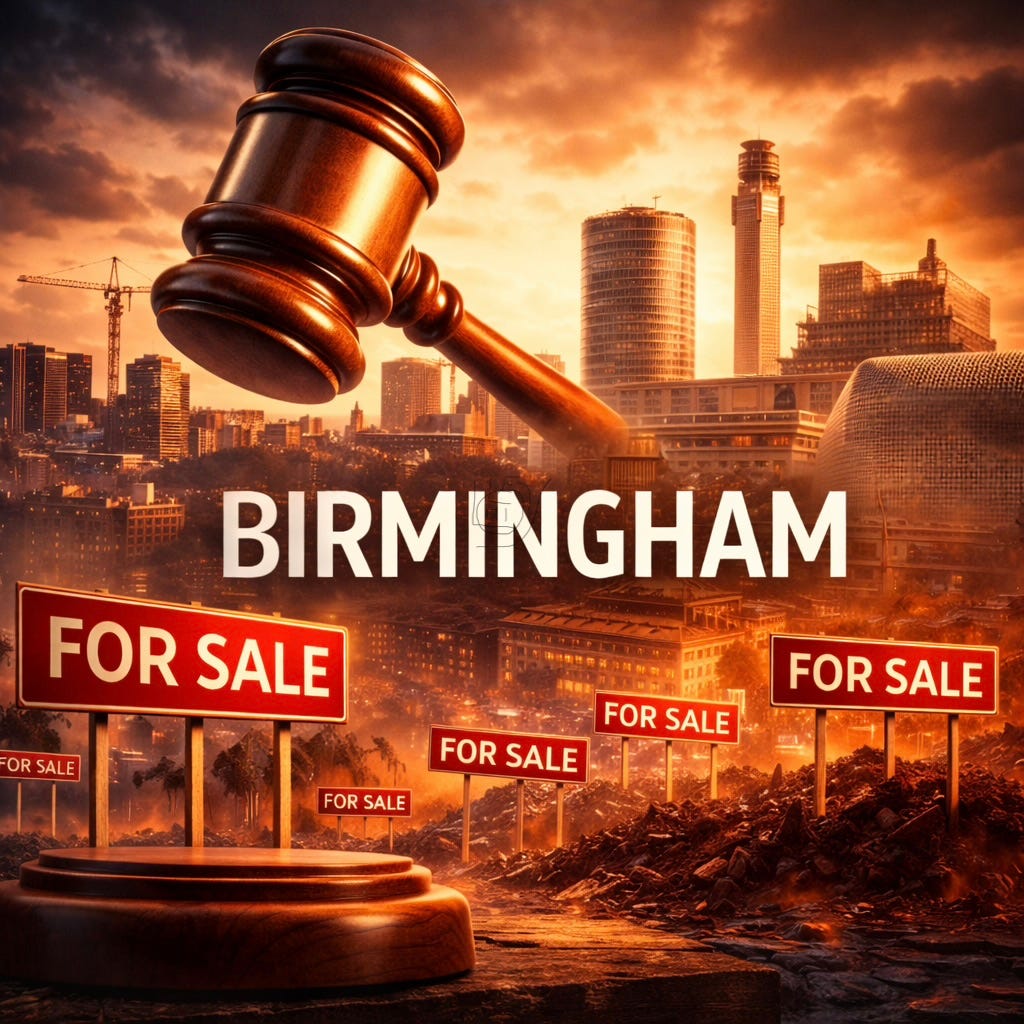
In September 2023 Birmingham City Council effectively declared bankruptcy.
The causes were stark. Equal pay liabilities heading towards £760 million. A disastrous Oracle IT system implementation that spiralled far beyond its planned cost. Years of weak financial oversight that had quietly accumulated inside the authority.
The result was the largest municipal financial collapse modern Britain has seen.
Whitehall stepped in. Commissioners were appointed to supervise the council’s recovery. Britain’s largest local authority suddenly found itself operating under direct government oversight.
Two years later the official tone has changed.
Birmingham says the crisis is easing. A balanced budget for 2026–27 has been approved. Ministers talk about progress. The language of emergency that surrounded the Section 114 notice has begun to fade.
But beneath that calmer narrative lies a financial strategy that deserves closer examination.
The city is still selling itself.
The disposal machine
Birmingham’s recovery rests heavily on one mechanism.
Asset sales.
The council launched a disposal programme originally expected to raise around £750 million from the sale of land and property.
But commissioner reports later revealed that as the scale of the equal pay liability became clearer, the expected disposal programme had expanded towards £1 billion.
In other words, the deeper the financial crisis became, the more assets the council needed to sell.
Hundreds of millions of pounds have already been realised through completed sales, with further transactions under offer and more assets still being identified.
This is not simply clearing out unused buildings.
Birmingham has built an institutional structure to keep the sales moving.
A Cabinet Property Committee was created to accelerate disposal decisions and approve the sale of council land and buildings. Delegated powers allow assets to move through the system once they are declared surplus.
What began as emergency action has become something more organised.
A disposal machine.
Turning assets into survival
Selling property offers something extremely attractive to a council facing financial collapse.
Immediate cash.
A building that might generate income over decades can be converted into a capital receipt overnight. That money can then be used to fund restructuring, reduce borrowing, or meet extraordinary financial pressures.
But asset sales always carry a hidden trade-off.
When a council sells a revenue-producing property, it also sells the income that property generates.
Commercial buildings, small retail units, offices and industrial estates often provide steady rental income for local authorities. Once sold, that income disappears permanently.
Local government finance therefore draws a strict distinction between capital and revenue.
Capital receipts provide a one-off injection of money.
Revenue pays for services every year.
Selling assets converts future income into present survival.
It solves today’s problem. It can also weaken tomorrow’s finances.
How much property income does Birmingham actually earn?
One difficulty when examining Birmingham’s asset sales is that the council’s accounts do not present property income as a single neat figure.
Revenue from property is scattered across different sections of the financial statements.
Housing rents appear inside the Housing Revenue Account. Commercial property income appears under investment property. Other property-related earnings such as markets, leases and parking sit inside individual service budgets.
Taken together, Birmingham’s commercial property estate appears to generate tens of millions of pounds each year in rental income, likely somewhere in the region of £40 million to £60 million annually.
That estimate comes with an important caveat.
The council’s accounts are complex and the numbers are spread across several categories. The true figure is therefore not always immediately obvious from the published accounts.
But what is clear is that council property has historically provided a steady stream of income to support Birmingham’s finances.
Which makes the disposal programme all the more significant.
The assets that matter most
Not all council property is equal.
Some buildings genuinely are surplus and generate little value. Selling them simply removes maintenance costs.
Others are strategically far more important.
Commercial properties often generate reliable rental income. Strategic development land can increase dramatically in value as cities grow. Operational assets such as car parks, markets and leisure facilities produce steady cash flow that supports services.
Selling too many of these assets may stabilise finances in the short term while weakening the city’s financial resilience in the long term.
Which raises the central question.
What kind of assets is Birmingham actually selling?
The big deals so far
Several transactions illustrate the scale and character of Birmingham’s disposal programme.
The Birmingham Wheels site
The former Birmingham Wheels site at Bordesley Park has been sold for around £50 million to Knighthead Capital as part of plans for a new Birmingham City Football Club stadium and sports quarter.
The project is presented as regeneration for East Birmingham.
But the sale also formed part of the council’s wider asset disposal programme.
Once sold, the land – and any future development value attached to it – passes permanently into private hands.
The Perry Barr Commonwealth Games village
Hundreds of homes built for the 2022 Commonwealth Games athletes were later sold to Legal & General Affordable Homes, while a smaller portion was retained by the council for social housing.
The development had originally been intended to help address Birmingham’s housing shortage.
Instead, large parts of the scheme became part of the council’s financial restructuring.
Critics argue the homes were sold at a substantial loss compared with their construction cost. The council says the deal reduced financial risk and secured affordable housing provision.
Both claims may contain truth.
But they also illustrate how assets created for long-term public use can end up forming part of a financial recovery programme.
The wider commercial estate
Beyond the headline sites sits a quieter portfolio.
Birmingham owns a range of commercial properties including shops, offices, industrial units and leased land.
These properties generate rental income that helps support council finances.
Selling them can produce large capital receipts.
But each sale also removes a revenue stream that might otherwise continue for decades.
A property producing £1 million a year in rent might sell today for £15 million or £20 million.
That may help the council survive the immediate crisis.
But over twenty years the lost rental income could exceed the value of the sale itself.
The buyers are not charities
There is another simple economic truth behind the asset sales.
Buyers do not purchase these properties out of civic duty.
Institutional investors, pension funds, developers and investment houses acquire public assets because they believe those assets will generate value.
Sometimes that value comes from rental income.
Sometimes it comes from redevelopment potential.
Sometimes it comes from long-term increases in land value.
But the logic is always the same.
Investors buy because they believe the asset will be worth more tomorrow than it is today.
Which raises an awkward question.
If experienced investors see long-term value in Birmingham’s property estate, why is the city selling those assets now?
The price of selling
Selling property also carries a cost that is rarely mentioned when headline figures are announced.
Commercial agents typically charge between one and three per cent of the final sale price to market and negotiate transactions. Legal advisers, surveyors, valuation specialists and planning consultants all take their share as well.
On a disposal programme that may approach £750 million to £1 billion, those professional fees alone could plausibly run into tens of millions of pounds.
That is money that will not go into Birmingham’s services, infrastructure or communities. It is the price the city pays simply to sell the assets that once belonged to it.
In other words, even the act of selling the city carries a significant bill.
A recovery on a political timetable
The timing of Birmingham’s recovery narrative is difficult to ignore.
In May 2026 every seat on Birmingham City Council will be contested.
At roughly the same moment the government will review the commissioner intervention imposed after the city’s financial collapse.
Ministers expect a further progress report and the outline of a possible exit strategy.
Three events now sit on the same political horizon.
A balanced budget.
City-wide elections.
And the possible beginning of the end of commissioner control.
That overlap does not prove political choreography.
But it does make the narrative of recovery politically useful.
The people making the decisions
There is another uncomfortable question.
Many of the officers who presided over Birmingham’s financial collapse have already left the organisation.
The political leadership that governed the city during those years still has strong elements in power, although after the May 2026 elections it is likely many will either have moved on or been moved on by voters.
Now a new mix of councillors and officers are tasked with implementing the recovery programme.
But how long will they remain in place?
Local elections may reshape the council chamber within months. Senior officers move between authorities regularly. Commissioners themselves will eventually depart once the government believes the crisis has stabilised.
The people authorising these decisions today may not be the ones managing the consequences ten or twenty years from now.
And by the time the long-term impact becomes clear, many of those responsible for the decisions will likely have disappeared from the civic stage entirely.
What Birmingham will own tomorrow
Birmingham may indeed be stabilising.
The emergency language has softened. The budget is balanced. Progress is being reported.
But a deeper question still hangs over the city.
Asset sales can stabilise a council in crisis.
They can also quietly dismantle the financial foundations that support a city for decades.
If Birmingham’s recovery depends on selling parts of itself to repair the balance sheet, the real question is not whether the books balance this year.
The real question is this.
When the recovery is finally declared complete, how much of Birmingham will still belong to Birmingham?