

Starmer’s Defence: Brilliant Lawyering, Dangerous Politics
Midlands MPs speak out, Labour stays silent, and Starmer’s case sounds more like advocacy than truth.

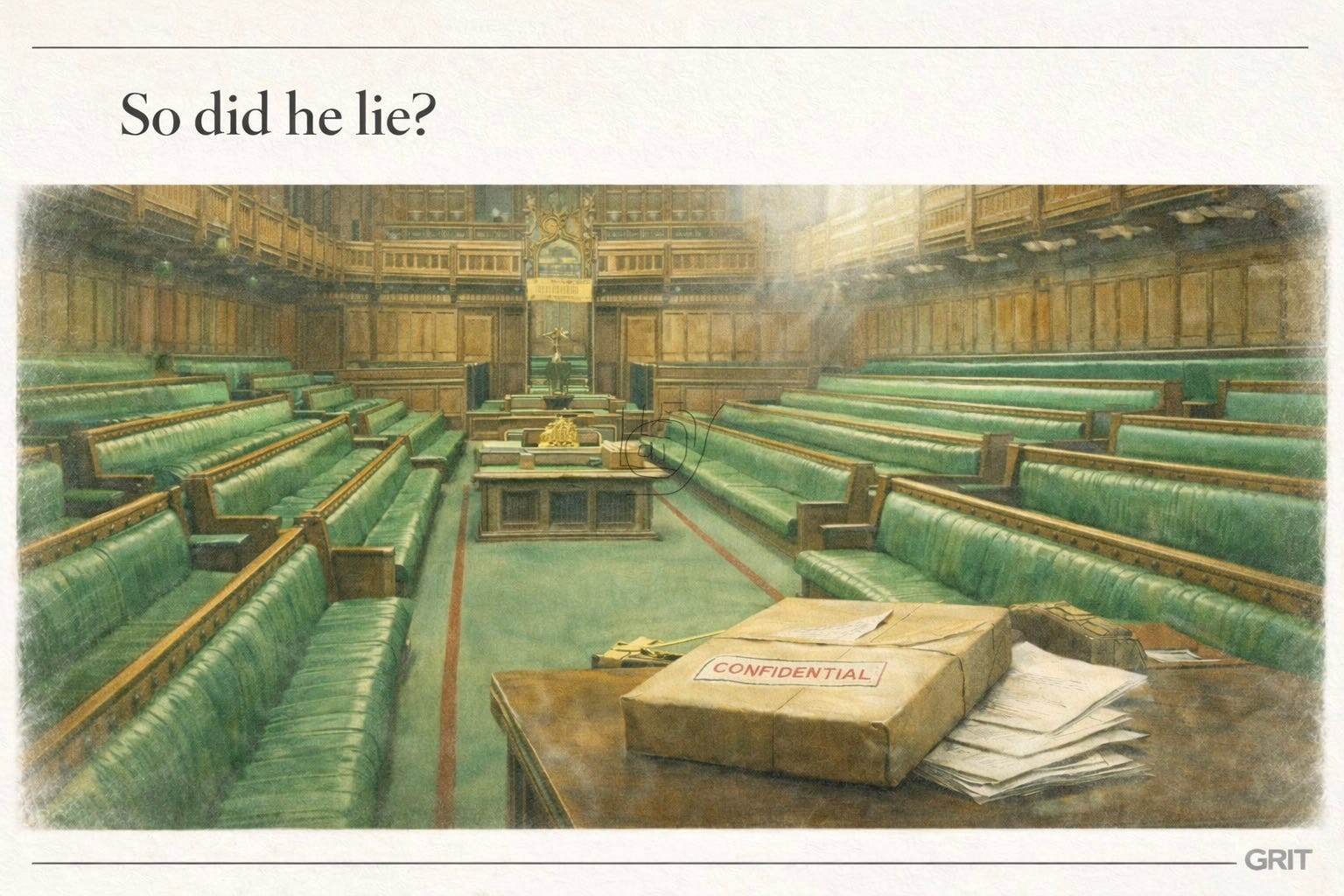
PART ONE: The Midlands spoke first, the rest stayed silent
There is always a moment in a political crisis when the script slips. When the polished lines, the careful phrasing, the lawyerly calm all collide with something raw, blunt, and impossible to ignore.
That moment did not come from the Cabinet. It did not come from the Labour front bench. It came from the Midlands.
Zarah Sultana MP stood up and called the Prime Minister what many are now thinking, a liar. She was promptly thrown out of the House of Commons. Procedure demanded it. Parliament does not allow that word. But the force of it landed anyway. Then came Lee Anderson MP, Midlands through and through, who said much the same thing in his own style, rougher, sharper, impossible to polish. He too was ordered out after refusing to withdraw, adding that the Prime Minister “couldn’t lie straight in bed”. And that is where the story truly starts, not with what was said, but with who said it, and who did not, because while those two were marched out, the Labour benches sat in near total silence.
The speech that sounded perfect, and felt wrong
Keir Starmer delivered what felt less like a political explanation and more like a performance drawn from the long tradition of advocacy that runs from Thomas Erskine through to the modern Bar, the sort of craft that would not look out of place in the chambers Rumpole would recognise. It was a classic “concede and contain” exercise, admit what cannot safely be denied, then control everything around it before it spreads. The structure was unmistakable, a tightly managed timeline, a carefully defined process, and then a deliberate distancing from the critical moment, expressed as surprise, even disbelief, that key details about the vetting of Peter Mandelson had not reached him.
It was disciplined, polished, and in purely forensic terms, highly effective. But that is also the problem. What was delivered was not the language of open political accountability, it was the language of case construction, where the aim is not to tell the whole story, but to present the version that can be sustained. It makes for excellent, even theatrical, barristering. It makes for very poor politics.
Mandelson, Trump, and the calculation that now haunts him
Strip it back and the truth is uncomfortable. Peter Mandelson was brought in for one reason above all others, Donald Trump. That was the calculation, that was the gamble, because Trump is not a man easily handled by cautious diplomats or tidy officials, and the belief inside Downing Street was obvious, if anyone could manage that relationship it was Mandelson, with the experience, the contacts, the instincts, and the political ruthlessness to match the moment. At the time, very little else mattered, not the baggage, not the associations, not the optics, because the priority was the United States, the economic weight behind it, and the belief that results would justify the decision.
That was the bet, and now it is the problem, because once you decide the ends justify the means, you lose the right to look surprised when those means come back to haunt you. Starmer now says he did not know key details about the vetting process, and that may be true in the narrowest administrative sense, but politically it sounds implausible, because he chose Mandelson, backed Mandelson, and drove the appointment through, and now asks the country to believe that the crucial warning signs passed somewhere beneath him, unnoticed and unspoken. That is not a proven lie, not yet, but it is a version of events that many will struggle to accept.
The silence that says more than the shouting
Labour MPs are not blind. They can read the mood. They understand when something is going wrong. And yet what followed was not a wall of support, not a disciplined defence, not even a visible show of unity, but something far more telling, quiet. That silence is not loyalty, it is calculation, because with elections looming no one wants to detonate their own leadership in public, no one wants to be first over the top. But silence like that does not protect a Prime Minister, it leaves him exposed, it suggests waiting, it suggests distance, and more dangerously it suggests that, when the moment comes, the challenge will not be loud and chaotic, it will be cold and decisive.
Midlands voices, Westminster caution, and the Labour thread running through both
There is another layer to this that should not be ignored. Both Zarah Sultana MP and Lee Anderson MP come out of the Labour tradition, one still rooted in it, the other having walked away from it entirely. These are not outsiders lobbing grenades from a distance, they are products of the same political culture now closing ranks around Keir Starmer. They understand how the machine works, how discipline is enforced, how language is controlled, and how dissent is managed.
That is what makes the contrast so striking. Those no longer fully bound by the Labour whip, whether by position or by temperament, are the ones prepared to say the unsayable. Those still sitting on the Labour benches, tied to the leadership and the electoral cycle, chose silence. That does not prove they agree with the accusation, but it does raise an uncomfortable possibility, that the quiet is not conviction, it is containment, a holding position until it is safe to move.
So did he lie?
Here is the straight answer. There is no clear proof, at this stage, that Keir Starmer deliberately lied to Parliament, but there is already a strong sense that he has not been fully open, that he has relied on precision instead of candour, that he has answered the narrow question while stepping around the wider one, and that he has defended himself like a barrister rather than spoken like a leader. That distinction matters, because people will forgive a mistake. They rarely forgive the feeling that they are being managed.
What comes next
This story is not finished, it is only beginning. Olly Robbins, the senior civil servant at the centre of the vetting process and now out of his role, will give his account, and that is where this moves from suspicion to substance. If his version aligns cleanly with Starmer’s, the Prime Minister survives, damaged but standing. If it does not, if even small cracks begin to show, then this stops being a question of judgment and becomes something far more serious.
For now, this is Part One. But already the outline is clear. A Prime Minister convinced of his own precision. A controversial appointment made for hard political reasons. A defence that sounds flawless but feels incomplete. And a Parliament where the only voices willing to break ranks came from the Midlands while the rest chose silence.
This tale is not over, not by a long stretch. There will be more accounts, more evidence, and more pressure.
There are plenty more Part Twos to come.