

Starmer’s “Just Enough” Defence Meets a Silent Midlands
Questions over judgment grow as Starmer defends the indefensible, and Midlands Labour keeps its distance.

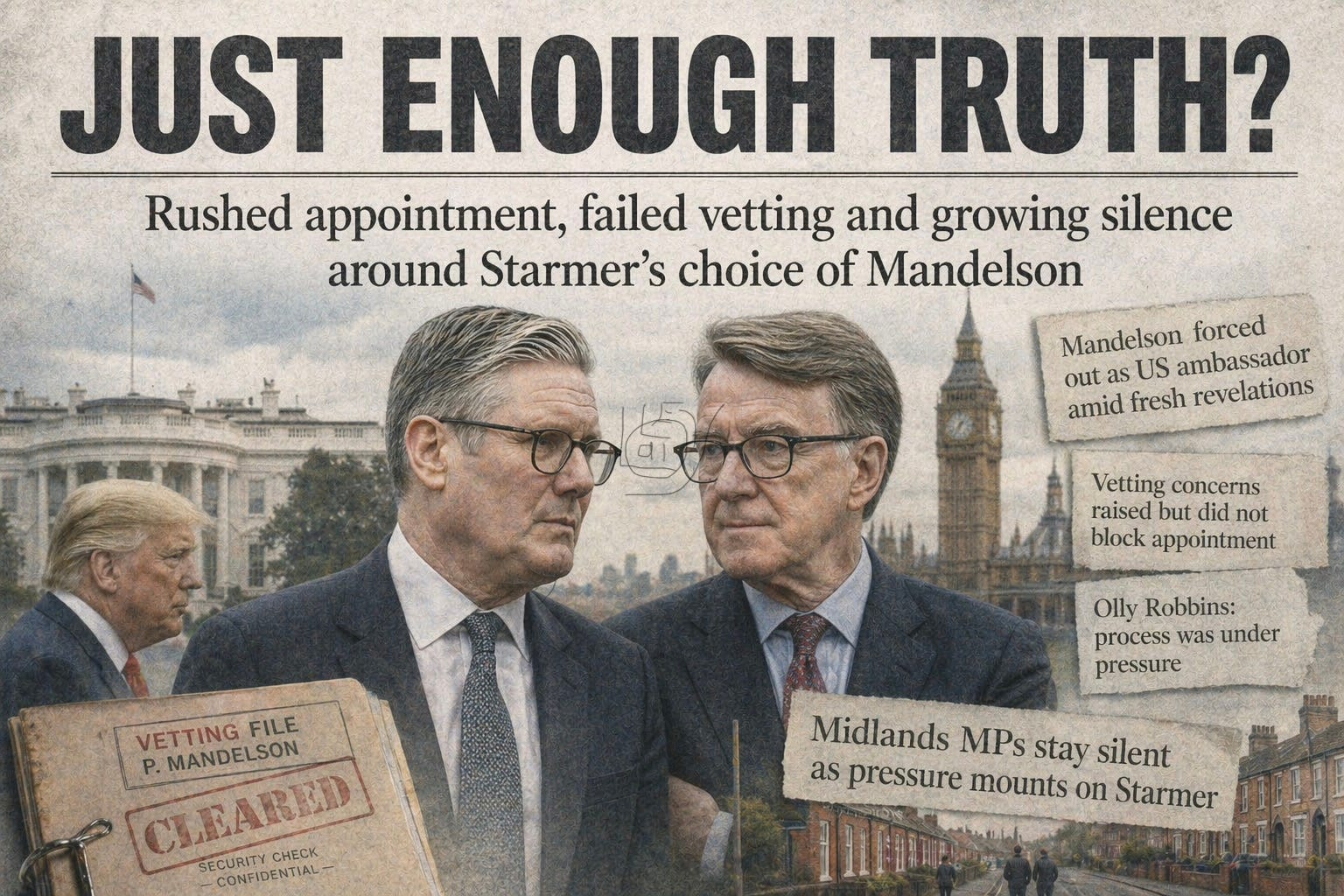
Just Enough Truth: The Silence Before the Storm
The story has moved on. Olly Robbins has now had his say. The former senior civil servant at the centre of the Mandelson vetting process, and now out of his role, has given his account. It adds detail and sharpens the picture. But to understand why this matters, you have to be clear about what actually happened. Peter Mandelson was pushed into the role of British Ambassador to the United States at speed, a political appointment made with urgency and purpose. Concerns were raised during the vetting process. They did not stop the appointment. He took the post. And then, as those concerns refused to go away, he was forced out. That is the story. Robbins’ evidence helps explain how it unfolded, but it does not settle whether it should have happened at all.
Which is why the question needs to change. “Did he lie?” is the obvious one. It sounds strong and feels decisive, but it is the wrong test. It belongs in a courtroom, not in politics, because it demands proof, intent, and a clean break from the truth. That is not what Robbins’ evidence gives us. The better question is simpler and far more dangerous. Did Keir Starmer tell the whole truth, or just enough of it? Because what Robbins appears to describe is not a moment of deception, but a process under pressure, a decision already moving, already shaped, already expected to happen, with the machinery of government working to keep pace. That does not prove a lie, but it does raise something else entirely, whether the decision outran the safeguards. And once you ask that, something else comes into view, not what has been said, but what has not.
Across the Midlands, the silence is striking. This is Labour territory, Birmingham, Coventry, Wolverhampton, Derby, Nottingham, not fringe seats but the backbone of the party’s electoral strength. And yet, from Labour MPs across the region, there has been almost nothing. No chorus of defence, no visible dissent, no urgency to step forward. Just quiet. That is not accidental. Politics does not produce silence like that by chance. It is chosen.
Silence in politics is never empty. It is not neutrality and it is not absence, it is a position. Sometimes it is loyalty, sometimes it is fear, but most often it is calculation. And calculation fits this moment perfectly. Because if the Prime Minister has told the whole truth, then the case is simple, you defend it, you repeat it, you reinforce it. But if he has told just enough of the truth, then you hesitate. You do not contradict him, you do not over-commit to him, you wait.
Strip it back and this was always a political choice. Peter Mandelson was not sent to Washington by accident. He was chosen, and chosen for one reason above all others, Donald Trump. The appointment was made at pace because the relationship mattered. Trump is not a conventional partner. He does not respond to the usual diplomatic playbook. He is personal, unpredictable, transactional. So the response was equally direct, send someone who can handle that world, send Mandelson. At the time, it looked pragmatic, hard-headed, focused on outcome. But once you make that choice, you own it.
There is another uncomfortable layer to this. Concerns about Peter Mandelson were not invented after the event. They were there at the outset. Questions about judgment, associations, and suitability were raised early, quietly at first, then more openly as the appointment gathered pace. But here is the harder question. Did the vetting, in reality, matter all that much? Because the system it sits within is designed largely for career civil servants, cautious, discreet, and bound by convention. Mandelson was none of those things. He was a political operator, a fixer, a figure who had spent decades moving at the highest levels of power, business, and international influence. His past was not hidden, his connections were not unknown, and his controversies were already part of the public record. He was a former Labour MP, a member of the House of Lords, a Privy Councillor, and for a time the closest thing Labour had to a deputy prime minister in all but name.
In other words, the file was already written. So the issue was never really whether Mandelson fitted the system. It was whether the system would bend to fit Mandelson. At the time, it did, because the priority was not procedural neatness but outcome, the relationship with Donald Trump and the belief that Mandelson, precisely because of who he was, could manage a volatile and unpredictable White House in a way others could not. That was the calculation, and for a while it held. But calculations like that come with a cost. Once you decide that the outcome matters more than the process, you lose the protection the process is meant to give you. The questions you parked do not go away. They return, louder and harder to contain.
What we are seeing now is something familiar in government. The decision came first and the process followed. That is why the defence sounds the way it does, controlled, narrow, precise. A timeline is laid out, a process defined, responsibility edged away, surprise expressed. It is disciplined and effective, but it leaves a gap. If the appointment mattered enough to be rushed through, why were the risks not resolved before it happened? Why did concerns surface after the fact strongly enough to end the appointment? That is not a question about lying. It is a question about judgment.
And so we return to the Midlands, not for noise this time, but for stillness. These MPs understand the stakes. They know their voters. They know what trust looks like when it holds and what it looks like when it starts to fray. And yet, they say nothing. Because timing matters, because elections matter, because stepping out of line carries risk. So they wait. But waiting does not erase the question. It stores it.
It might be worth asking your local Labour campaigning team what they make of all this. They will tell you it is not a local issue. They will point you to process, to national messaging, to the official line. But Labour is not loosely run. It is tightly controlled, disciplined, directed from the centre. And at the centre sits Keir Starmer. So the question does not disappear. It travels. Did Starmer tell the whole truth, or just enough of it? And if those closest to the voters are not willing, or not able, to answer it, that tells you something as well. Because in a party this tightly run, silence at the edges usually reflects something unresolved at the centre.
The political temperature is rising. Kemi Badenoch has called for Keir Starmer to resign. That, in itself, is not unusual. Opposition leaders call for resignations as part of the rhythm of Westminster. What is more telling is what is happening behind the Prime Minister, not in front of him. The silence from his own MPs is no longer just notable. It is becoming defining. Because if this were a storm that could be easily ridden out, you would expect voices to emerge, steady, supportive, confident. Instead, there is hesitation, distance, quiet.
And that raises a harder question still. Do they believe he can ride this out, or are they simply waiting for the moment when they no longer have to defend him? In politics, leaders rarely fall because their opponents attack them. They fall when their own side stops believing they can survive. Which leaves one final, uncomfortable thought. Is Keir Starmer the only person who still believes he can recover from this?
So we come back to the core. Not a legal test, but a political one. There is no proof of a lie, but there is no sense of full candour either. A rushed appointment, a process that struggled to keep up, an exit that confirmed something had gone wrong, a defence that answers the narrow point, and a silence that fills the space around it. That combination does not prove guilt, but it does create doubt. And in politics, doubt is the thing that lingers, the thing that spreads, the thing that waits, just like the silence.
This is not the end of the story. It is the moment before the next one begins.