


In Part 2, Knowing, Logging, Allowing, we followed criminal money as it passed through banks that claim to resist it. We looked at compliance systems that do not stop drug money but record it, tolerate it and pass it upstream. Banks process it. Regulators log it. Governments quietly profit from the taxable residue.
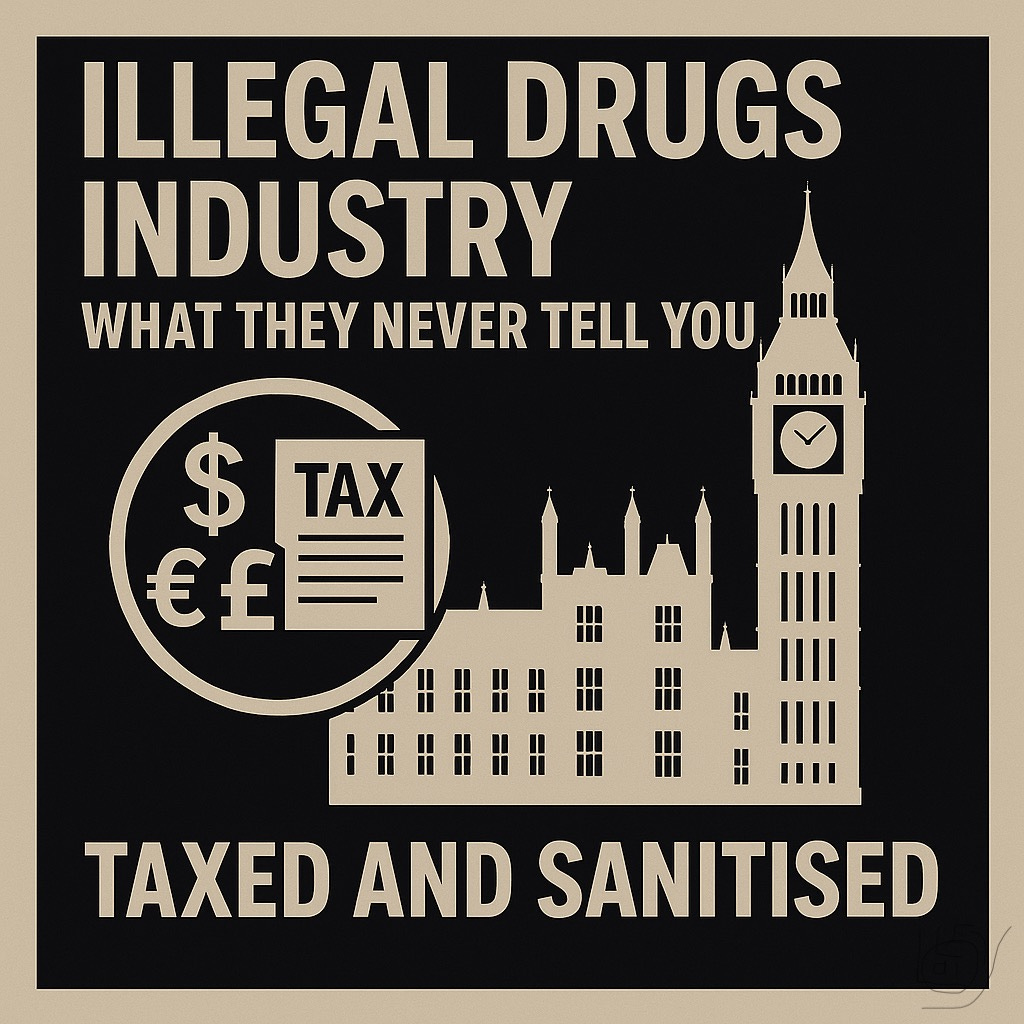
Part 3 follows the money from the banking system to the Treasury.
If Part 2 revealed how the system sees drug money, Part 3 exposes how the state earns from it.
The illegal drugs economy is huge. Fifteen to twenty billion pounds a year, running through the high street behind polite shopfronts and dormant accounts. The political class condemn this with full theatrical force. Yet the same money, once laundered, generates VAT, corporation tax, payroll contributions, stamp duty, capital gains and now even mansion tax revenue. We live in a country where ministers condemn the trade in public and quietly absorb its tax benefits in private.
Part 3 asks the question that nobody in Westminster dares to answer.
If Britain hates the drugs trade so much, why does the Treasury keep banking its money.
⸻
Taxed and Sanitised: How Criminal Wealth Becomes State Revenue
There is a persistent myth that illegal money floats outside the British tax system, unconnected to the public finances. In reality the opposite is true. Once dirty money passes through the laundering cycle it becomes taxable at almost every stage. The system that claims to block criminal finance has actually built a series of fiscal toll gates. Each gate collects a quiet, consistent fee.
This is not an accident. It is not even a failure. It is the design.
VAT: The First Quiet Bite
VAT attaches itself to transactions, not morality. Laundering requires transactions. Cash must become turnover. Turnover must look real. Even the weakest front business has to generate receipts, invoices and sales entries.
That alone creates a VAT obligation.
If ten to twenty percent of the UK drugs economy moves through VAT registered fronts, the Treasury collects between three hundred and eight hundred million pounds a year from the laundering cycle. That is more than the entire annual air passenger duty collected from private jets, those discreet, unmarked symbols of luxury cruising out of Farnborough and Biggin Hill.
The idea that Britain’s fiscal stability is helped more by laundered drug money than by the jet class is not spoken aloud in Whitehall. It remains one of the capital’s quieter truths.
Corporation Tax: The Respectable Slice
Front companies need to make modest, believable profits to avoid suspicion. Not too high and not too low. Just enough to pass as a functioning business.
Declared profits become corporation tax. Even if only five to ten percent of laundered turnover shows up on the profit line, the state still receives between one hundred and eighty and two hundred and fifty million pounds in corporation tax every year.
The Treasury is not squeamish about where these pounds have travelled. Once money enters the system, it loses its biography.
Anti Money Laundering: The State’s Own Tax Funnel
Officially, anti money laundering rules were created to choke off criminal finance. In practice they do something very different. They channel criminal finance. They force illicit wealth to reveal itself, layer by layer, through declarations, filings, property registrations and banked transactions. All of which are taxable moments.
The system is not designed to prevent laundering. It is designed to structure it.
It is a domestic washing machine.
It cleans the money and taxes the rinse water.
The illegal drugs industry has effectively developed its own taxation cycle and the state, whether by design or drift, has built the pipes that carry it.
Property: The Final Resting Place Of Drug Money
Property is where the biggest state take occurs. Britain does not just love property. Britain treats it as sacred. And criminals know this. When laundered money seeks a long term home, it goes into bricks and mortar.
Stamp duty lands immediately.
Council tax flows every year.
Capital gains arrives on disposal.
Inheritance tax arrives later.
And now, thanks to Rachel Reeves, the new mansion tax applies to homes above two million pounds.
The question is how many such homes come from drug money. The answer is not small.
If even fifteen percent of the UK drug economy ends up in property, that is between two point two and three billion pounds a year entering the market. The average laundered high end purchase sits around two and a half million pounds.
Across a decade, that produces between nine hundred and twelve hundred drug funded high end property acquisitions. At any given time, the stock of such homes sits somewhere between eight thousand and twelve thousand across the UK.
Under the new mansion tax alone, that produces a fresh and consistent annual revenue stream for the state.
High and Low Annual Property Tax Estimates
When stamp duty, council tax, capital gains, renovation VAT and the new mansion levy are combined, the annual intake sits somewhere between one hundred and fifty million and four hundred million pounds.
This is the most quietly profitable part of the laundering cycle. Drug money does not just pass through Britain. It buys Britain.
Payroll Contributions: The Overlooked Tax Stream
Laundering creates employment. Fronts overhire to justify turnover. They file payrolls because payroll makes them look legitimate. Many small launderers pay more PAYE and National Insurance than entirely legitimate firms in the same postcode.
A cheap car wash with ten workers may be a tax contributor in ways nobody expects. The workers may be underpaid and informal, but the books still carry just enough staff to keep HMRC satisfied.
Criminal payrolls help fund the welfare state. The irony is sharp and entirely unacknowledged.
The Real Total
If we combine the full spectrum of tax points, the figures speak clearly.
VAT: three hundred to eight hundred million
Corporation tax: one hundred and eighty to two hundred and fifty million
Property taxes: one hundred and fifty to four hundred million
Payroll taxes: two hundred to four hundred million
Total annual intake: between eight hundred and fifty million and one point eight billion pounds.
Across a decade: between eight and eighteen billion.
Britain does not just permit the laundering of drug money. Britain taxes it.
The Sermon And The Silence
Politicians condemn the drug trade for the cameras. They talk about its violence, its human cost, its corrosive influence. All of that is true. Yet behind the speeches lies a quieter reality. The British state earns billions from the laundering of the very industry it denounces.
The system does not merely tolerate criminal money. It harvests it.
The Treasury does not just witness laundering. It benefits from it.
Taxed and sanitised, the illegal drugs economy becomes another revenue stream.
The hypocrisy is vast. And it is entirely routine.
⸻
Coming Up Next: Part 4 – Calm, Professional, Invisible
In Part 4 we leave the accountants and follow the people. We look at the real business culture of the drug economy, where stability matters more than chaos, where loyalty outweighs fear and where violence is not a feature but a failure. If Part 3 exposed how the state profits from criminal wealth, Part 4 shows how the operators themselves survive.
The next layer changes the entire picture.