

The Bins, the Bench and Birmingham’s Democratic Fog
Bins, judges, police frustration and a city still waiting to be led.

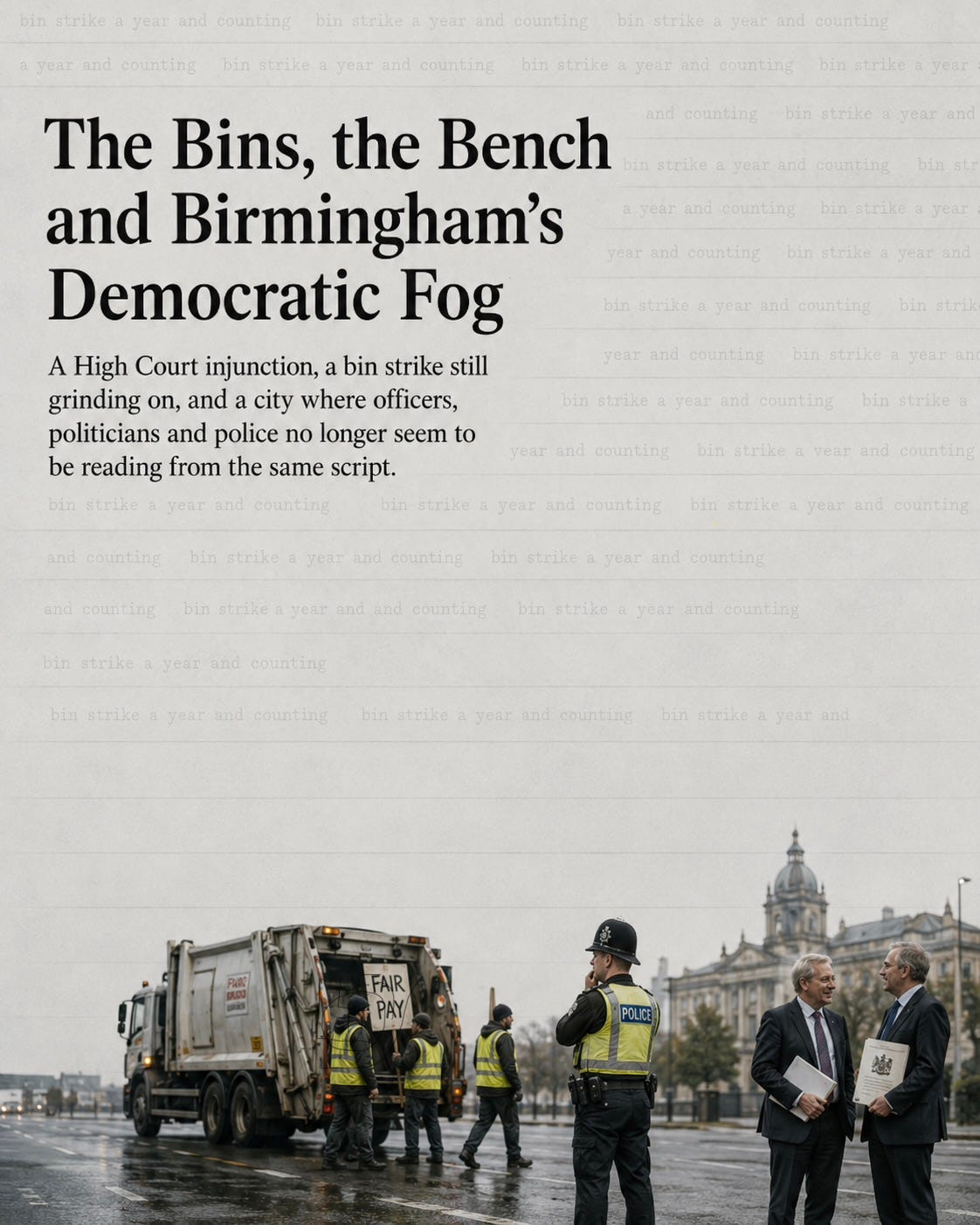
The evidence also has its moments of accidental theatre. In this strange legal world, people are not always identified by name. Instead, the council evidence follows them through clothing, video footage and repeated appearances. One protester becomes “Mr Greybuff”, apparently because of a grey face covering. Another becomes “Mr Camouflage”. There is also a gentleman with a distinctive cane, shoes and jacket. It is not quite Dickens. It is more like civil procedure after a collision with a depot CCTV compilation.
But the point is serious. The council was trying to show continuity. It was not saying, “Here is a random crowd.” It was saying, “Here are some of the same people, turning up repeatedly, moving between sites, and shifting the pressure point when the injunction made Birmingham harder ground.”
That is where Coventry becomes important. The court accepted that the February injunction had worked in Birmingham. There was no evidence of breach within the city after it was made. But the council then pointed to protest activity at Tom White’s Ryton depot in Coventry, outside the reach of the Birmingham order, where Tom White was providing waste support to Birmingham. According to the council’s evidence, one video included wording to the effect that the council had obtained an injunction to stop protests in Birmingham, but Coventry was not included.
That was powerful evidence for the council. It allowed them to say: the injunction stopped disruption here, but the pressure moved there. If the order lapses, it will come back here.
The judge accepted that logic. The injunction was extended until 20 November 2026, final determination of the claim, or further order, whichever comes first. The council’s wider claim seeks relief until 1 January 2028. That date matters. This is not merely a quick emergency shove to keep the depot gates clear for a fortnight. Within days of the February order being sealed, the council applied to amend its claim form to specify that it wanted injunctive relief until 1 January 2028. That is a long legal horizon. Not quite the Hundred Years’ War, admittedly, but in bin strike terms it is not exactly a passing shower either.
The council would say this is necessary. It would say residents have suffered missed collections, waste build-up, increased fly tipping, environmental risk and large extra costs. The Particulars of Claim refer to tens of thousands of missed collections and more than £400,000 in January 2026 overtime and additional resource costs. A city has to collect waste. Clinical waste is not a debating society. Missed collections are not a romantic expression of civic dissent when rubbish starts piling up outside people’s homes.
But there is another revealing part of the council’s case. It was plainly not satisfied with the police response.
In the council’s pleaded case, West Midlands Police had allegedly allowed protesters to remain for hours because of their interpretation of protest law. Lots of people think the police do not do a proper job from time to time, usually after a stolen bike, a noisy neighbour, or an online fraud report disappears into the national filing cabinet of despair. The difference here is that Birmingham City Council managed to turn its dissatisfaction with policing into evidence before a High Court judge.
That is quite a thing. Two public authorities, both theoretically on the same civic side, and yet the council’s case effectively says: the police did not give us the operational protection we needed, so we came to court.
You would not necessarily know from the polite legal language that anyone had fallen out. There is no slammed door. No municipal handbags. No chief officer shouting across Lloyd House car park. But the meaning is clear enough. The council wanted protesters moved more quickly. The police were apparently not prepared to do that. So the council asked the High Court to put things right.
And, from the council’s point of view, the judge did.
That does not make the injunction wrong. It does make the governance question sharper. The law is now being used to define the practical boundary of solidarity protest in an industrial dispute. The injunction does not ban protest, but it does create a contempt-risk zone around the places where protest has maximum operational effect. A protest that has no effect is not always much of a protest. A protest that has too much effect may become an unlawful blockade. Somewhere between those two sits the battered British compromise, wearing a hi-vis jacket and looking for a toilet.
This is why the story is not simply “Labour council crushes protest”. It began under Labour, yes. But it now belongs to a wider system: officers, external lawyers, commissioners, police frustration, High Court judges, trade union strategy, activist networks and the long shadow of Birmingham’s collapsing civic governance.
The bins are the visible issue. The deeper issue is power. Who holds it when an elected administration falls away? Who owns a legal strategy when the political leadership changes? When does public service protection become protest management? When does solidarity become obstruction? When does a temporary injunction become long-term architecture?
And when a new leadership team arrives at 6pm on a Friday, how much of Birmingham is actually waiting to be led, and how much has already been placed inside legal, financial and commissioner-shaped tramlines?
Birmingham has not banned protest. But it has built a legal perimeter around the places where protest bites hardest. The High Court has accepted that, for now, the perimeter is justified. The council has shown the machinery behind it: legal officers, DLA Piper, witness statements, depot notices, social media posts, process servers, finance sign-off and commissioner support.
It is all very public. It is also very heavy. The documents are online, but reading them feels less like civic transparency and more like being invited to assemble a wardrobe from legal plywood while someone shouts “Article 11” through the letterbox.
Still, the story is clear enough.
Birmingham’s bin strike has entered its High Court phase. The council says activists filled the space left by Unite’s injunction. The court says the risk remains. The officers say the legal process is properly notified. The finance officer says the council can meet the damages risk. The commissioners are supportive. The police, it seems, were not moving fast enough for the council’s liking. The politicians, as ever, are somewhere between a press statement, a private briefing and a future meeting.
And the rest of us are left staring at the municipal spectacle: a city in democratic fog, a legal machine still moving, and a bin lorry waiting at the gate while Mr Greybuff becomes part of English civil procedure.
Richard makes a fair point. One unexpected benefit of the bin strike is that the substitute crews have often done a decent job. One bin, fewer arguments, less municipal theology about lids, bags and collection rules.
The loss of recycling is disappointing, although Birmingham probably needs a more honest debate about how much was truly recycled in the first place.
The removal of park and street bins is stranger. Japan has few public bins because people take litter home. Birmingham is not Japan. Removing bins here feels less like civic discipline and more like hoping rubbish gives up from confusion.
Best example: a council worker beside fly tipped bags told Richard, “No mate, we do roads. That’s parks.” Perfect. The rubbish had crossed an invisible departmental border.
Thanks as ever to Richard. A very useful comment.
One of the benefits of this strike has been how good the substitute binmen have been. OK the blue recycle bins have not been collected but that’s not important. Only about 10% of the recycle bins were ever recycled. Most people have got used to putting everything in one bin. And the bin men have done an excellent job. Gone are the days of more rubbish littering the street after the striking bin men collected. Gone are the days of the bin men refusing to take black bags on top of the wheelie bin or beside it. And our substitute bin men will collect from the garden if you fail to put the bin out or if the collection is moved to another day. All in all it has been a better service. Yes there has been fly tipping but it was ever thus. Nothing has changed there. The two issues I do have is the removal by the council of waste bins in parks and on the streets. Here at least 8 have been taken away on the orders of the council, apparently to stop fly tippers placing rubbish next to bins. Bus stops used to have bins but around here no longer… yet that has not stopped the fly tippers. The other thing I find bewildering happened last week. Walking the dog I came across a council rubbish collector. He was sitting on a park bench sunning himself while on his mobile phone. His van was parked outside the small park on the pavement (don’t get me onto vehicles parked on pavements!) Next to the bench were some black bin bags full of fly tippers rubbish. I said to him would he mind taking the bags when he is finished on his mobile. His answer … no mate we deal with the roads rubbish that’s the parks responsibility. What an out dated system!