


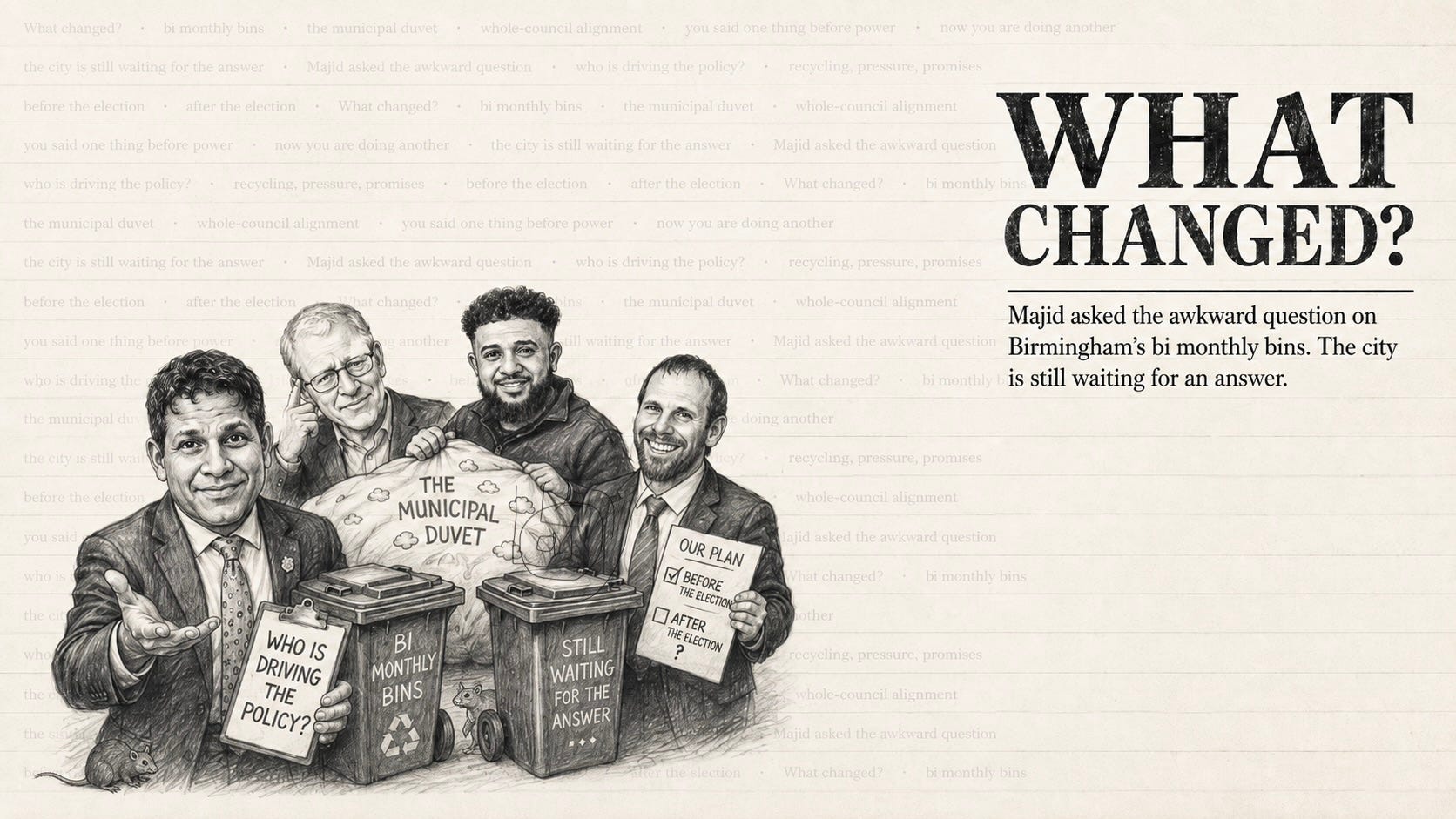
Cllr Majid Mahmood may just have done Birmingham a favour. In a short video defending the waste changes he helped set in motion while still a Labour cabinet member, he asked the question the city’s new administration has not yet answered: what changed?
Before the election, leading voices now inside the Green, Liberal Democrat and Better Birmingham administration were distinctly uneasy about moving to bi monthly bin collections while the service remained unreliable. Now, with power obtained, offices occupied and cabinet titles printed, the same broad direction is being rolled out. That may be necessary. It may even be right. But if it is right now, Birmingham residents deserve to know why it was so wrong then.
Majid’s point is blunt. He says the move to bi monthly collections was never about politics, but about Birmingham’s financial and environmental position. The city’s recycling rate was dire. Too much waste was being burned. The service needed modernising. Taxpayers needed better value. These were, in his argument, difficult decisions rather than popular ones. He backed them when they carried political pain. He now accuses the new administration of opposing the same course, warning residents about its consequences, then introducing it anyway with too little communication and too much confusion.
The awkward evidence starts with Cllr Roger Harmer’s own election-facing words. The Liberal Democrat manifesto did not merely say waste services needed improvement. It said weekly collections would be maintained until the service had shown itself to be completely reliable for a significant period of time. It also said moving to fortnightly residual waste collections was simply not acceptable while missed collections remained high. Strip away the council vocabulary and that is the same doorstep issue: do not reduce the main bin collection while the service is still in a mess.
That was not an offhand comment. That was an election document, offered to voters before power was won. Now the administration is proceeding with a pilot that includes bi monthly residual collections. So the question is unavoidable. Has the service now become completely reliable for a significant period? If so, show the evidence. If not, what happened to the promise?
Cllr Julien Pritchard’s Greens also faced the electorate on waste and recycling. Their political territory was clear: cleaner streets, restored recycling, less incineration and a greener waste system. Nobody can reasonably complain that Greens want better recycling. That is rather like complaining that a council report has too many appendices. But the issue here is not whether recycling matters. It does. The issue is sequencing and honesty. If the new administration believes Birmingham can only restart serious recycling by reducing residual collections, it should say so plainly. If the financial and environmental case now overwhelms its earlier doubts, say so. If government funding, statutory waste changes, recycling targets or Defra pressure have changed the room, say so.
Then there is Cllr Harris Khaliq. He is new to the council, new to cabinet, and has landed in one of the most exposed jobs in Birmingham politics. That deserves some allowance. But he also campaigned as a community voice, as someone who would rebuild trust, deliver reliable services and stand up for residents who felt ignored by the old political system. He is now the Cabinet Member for City Operations and Digital, which means the bin mess is no longer someone else’s problem. It is on his desk, in his title and probably in his dreams.
GRIT asked Cllr Harmer, Cllr Pritchard and Cllr Khaliq for comment. At the time of writing, none had replied. That is disappointing, particularly because Cllr Harmer has previously been attentive and responsive to difficult questions, and Cllr Pritchard has often been willing to engage seriously. One unanswered enquiry does not prove a collapse into old habits. But it is striking. This is not a niche enquiry about a bent parking sign or a missing shrub outside a leisure centre. It goes directly to whether the city’s new political leadership has moved away from words used before the election.
The deeper problem is that Birmingham’s waste policy was already moving before the new administration took office. Cabinet papers from the previous period show the waste transformation programme was not a sketch on the back of a recycling sack. Routes and rounds had been developed. Containers had been ordered. The plan included food waste, extra recycling capacity and a shift away from weekly residual collections. Commissioners welcomed the direction, supported the timetable and called for whole-council alignment. That phrase matters. Whole-council alignment is the sort of phrase that sounds harmless in a report and ominous in a democracy. It means the machine had a destination. The new councillors have now climbed into the cab. The public is entitled to ask whether they are steering, navigating, or merely announcing the next stop.
This is where ITV Central’s reporting on the bin strike becomes relevant. ITV revealed a confidential March document, drawn up by senior council officers, which suggested sacking striking bin workers without the approval of elected councillors as a way of bringing the dispute to an end. That does not prove commissioners or officers forced the present administration to proceed with bi monthly collections. But it does show the atmosphere in which Birmingham waste policy has been made: senior unelected figures were prepared to contemplate routes around elected councillors when dealing with the bin crisis.
Majid is an awkward messenger because he was inside the previous Labour administration. He helped lay the groundwork. He owns his part in the decision. That gives him vulnerability, but also force. He can say he took the political pain openly while others opposed, criticised or warned, only to arrive in office and carry on. His video lands because it asks the question residents understand immediately. You said one thing before power. You are doing another thing after power. What changed?
There may be a good answer. Perhaps the new administration has seen fresh reliability data. Perhaps officers have shown them that the old promise cannot be delivered. Perhaps government recycling rules make delay costly. Perhaps commissioners have made clear that the waste transformation programme is not optional. Perhaps the new leadership has simply discovered that Birmingham is easier to criticise from the pavement than to govern from the Council House.
Any of those explanations would matter. Some might even persuade residents. But explanations must be given before trust can be rebuilt. Until then, the suspicion will grow that Birmingham’s new leadership is already being pulled towards the old municipal gravity: officer reports hardening into inevitability, commissioner objectives becoming the real programme, and elected promises being quietly folded away once the votes have been counted.
Cllr Majid Mahmood asked a simple question.
What changed?
Birmingham is still waiting for the answer.
During this strike we had only one week when the main bin was not collected. In fact the service was better than when the striking binmen worked. If we forgot to put the bin out it was collected from the garden and put back in it. Like most residents we put all our rubbish in the one bin collected. Now we have been told that our weekly collection day has been changed and will only be fortnightly. As for the recycle blue bin it is to be replaced by a new recycle bin and that we have to return the old blue bin to the recycle depot… they must be joking!!! Next we are to get a little bin for food waste… so small that it will be full in a couple of days… thirty years ago where I then lived introduced wormier bins with live worms to eat the waste food … as to recycling why bother when only 7% is recycled… how do you know what plastic is recyclable and what is not… the whole system is rubbish… and the councillors are creating a situation in which huge amounts of rubbish were and will be just dumped on the streets… fly tipping is everywhere. If you wish to improve the service you build the infrastructure first and then create the system… instead the Infrastructure cannot cope with the present situation let alone be able to sustain this more complex system. Then there is the stupidity of the one incinerator being in Tyseley. It is not in an accessible place… more thought ought to have been given in sharing facilities with other local authorities and developing waste turned into electricity for local consumption. But there is a bigger political issue… you lose votes and seats in an election and then you take over the council. This is what we have got. The Liberals lose votes and seats in the city but now lead the council. The Council Leader won in Acocks Green with a third fewer vote %… how democratic is it for the council of 101 seats to be led by a party with 12 seats? Let’s be frank the Council has no democratic legitimacy. It reminds one of the Rump Parliament during the Civil War. That claimed legitimacy and they called themselves Parliamentarians but the majority of MPs, who supported the King, were long gone from Westminster or in prison there. No doubt this motley collection of councillors will limp on until another Cromwell comes a long and, like his abolition of Parliament, abolishes the City Council, creating a system that is democratically accountable and which does not place losers in charge. To lose is to win is the mantra of this administration!
My analysis of the election 26 is delayed by the need for a rigorous review of the ward structure. I thought this important as I needed to consider why those wards with two members not only existed but had substantially smaller electorates than two single council seat wards. I needed to get the boundary commission to review my critique that it is easier ie requires a fewer % of votes to get elected in a two seat ward than in a single seat ward. I needed also to analyse more fully “ghost” voting registers that is the fact that the registers in some wards have people who are not entitled to vote or may not live in that ward. This is not because they vote… in fact they never vote. Rather it is because they affect the size of each ward, meaning some wards are substantially smaller than others.