

The Californian who came looking for Black Sabbath… and found Birmingham
A boy in California grew up listening to Birmingham’s greatest bands. Decades later, he crossed the Atlantic to invest in the city that inspired him.

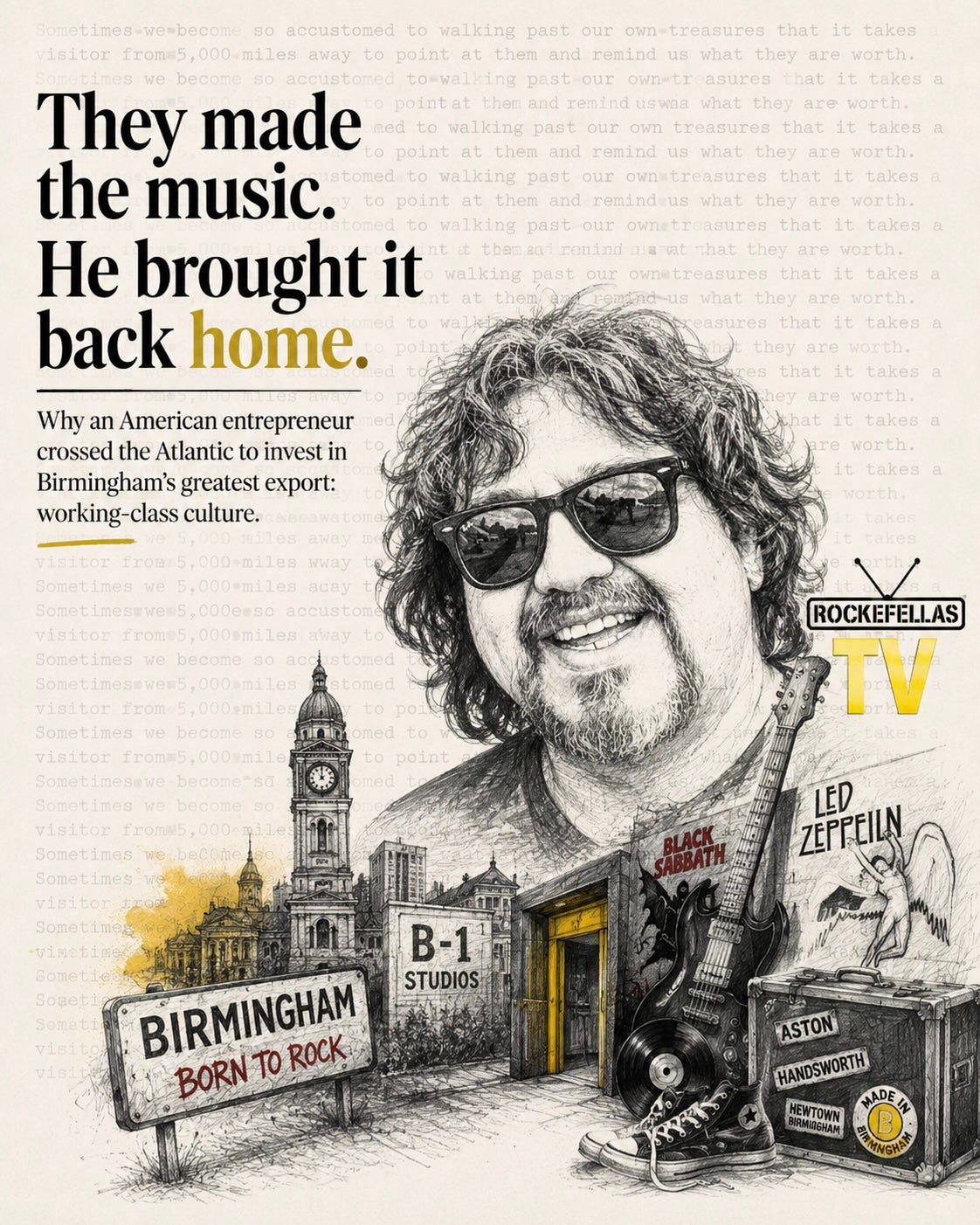
I nearly smiled when I walked into the launch of Rockefellas TV’s new Birmingham studio. For a fleeting moment I thought I had spotted one of the city council’s culture officers. Then I remembered that this was rock music. Working-class culture. There were no discussions about strategies, consultation documents or five-year plans. This was culture in the way Birmingham has always done it best. Music, stories, guitars and characters. The sort of creativity that starts in pubs, clubs, terraced houses and makeshift rehearsal rooms before escaping to conquer the world. As I looked around, it dawned on me that this was not really a story about the opening of a television studio at all. It was a story about Birmingham itself.
If somebody had told a young Ozzy Osbourne, Tony Iommi, Geezer Butler or Bill Ward, rehearsing in Aston in the late 1960s, that one day an entrepreneur from California would invest heavily in Birmingham because of the noise they were making, they would probably have laughed. Yet that is pretty much what has happened. Alex Garcia, founder of Rockefellas TV, grew up in America captivated by the music pouring out of Birmingham and the wider West Midlands. Black Sabbath, Led Zeppelin, Judas Priest, Electric Light Orchestra, Duran Duran and The Moody Blues. Those records travelled thousands of miles, found their way into California homes and inspired a young man who would eventually build a successful business before deciding that Birmingham was exactly where he wanted his company’s first European studio.
Now that is a compliment no civic award can ever match.
Garcia’s own story is almost as interesting as the one he has chosen to tell. He started his working life creating striking, large-scale murals before moving into outdoor advertising and becoming a major independent billboard operator in California. He understands pictures, audiences and how to grab people’s attention. More importantly, he understands that authenticity cannot simply be manufactured. Hollywood can build almost anything on a film set, but it cannot recreate the history of a city that accidentally invented heavy metal, influenced generations of musicians and still wears that achievement with almost embarrassing modesty. Birmingham has spent decades wondering whether London notices it. Alex Garcia has quietly answered that question. California noticed years ago.
Rockefellas TV is not a traditional television station where viewers wait for a programme to appear at a set time after the weather forecast. It belongs to the newer streaming world, with its own app and an online service available through platforms including Google. Its mixture of interviews, documentaries, live performances and original entertainment can be watched across Europe and North America, with the company’s own publicity reporting an audience running into the millions. This is television without the old geographical boundaries, and Birmingham has become an important part of its international operation. The little old Californian who was given Black Sabbath and Led Zeppelin by Birmingham has now come here carrying his cheque book.
The heart of the new Birmingham operation is Brad’s Basement, fronted by Birmingham-born singer Brad Henshaw. If ever there was somebody suited to sitting opposite musicians and coaxing stories from them, it is Brad. He has the warmth of an old friend, the curiosity of a proper interviewer and, perhaps most importantly, the credibility that comes from spending years making music himself. His opening guest is Jim Simpson, the man who first managed Black Sabbath when they were still called Earth and who remains one of Birmingham’s most important musical figures. Listening to Jim is rather like opening a living history book. There are not many people who can casually begin a sentence with, “When I first managed Black Sabbath…” Jim can, and does so without the slightest trace of showing off. It is simply part of his extraordinary life.
Birmingham has always been a curious city. We have frequently been far better at creating talent than celebrating it. Liverpool rightly embraces The Beatles. Nashville proudly sells country music. Motown became synonymous with Detroit. Birmingham, meanwhile, managed to change popular music forever and then carried on as though nothing particularly unusual had happened. Heavy metal was not born in a boardroom. Nobody commissioned it. Nobody appointed a steering group. Four working-class lads plugged in their instruments, turned up the volume and changed music forever. Had they waited for a consultation exercise, the first power chord would probably still be awaiting approval.
Perhaps that is why Garcia’s investment feels so significant. This is not somebody chasing a fashionable postcode or arriving because a committee has invented a short-term grant scheme. He has invested because he believes Birmingham’s musical story still matters and can generate something new. It is a rare thing to see somebody from overseas value your city’s history quite as much as you do yourself. Sometimes we become so accustomed to walking past our treasures that it takes a visitor from 5,000 miles away to point at them and remind us what they are worth.
The launch had exactly the right atmosphere. There was excitement without pretension, enthusiasm without too much hype and a genuine sense that those involved wanted to make programmes people would enjoy watching. There was music, conversation, plenty of laughter and sufficient coffee and pastries to keep a small newsroom operational until teatime. More importantly, there was optimism. In a world where too many Birmingham stories revolve around cuts, disputes and political rows, it was rather uplifting to spend a morning talking about investment, creativity and ambition.
As the formalities wound down, somebody casually asked whether they could buy a Rockefellas TV shirt. “Hell no,” interrupted Alex Garcia. “We’re giving them away.” It was a small moment, but a lovely one, and it told you plenty about the man behind the investment. Sadly, I missed out because I was too busy talking.
By the way, I’m a 2XL.
None of this guarantees success, of course. Television, even in its newest streaming form, is fiercely competitive. Audiences have never had more choice, and every new network and platform must earn its place. But every worthwhile venture begins with somebody prepared to take a chance. Garcia has done precisely that. He has backed Birmingham with his own money, his reputation and his belief that the city’s musical heritage can still inspire new audiences. Investment does not always arrive accompanied by ministers, development agencies or a large novelty cheque. Sometimes it walks into an old building in Camden Street wearing a Rockefellas TV shirt and starts giving the shirts away.
As I left B-1 Studios, I kept returning to one thought. We spend an awful lot of time asking what Birmingham can do to attract investment. Perhaps we should also ask what Birmingham has already done to deserve it. The answer can be heard whenever somebody anywhere in the world puts on a Black Sabbath record, turns up the volume and wonders where that extraordinary sound came from. It can be heard in the music of Led Zeppelin, Judas Priest, ELO and the generations that followed them. Birmingham’s greatest export may never have been cars, metal or manufactured goods. It may have been culture, made by working people who had no idea they were creating an international inheritance.
Rockefellas TV can be watched through its dedicated app and online streaming service, giving viewers access to its growing catalogue of music and entertainment programming. If Alex Garcia and his team fulfil even a fraction of the ambition on display at the launch, the next chapter in Birmingham’s musical story will not merely be heard around the world.
It will be watched as well.