

The Chief Constable Who Acted When the Prime Minister Did Not?
Chief Constable Jason Hogg is seeking action over PC Andrew Harper’s killers. Andy Burnham must now explain when Britain’s prison crisis will finally be fixed.

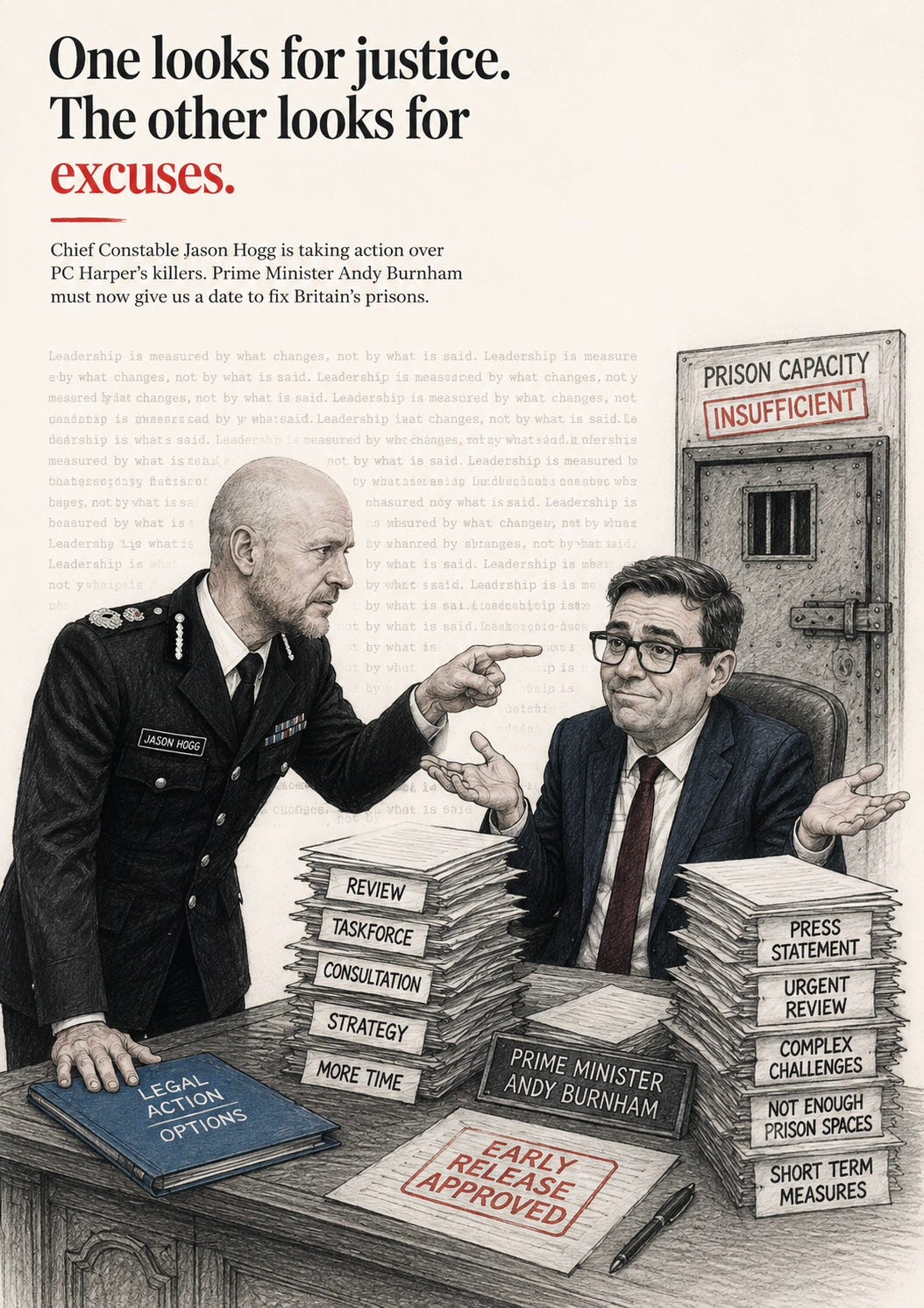
Prime Minister Andy Burnham told the country he would look again at the proposed early release of two of the men convicted over the killing of PC Andrew Harper. That intervention raised a reasonable expectation that something might actually change. The Government paused, reviewed and announced further exclusions from its early-release arrangements, but Albert Bowers and Jessie Cole, each sentenced to 13 years for the manslaughter of PC Harper, remain eligible to leave prison earlier than many expected. The Prime Minister looked at the matter, ministers expressed concern and apologies were offered. Yet the outcome remains the one Andrew Harper’s family, former colleagues and much of the public feared. Politics is not ultimately judged by how sincerely ministers say they care. It is judged by what changes after they have finished telling us they care.
That is why Thames Valley Police Chief Constable Jason Hogg deserves substantial praise. He has publicly condemned the outcome, sought legal advice and indicated that his force may support a legal challenge. Here is a serving chief constable prepared to make the Government uncomfortable because he believes justice, police morale and public confidence have been placed at risk. Whether any proceedings succeed will be for the courts, but Hogg is at least searching for a remedy while ministers search for explanations. Britain has no shortage of courageous public officials once they have retired, collected the leaving present and checked that the pension has arrived. Courage while still in office, when ministers can still influence careers, appointments and honours, is a rarer and more valuable commodity.
The Government says the difficulty is prison capacity. That may explain the decision, but it does not excuse it. A shortage of prison places is not a natural disaster. It did not arrive unexpectedly on a strong easterly wind. It is the result of political choices, delayed building programmes and successive governments failing to ensure that the prison estate matched the sentences being imposed by the courts. Labour inherited a serious problem, but after two years in office it cannot continue talking as though ministers discovered it last Thursday behind a filing cabinet at the Ministry of Justice. There comes a point when an inherited failure becomes the responsibility of the people who inherited it, and the public is entitled to ask whether that point has now arrived.
So let the Prime Minister answer one simple question. By what date will Britain have sufficient prison capacity to ensure that serious offenders serve the sentences the courts and the public reasonably expect? Not another strategy, consultation, emergency review, ministerial taskforce or aspiration to create a more resilient custodial estate. A date. If the answer is two years, say two years. If it is five, have the courage to say five. But ministers cannot repeatedly argue that justice must bend around the number of available cells without telling us when that excuse will cease to apply. A temporary crisis without an end date is not temporary. It is government policy.
There is a wider lesson here about senior police officers who are willing to speak while doing so may still cost them something. I met former West Midlands Police Chief Constable Chris Sims several times. He could be gruff and was unlikely to be mistaken for the entertainment officer on a Mediterranean cruise, but I always regarded him as extremely well suited to his role. Officers who served under him spoke of him as a good bloke, which in policing is praise generally issued upwards only after lengthy reflection and a fair amount of private muttering. Sims led one of Britain’s largest police forces through riots, terrorism threats and severe financial pressure. When government cuts damaged the force’s ability to police the West Midlands, he said so plainly. He did not dress shrinking numbers and reduced capacity in management jargon and describe them as an exciting opportunity to deliver services differently.
As someone who has spent many years around Birmingham’s civic and policing circles, I often heard the suggestion that Sims’s willingness to speak uncomfortable truths had done little to advance his prospects of a knighthood. Whether that was true I cannot know. The honours system operates behind doors rather less transparent than the average police custody suite. It nevertheless remains an intriguing coincidence that the chief constable before Sims was knighted, the chief constable after him was knighted, and Sims was not. The missing title is not the important point. Sims spoke while he still had something to lose. Jason Hogg the Chief Constable of Thames Valley police now appears willing to do the same.
That does not make every chief constable deserving of automatic support. I have recently written critically about senior police leadership in Staffordshire and about the continuing questions surrounding Warwickshire Police’s handling of the complaints made by Philip and Mandy Bond. Philip Bond, a former Metropolitan and West Midlands police officer, says repeated reports of harassment were not adequately considered as a continuing course of conduct. I have requested a meeting with Warwickshire’s Chief Constable and remain politely waiting. Some readers might use rather less polite language about the force’s apparent reluctance to engage, but courtesy allows the unanswered questions to do the work. Speaking truth to government is admirable. Listening when members of the public raise serious concerns with the police would also be welcome.
There is no contradiction in criticising one chief constable and praising another. Senior officers should be judged by their conduct, not by the braid on their shoulders. When they avoid accountability, they deserve scrutiny. When they place professional comfort behind principle, they deserve recognition. Chris Sims did that in the West Midlands. Jason Hogg is doing it now in Thames Valley.
The greater embarrassment is that Hogg has had to intervene at all. Andy Burnham led people to believe that the Government would seriously reconsider an outcome many regarded as intolerable. The reconsideration took place, but the feared outcome remains. The Prime Minister may care deeply about the case, and I have no reason to claim otherwise. But caring without delivering will be of little comfort to Andrew Harper’s widow, his family or the officers who remember what happened to him.
Jason Hogg has therefore been left searching through the law for the protection the Government failed to provide through politics.
The Chief Constable has told us what he is prepared to do. While still serving, and with his future relationship with ministers, Whitehall and perhaps even the honours system still capable of being affected, he is prepared to challenge the Government in court over a decision involving the killers of one of his own officers. That is not a retirement speech, a carefully worded expression of concern or courage discovered after the pension has cleared. It is a serving public official accepting personal and professional risk because he believes justice has been compromised.
For that, Jason Hogg deserves my wholehearted respect. We need more senior public officials prepared to tell those above them when they believe they have got something fundamentally wrong. Too often, difficult truths travel upwards only after the office has been emptied and the farewell lunch has been eaten. Leadership is not about telling those beneath you what they want to hear. Sometimes it is about having the courage to tell those above you that they have no clothes. Britain would be better governed if more people in positions of authority remembered that simple truth.
The Prime Minister must now tell us when he will fix the prisons so that this can never happen again.