

The Chief Constable Who Resigned Before They Could Sack Him
Chris Noble would have been dismissed without notice for gross misconduct. The public knows the verdict, but not what Staffordshire’s former Chief Constable actually did.

Last week it was Bond, Phillip Bond, and Mandy Bond, whose experience left me asking whether Warwickshire Police had ever placed the whole untidy collection before one experienced investigator and joined the dots. Phillip is a retired officer, not a secret agent, although his command of documents might make the average desk officer look hopefully towards the nearest revolving bookcase. The force has not answered, so Warwickshire remains under the GRIT lamp. This week we cross into Staffordshire, where the problem is the man who was running the police.
Chris Noble had been Chief Constable of Staffordshire Police since December 2021. He was suspended in August 2025, resigned on 28 July 2026 immediately before an accelerated gross misconduct hearing, and two days later an independent panel found gross misconduct proved. It concluded that he would have been dismissed without notice had he remained in office. He will be placed on the College of Policing barred list, while the Independent Office for Police Conduct says other allegations involving him remain under investigation. Strip away the anaesthetic of official language and this is the position. A British Chief Constable was judged unfit to remain a police officer for one more day. This is an absolute horror show.
A Chief Constable is not simply the bloke with the largest office and the most polished hat. He sets the culture, commands thousands and represents the authority of the law across an entire county. Noble served for about thirty years, beginning with the Royal Ulster Constabulary and continuing through the Police Service of Northern Ireland and Humberside. It did not end with a dinner and a silver salver. It ended with resignation on the eve of judgment and a panel saying the sack would have followed immediately. Strewth.
Before anybody concludes that I am conducting an anti police tour of the Midlands with a notebook and enough petrol to reach West Mercia before teatime, I should declare my position. I believe in the police. In the late 1970s I was expected to follow a family tradition and join the British South Africa Police in Rhodesia, although history carried us in different directions. Many of my former police friends now travel the world showing others how British policing is done. Noble inherited that precious reputation and knocked it down a peg or two. Shame on him.
The Midlands has not enjoyed a settled season at the top. In January, West Midlands Chief Constable Craig Guildford retired with immediate effect after a damaging inspectorate report into the proposed ban on Maccabi Tel Aviv supporters at Villa Park and after the Home Secretary said she had lost confidence in him. Guildford was not found guilty of gross misconduct and the cases are different. The public, however, sees another chief gone, another force damaged and another promise that lessons will be learned once somebody finds the correct form.
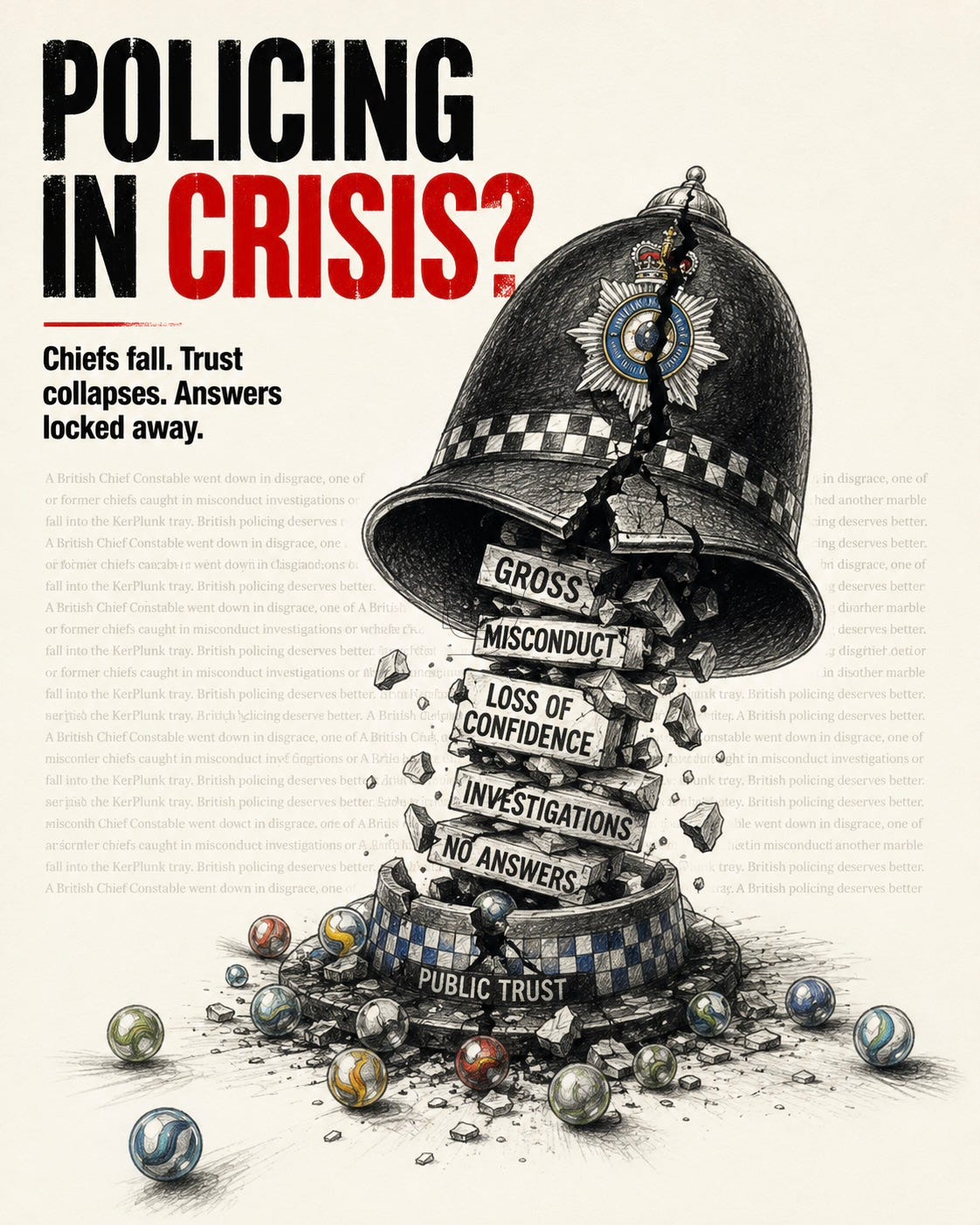
Lady Bracknell believed that losing one parent might be regarded as a misfortune, while losing both looked like carelessness. Across the wider Midlands we have seen Guildford depart West Midlands Police under enormous pressure, Noble leave Staffordshire before being found guilty of gross misconduct, and Northamptonshire Chief Constable Nick Adderley dismissed without notice for gross misconduct in 2024. Warwickshire belongs here for a different reason, because Bond, Phillip Bond, and Mandy Bond still await a proper answer. If this were KerPlunk, the Midlands would be enjoying a remarkable winning run, except every marble hitting the tray is another blow to public confidence and the only prize is embarrassment.
I considered attending Noble’s hearing at Yarnfield Park. Then I read the conditions. It was formally public, but Kathryn Stone, who chaired it, prohibited reporting of the content by any means whatsoever until she directs otherwise. I could have listened to the evidence, discovered what Staffordshire’s Chief Constable had done, filled a notebook and returned home unable to tell GRIT’s readers. I would have ceased to be a reporter and become an officially licensed keeper of secrets, allowed to know the truth provided I did nothing vulgar with it, such as report it. A public hearing that cannot be reported is public in much the same way that the Crown Jewels belong to all of us. You may look, but reaching for the important bit changes the atmosphere rapidly.
I am not putting the boot into Kathryn Stone, at least not now. Her career in standards, Parliament, the Bar and police inspection suggests she understands openness rather better than most. Other investigations continue, and witnesses or later proceedings may need protection. I assume she had formidable reasons and that the restriction is temporary. For the moment Stone gets a free pass, but not a season ticket. When the danger has passed, Staffordshire must receive a properly redacted account of what was proved.
The secrecy also does Noble no favours. Before the hearing, the public had already been told of concerns about conduct outside work and a separate allegation involving the sharing of confidential information without a proper policing purpose. Those remained allegations and we cannot say either was the misconduct proved. We know what had been alleged on one side and that gross misconduct was found on the other. The restriction places a thick black line where the explanation ought to be. People dislike an empty space and will fill it with rumours and the testimony of a man who knows somebody whose cousin once serviced a police car. Temporary secrecy may protect justice. Permanent secrecy manufactures gossip.
Then there is the barred list, which sounds like a register kept behind the counter in a particularly strict public house. It is far more important. The College of Policing is the professional body for policing in England and Wales. It develops national standards, training and authorised professional practice, and maintains the barred list. Once Noble is placed upon it, he cannot simply return as a police officer or take employment or appointment with a police force or another specified policing or law enforcement body. It is the national memory intended to stop somebody leaving through one door in disgrace and reappearing through another with a fresh lanyard.
That does not prohibit him from earning a living or automatically prevent private consultancy, lecturing, security work or employment abroad. Whether anybody hires him to speak about integrity and public confidence is another matter. The seminar may require a persuasive buffet. Nor does gross misconduct automatically wipe out an accrued pension. Pension forfeiture is a separate and narrower process. The fair question is whether resigning when he did gave him any advantage involving salary, notice or retirement timing. We should ask, not invent.
Now we reach the figure that should make every Police and Crime Commissioner sit bolt upright. The IOPC says that, until Noble resigned, he was one of eight serving or former Chief Constables under misconduct investigation or awaiting linked proceedings. Eight people who reached the highest office in a force. England and Wales has 43 territorial forces. The comparison is crude because the eight include former chiefs as well as serving ones, but eight against 43 is just under one in five. Apply that same rough proportion to the 8,027 officers recorded for West Midlands Police and the equivalent would be about 1,500 officers caught in misconduct investigations or linked proceedings. A force in that position would be described as suffering an institutional emergency. At Chief Constable level, apparently, it is a paragraph in a press release.
What in heaven’s name is in the water at the top of British policing? Eight serving or former chiefs caught in that machinery is the sort of figure we expect from a banana republic where the police commander owns three villas, several judges and a small private army. It is not what we expect in the United Kingdom of Great Britain and Northern Ireland, whose retired officers travel the globe explaining professional policing to everybody else. The IOPC says its investigations too often uncover longstanding and previously unreported concerns about senior behaviour. In plain English, people may have known, worried or whispered, yet the career escalator continued because the face fitted and nobody pressed the red button.
A Chief Constable does not materialise after answering a card in the newsagent’s window. There are years of promotion, vetting, references, assessments, courses, panels and Police and Crime Commissioners. Noble passed through people whose job included deciding whether he had the character to lead. We do not know whether the conduct proved was recent, historic or something that should have been detected earlier. Stone’s order prevents us knowing. But eight Chief Constables in the misconduct system cannot be dismissed as one bad apple rolling from a spotless bowl. Somebody needs to inspect the orchard.
Staffordshire, West Midlands and Warwickshire are different stories, but confidence runs through all three. Staffordshire has lost a Chief Constable after gross misconduct was proved. West Midlands lost its chief under severe political and institutional pressure, though without such a finding. Warwickshire faces questions from Bond, Phillip Bond, and Mandy Bond about whether its systems properly gathered and understood what they reported. The public must believe that complaints are investigated, rank does not provide body armour and accountability produces more than a conclusion with the interesting pages removed.
Most police officers will never spend more than a ceremonial minute with a Chief Constable. Tonight they will still enter violent homes, comfort victims, search dark buildings, arrest dangerous people and make decisions in seconds that lawyers may examine for weeks. They need the public to believe that the uniform means something. My former police friends working abroad need the world to believe that British policing still has something worth teaching. One disgraced chief cannot destroy generations of confidence, but he can chip the badge and leave thousands of better officers carrying the damage.
Chris Noble has lost his office, his standing and any realistic future inside British policing. Kathryn Stone has, for now, prevented publication of the facts behind the finding. Given her record and the continuing investigations, I accept that temporary silence may be necessary. I will wait, but not forever. Staffordshire has been told the verdict. In due course it must be trusted with the truth. Until then, the conclusion is stark. A British Chief Constable went down in disgrace, one of eight serving or former chiefs caught in misconduct investigations or linked proceedings, while the Midlands watched another marble fall into the KerPlunk tray. This is a shocker of shockers. British policing deserves much better. Shame on him.